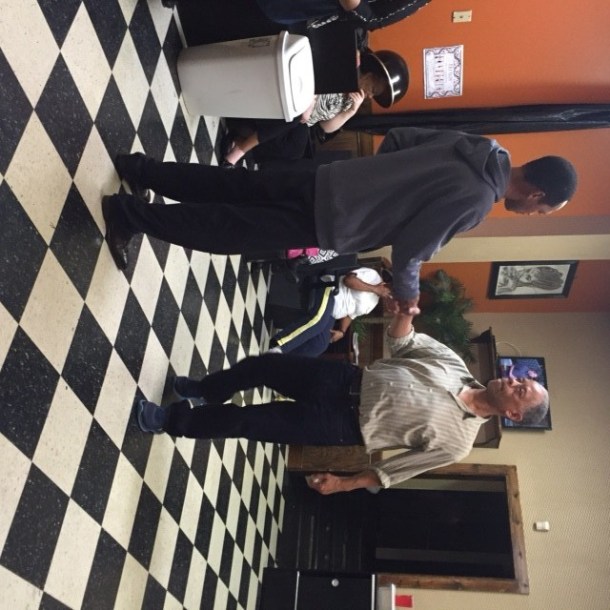
[R]OCK HILL, S.C. – There’s a Hillary Clinton campaign sticker on the glass front door of the Barnes Hair & Spa Salon on Main Street here, a powerful endorsement in a state where barbers have the pull of barbecued pork and the sway of a preacher in the pulpit.
“In a beauty salon or barber shop atmosphere, it’s taught and told that as a stylist you should be in the middle, because everybody has their own opinions,” said Freddie “Red Fox” Barnes, who has run this family-owned shop for 39 years.
“You try not to be too opinionated with your politics when you are working behind the chair,” he added. “You just listen to people.”
That said, the 59-year-old Barnes, generally mellow yet passionate about his politics, said he was proud to display the Clinton sticker on his shop door. The light-skinned African-American with a thin mustache, big hands, the remaining hair left on his balding head closely cropped, cast Clinton’s candidacy in the same historic lens as the election of Barack Obama, where change this time would come with the ascent of the first female chief executive.
“Quite honestly, if we didn’t support her, we wouldn’t have put it up there,” he said, pointing to the sticker.
Inside the beauty shop, the smell of heat pervades – an almost burning hair aroma – as patrons sit patiently and talk, their heads covered in hood dryers. While business on the rest of the block was slow on this sticky, rainy weekday afternoon, a steady stream of people visited Barnes for haircuts. And some banter.
You don’t have to look hard for signs of the president in this family barbershop, where the floor is tiled checkerboard black and white, the walls a blaze orange, and an old campaign sticker for Barack Obama is stuck to the side of the main counter, while two framed photos of the president hang a few feet away.
Barber shops like this one are a main spot where politics is parsed and preached in the Palmetto State.
So the Clinton sticker on the door — not to mention the general support of the former secretary of state by those getting their hair cut and those doing the clipping — is likely a bellwether of how Clinton will fare in the South Carolina primary this February.
“In the Democratic primary, more than half the voters are going to be African-American and more than half of them are going to be African-American women, so you have to go to those places where black women congregate,” said Dr. Adolphus Belk Jr., a Winthrop University professor who studies southern politics.
“It may be in a church, it may be in a beauty salon,” Belk added. “You have to find wherever they are, in big numbers, and get in front of them and talk about their concerns.”
Red Fox’s sister, Patricia Barnes, cuts hair alongside her brother. She also supports Clinton.
“She’s more abreast on all the things that we need here,” Barnes said as she skillfully yet forcefully massaged a gooey pink gel into a customer’s hair. “I also think that we need a woman up in there, to calm things down and straighten stuff out.”

The 61-year-old straight-talking older sister had a general awareness of Sanders, but didn’t really know what he stood for.
“I like all the candidates that they have,” Patricia said. “Ummm … I like the other candidate, what’s his name. Bernie?”
“I like him,” she added “I like some of the things that he says too, but I think so far for the Democrats that [Clinton] would be the one.”
Most South Carolinians think Clinton is the one, according to recent polling data from Winthrop University. Clinton leads Sanders, 71 percent to 15 percent. And when only African-Americans are accounted for, Sanders’ numbers diminish to 8 percent while Clinton’s climb to 80 percent.
“South Carolina is currently Clinton country,” said Winthrop Poll Director Scott Huffmon after the data was released. “While Sanders has drawn large and boisterous crowds – including here at Winthrop – it appears that those crowds might not have significant overlap with likely primary voters.”
Patricia and Freddie both spoke very highly of President Obama, and the Winthrop poll showed a 90 percent approval rating of the sitting leader in the state. Clinton seems to recognize these numbers, and has cast her agenda as a general continuation of Obama policies in recent weeks.
“All the things that [Obama] put as roots in the ground, I think [Clinton] will continue,” Patricia said.
The Barnes siblings say they hear a lot more about Clinton from clients in their barber chairs than Sanders, and that most are fairly positive about her candidacy. Patricia said as the election nears, talk in the shop will turn almost exclusively to politics.
“Especially during the election, I sort of make them talk about politics because that’s all they keep on TV,” Patricia said.
She then glanced up at the shop’s television, which was showing a game show, and continued manipulating hair.
Five and Dine
A few hundred feet down the street from the Barnes barbershop is the historic Five and Dine Restaurant, a place where some of the first civil rights sit-ins by black students took place in the winter of 1960. (The original counter remains intact in the remodeled diner.)
The tactics adopted here by nine students who refused to leave this counter were later adopted as the model strategy for the 1961 Freedom Rides, according to a historic marker outside the diner where one of the specialities is “Juicy Fried Chicken Breast and a Made-to-Order Buttermilk Waffle,” drizzled with maple bacon glaze. (Delicious.)
While the hair salon was buzzing with customers, the 100-seat restaurant was completely empty, save for one booth near a window. There sat U.S. Rep. Jim Clyburn of South Carolina’s Sixth District. He’s the former House Majority Whip and remains one of the most powerful black leaders in Congress.
Munching on fries with his wife, Emily, Clyburn said he promised party leaders he would not make an endorsement before the South Carolina primary; he acknowledged that both Sanders and Clinton were lobbying hard for it.
Sanders and Clyburn have a good history in Congress, with the two working together to boost federal funding of community health centers during the drafting of the Affordable Care Act.
“He was my go-to guy in the Senate when we were putting together the Affordable Care Act,” the deep-voiced Clyburn said, empty plates sitting on the table in front of him. “He was a very reliable source.”
Clyburn said the political philosophy of Sanders and Clinton overlaps significantly, pointing to the relatively few policy differences the frontrunners now share. Clinton has evolved on a number of issues that Sanders has been steadfast on, including the Keystone XL pipeline, gay marriage and opposition to the Iraq War.
Clyburn said that while Sanders’ consistency is admirable, it wouldn’t likely matter much with voters here.
“I feel like people from the North, they talk faster and act quicker,” Clyburn said, defending Clinton’s recent policy shifts.
Clyburn then paid and left, headed back to Winthrop University for the MSNBC “First in the South” presidential forum, where he acted as official master of ceremonies, his attire going from the black sweater he wore in the diner to the stage where he wore a dark suit, an orange and yellow tie and oozed gravitas.
About the Republicans, Clyburn said “they say the Pledge of Allegiance very well, but after that not much.”
Following the forum, Clyburn walked onstage to congratulate the candidates. The stocky leader gave Sanders a quick hug and the two briefly exchanged remarks. He then walked up to Clinton, and gave a much longer embrace.
Amelie’s French Bakery
Just up the street from the Five and Dine is Amelie’s French Bakery, a beautiful café serving pastries in an authentic atmosphere filled with reprinted Picassos and chandeliers.
Eating a salad and sandwich was Clark Stancil, 25, who drove more than four hours from his home of Nelson, Georgia, to see Sanders at the MSNBC forum. Sanders’ income inequality rhetoric is what Stancil said he latches onto the most.
Stancil is a “yellow dog Democrat,” a Southernism he said emerged after the Civil War to stand for someone who “would rather vote for a yellow dog, as a Democrat, than a Republican.”
“I was a Sanders supporter from the get-go,” Stancil said with a thick Southern accent. “I think he’s bringing this new energy to the party.”
Stancil said Sanders’ message could take root in the state, and he said hopes to volunteer on behalf of the Vermont senator in the South. He believes Sanders can gain traction if he highlights the rural character of Vermont and the support he gets from its quarters.
“I mean, hell, Vermont’s a rural state, you know,” he said. “Bernie pontificates on that and mentions that a lot. I think that’s important and if he really plays on that he could get some momentum in the South.”
Nineteen percent of respondents in the Winthrop poll were unfamiliar with Sanders; almost none of the respondents didn’t know Clinton. Twenty-eight percent of those polled said they might switch their allegiance from Clinton before the February primary, a number Team Sanders has seized upon.
“We actually have people, right now, that are at the barbershops, going to the basketball courts, going to the unconventional places” for voter education, said Marcus Ferrell, Sanders’ African-American outreach coordinator.
And Sanders, a fan of shooting hoops, is more likely to be caught on the basketball court than in a chair at the Barnes Hair & Spa Salon.