

Editor’s note: This article is by Stanley Blow III and Tommy Gardner of the Waterbury Record, in which it was first published Oct. 15, 2015.
[I]ts famous ads launched an oft-repeated catchphrase: “Can you hear me now?”
Now, after a pair of packed public meetings in Waterbury and Stowe about a proposed cell tower on a picturesque hillside that straddles the town line, telecommunications giant Verizon Wireless might be listening to pleas to slow down.
Both towns have been scrambling to attain official party status before the Vermont Public Service Board on Verizon’s plan to build a 90-foot telecommunications tower.
The tower and its attendant structures would be on North Hill, just on the Waterbury side of the town line, but mere feet away from Stowe.
Last week, the Waterbury Select Board voted unanimously to ask the Public Service Board for party status, and Tuesday, at a standing-room-only select board meeting in Stowe, residents urged their town to do the same.
Polly Motley of Stowe asked Brian Sullivan, lawyer for Verizon Wireless, if the company could “just be magnanimous” and “back off” for a few months so the towns can better research the project.
Sullivan agreed, and said he will ask Verizon to agree, too.
Verizon and Sullivan’s law firm were due to meet Thursday, and Monday is the deadline for Stowe to ask for party status.
Sullivan said he can’t guarantee Verizon will choose to delay, but he thinks it should, and he thinks the Public Service Board will, too.
“It would be better for all parties involved” to wait, Sullivan said.
He warned that some people will simply be unhappy with any tower, anywhere. But to deliver cellular and LTE data through the air to smartphones and other devices that have become commonplace for more and more people, the tower needs to stick up at least a bit above the trees.
“We can’t make an invisible site,” Sullivan said. “It simply won’t work.”
Waterbury wants data
Party status will allow the Waterbury Select Board to request an aesthetics study and a propagation study, municipal manager Bill Shepeluk told the board Oct. 5.
The board decided unanimously to request the studies.
The first study will examine whether the tower will cause lasting harm to the aesthetics of the area; the second will examine possibilities for putting the tower equipment on existing towers, without need for a new one.
For now, the Waterbury and Stowe boards have decided not to take a position either way on the North Hill tower proposal, and everybody wants more time for the aesthetics and propagation studies, which have yet to be scheduled.
“We want to get these studies done,” said Don Schneider, a Waterbury Select Board member. “Why come out until we get the relevant information?”
Board chair Chris Nordle stayed out of the tower discussions because of a possible conflict of interest. His law firm represents a number of local residents who oppose the tower, and he did not want to appear to favor either side, said Schneider, who took over for Nordle.
Schneider said he was happy to see so many people at the meeting.
“That’s what a democracy is for,” he said. “It’s good to see that folks are so passionate about this.”
Many concerns expressed at the meeting centered on the aesthetics of the tower, which will be about 93 feet tall — including the actual antennae.
Marcy Blauvelt of Waterbury Center has lived on Gregg Hill for 30 years, with views of the area she thinks would be hurt by the new tower.
“The ridge means a lot to me,” Blauvelt said. “In my eyes, there is no more beautiful vista than the views my neighbors and I have enjoyed for as long as we have lived here.”
She is also concerned about a potential decrease in property value.
Aesthetics weren’t the only concerns expressed at the meeting. Steve Hagenbuch, a member of the Waterbury Conservation Commission, expressed concern for local wildlife.
Hagenbuch said the conservation commission is neither for nor against the tower proposal, but he advised the select board to consider that the tower could have lasting effects on natural resources in that area.
The tower would be built on “an important, documented wildlife corridor locally known as Shutesville Hill,” he said. It allows large animals — such as moose, black bears and bobcats — to move among habitats in the Worcester Range and the Green Mountains.
He also said migratory birds may run into the tower or be affected by radiation coming from it.
David Harding lives on Stowe Hollow Road; his Stowe property abuts the Waterbury property owned by Tari Swenson and Chris Curtis, who have allowed Verizon to use their land for the tower.
Harding is behind a group called Save North Hill, which opposes the tower. He read from a prepared statement at Tuesday’s Stowe Select Board meeting, and had the crowd applauding at the end.
“Over the past weekend, people were literally stopping their cars in the middle of the road, jumping out of their cars and taking pictures of our hills, meadows and ridgelines,” Harding said. “Not to put too fine a point on this, but these ridgelines are critical to our economy and our way of life.”
Local control?
If Waterbury has little say about the tower — new telecommunications projects are not subject to local zoning laws — then Stowe has even less, since the tower location isn’t in Stowe. And Verizon’s site planners hardly even included Stowe in their work.
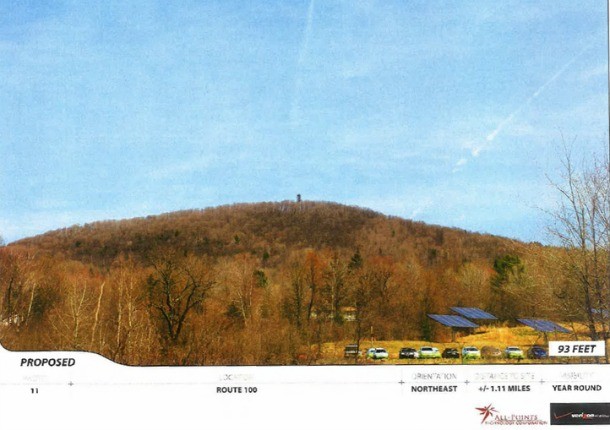
Last spring, the company floated a large weather balloon at roughly the same height — 94 feet — as the top of the tower. Mike Libertine, a consultant for Verizon, took 17 photos of the balloon, then replaced the balloon in the photos with a scale simulation of a similar-shaped tower.
All but one of those photos were taken from vantage points in Waterbury; only one was take in in Stowe, at Trapp Family Lodge, 3.77 miles away.
Libertine said the photographers traveled all the publicly accessible roads in Waterbury and Stowe from which people might be able to see the tower. He also said, in the spirit of transparency, that the photos were taken when the leaves were off the trees, and from angles where the tower would be most visible.
“We show the money shots,” Libertine said.
He acknowledged people would likely be able to see the tower from private properties, and people hiking up peaks such as the Pinnacle might be able to look down at it. He also said the 17 photos are only “representative” shots, not meant to convey every single place along the Route 100 corridor where someone might spy the tower.
Harry Bonyun, another resident from the Stowe side of the hollow, decried the whole process that Vermont uses to approve telecommunications facilities, such as this tower. He said the Public Service Board “has usurped all the rights from Act 250,” and the result will be a state-level decision that affects “one of the classic views from Route 100.”
Sullivan said Verizon knows of this rancor that is nearly unique to Vermont, a state famous for banning billboards and other edifices that block the state’s pristine views. And the landowners who have allowed Verizon to use their property, Tari Swenson and Chris Curtis, have wrestled with whether to allow it. They have allowed it to be only 90 feet tall, instead of 140 feet, like other towers.
“That’s not the first time it’s happened,” Sullivan said of strong reactions to a cell tower coming to town. “And it’s not the last time it will happen.”
