


BRATTLEBORO – If Entergy has its way, Vermont Yankee’s emergency programs – and the funding that goes with them – are due for a major downsizing in the first half of next year.
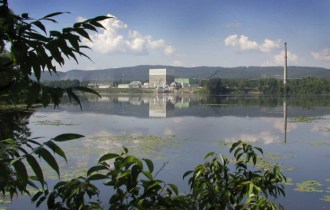
In Brattleboro on Thursday night, several Vermont officials argued that the company’s emergency commitments to surrounding towns and to the state should continue for at least the next several years. Those programs are necessary, they say, to protect public health and the environment around the Vernon plant, where spent nuclear fuel is stored in a pool in the reactor building.
Vermont Public Service Department Commissioner Chris Recchia confirmed that there have been talks between state officials and Entergy aimed at securing an ongoing financial commitment from the company to support emergency operations. But Recchia also complained, strenuously, that the two sides are far apart.
“The fact of the matter is, (the talks) have been unproductive and going in the wrong direction,” Recchia said.

If all else fails – if the state can get no long-term emergency-planning commitment via Entergy or the federal government – Recchia pledged to ask the state Legislature to find money for Yankee-related emergency programs.
“I fully expect legislative action … and we’ll see where that goes,” he said.
Entergy’s position is clear: With Vermont Yankee having ceased producing power Dec. 29, and with all fuel having been removed from the reactor the following month, the company sees no need to continue commitments to the Emergency Planning Zone.
Entergy has asked the Nuclear Regulatory Commission for permission to shrink the perimeter of the Emergency Planning Zone – a circle that includes all or parts of six towns in Vermont, five towns in New Hampshire and seven in Massachusetts – to the boundaries of the plant compound.
The NRC has agreed to the change, but the state has appealed that decision.
With federal approval, the Emergency Planning Zone change would take place in April or May 2016, and the effects would be far-reaching. Internally, Entergy would reduce its workforce by about half (down to 150) and eliminate programs such as its emergency operations facility and joint information center. Externally, there would be no more Entergy support for warning sirens, iodine tablets or batteries for emergency radios.
Entergy would also stop sending emergency-planning funding to Vermont, Massachusetts and New Hampshire. The funding would run out June 30, 2016.
According to company figures, Entergy in fiscal year 2015 gave $2.1 million to Vermont, $1.2 million to New Hampshire and a little over $1 million to Massachusetts. The states use some of the money for emergency operations and the rest is distributed to the Emergency Planning Zone towns, which maintain their own emergency management directors, radiological officers and emergency operations center staff.
In Vermont, the state’s radiological-planning budget in fiscal 2016 is $1.6 million – an amount funded entirely by Entergy, said Erica Bornemann, chief of staff for the Division of Emergency Management and Homeland Security. The state maintains three employees and one temporary worker connected to the program, plus a Brattleboro office and associated equipment.
The Vermont EPZ towns each receive baseline funding of $32,000 per year, Bornemann said. And she believes the Yankee-related funding, training and regular drilling in those locales is invaluable: “The emergency planning zone towns are at a pretty steep advantage in terms of incident management as compared to the rest of the towns in Vermont,” she said.
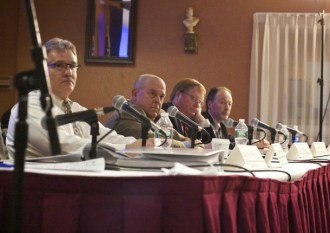
Bornemann spoke Thursday at a meeting of the Vermont Nuclear Decommissioning Citizens Advisory Panel, where she urged a gradual, “step-down” approach to phasing out the Yankee emergency zone. She lobbied for the towns to remain in an EPZ, albeit with scaled-back planning, training and exercises.
At the state level, “we also need to ensure that there is at least some staff planning-level of support … for those towns,” Bornemann said.
Bornemann and other state officials say the radioactive spent fuel at Yankee remains mostly in a spent fuel pool. The plan is to transfer the waste into more-stable dry cask storage by the end of 2020. But until that happens, state officials want Entergy’s emergency programs to remain robust.
Recchia noted that a federally required exercise at Vermont Yankee earlier this year featured a theoretical hostile attack on the spent fuel pool. He believes it is “nonsensical” for the NRC to require such an exercise while also allowing Entergy to scale back its emergency operations so significantly.
Vermont Yankee Site Vice President Chris Wamser said no such connection should be made. He said drills often are “manipulated to get the desired outcome” – meaning to test all facets of emergency response.
“You should not necessarily conclude, just because we drilled on something, (that) means that it’s likely or probable or even possible,” Wamser said.
Joe Lynch, Entergy’s government affairs manager, discussed training sessions for Vermont Yankee’s security force in which the NRC sends “adversaries” into the site in an attempt to break through to sensitive areas.
“We have successfully completed all of our force-on-force exercises over the years, demonstrating that our security force is second to none when it comes to nuclear safety,” Lynch told the panel.
Wamser also asserted that, even after making the changes Entergy seeks, “Vermont Yankee will continue to have an emergency plan after April 2016.” And Wamser said the changes planned at Yankee are consistent with those that occurred at other shuttered plants such as Maine Yankee, Connecticut Yankee and Yankee Rowe in Massachusetts.
“In general terms, it seems like (state officials) are characterizing this as a want versus a need – what we would like to maintain versus what we must maintain,” Wamser said.
Bornemann disputed that notion, pointing out that it will be years before all spent fuel is moved into dry casks at Vermont Yankee.
Bill Irwin, the radiological and toxicological science program chief for the Vermont Department of Health, says there are extensive, ongoing risks that require monitoring at and around the Yankee site even after the fuel is loaded into casks.
The rationale for decreased emergency requirements outside the plant site is that no Vermont Yankee accident could result in radiation doses that exceed U.S. Environmental Protection Agency guidelines.
Irwin, however, contends those guidelines were not meant to determine whether a nuclear-plant operator ought to maintain emergency-response capabilities outside the plant.
He says radiation doses that fall below EPA standards “are unacceptable from incidents occurring at a shut-down nuclear power station awaiting cleanup.” Radiation doses still could come from contamination released by the plant and deposited off-site. Possible incidents include leaks caused by transportation accidents, fire, natural disasters and attacks, Irwin said.
“From the Department of Health, we demand a response to contamination, and we believe other Vermonters will demand a response to contamination of their environment and the risk to their economic well-being,” Irwin said.

“This contamination has to be measured,” he added. “Measurements are made of samples taken from the environment. Samples and measurements are obtained, calculated, interpreted and acted upon by people with skills other than those possessed by firefighters, law enforcement officers and emergency medical service providers.”
Irwin said the Department of Health can develop a “scaled-back budget” to continue its monitoring work throughout Yankee decommissioning.
New Hampshire officials already are scaling back emergency planning. Entergy said it has committed a total of $279,000 over four years – from fiscal 2017 to 2020 – for continued support of emergency operations there.
Diane Becker, chief of technological hazards at New Hampshire Homeland Security and Emergency Management, praised the deal. Entergy administrators “have been more than willing to sit down and talk and, as a result, we ended up with funding,” said Becker, who also serves on the citizens advisory panel that met Thursday.
Becker added that officials in her state “did not feel the high level of anxiety over the potential for any kind of (radiological) event” at Vermont Yankee.
Recchia characterized the New Hampshire deal as a way for Entergy to “put a stick in our eye.” Becker and Entergy’s Lynch took exception to that comment.
“The state of New Hampshire approached Entergy on a long-term emergency-planning deal,” Lynch said. “We did not approach them. We worked with them in good faith. We negotiated something that I think they appreciate greatly.”
Wamser said Entergy has begun similar discussions with Massachusetts and also is willing to discuss “some kind of scaled-back support in Vermont.”
While there have been extensive talks between Vermont and Entergy about emergency planning, the discussions have not gone well from Recchia’s perspective.
Recchia declined to get into specifics, but he said $850,000 annually for the next five years is “what we think is necessary to support appropriate emergency management.”

