


[T]he Green Mountain Care Board has approved all 14 of Vermont’s private hospital budgets with only minor changes, the regulatory authority said in a news release Thursday.
The approved 3.5 percent aggregate increase in hospital patient revenue is slightly below the aggregate request of 3.6 percent — which was the target set by the board. The increase means Vermont hospitals can expect to receive a combined $77 million more than last year.
More than half of the increase, $39 million, is slated for UVM Medical Center in Burlington, the state’s largest hospital. Its patient revenue of $1.1 billion is nearly half of the $2.3 billion hospitals can expect to earn for treating patients in the coming fiscal year, which begins in October.
Patient revenue is what hospitals collect from direct patient services and does not include revenue from a cafeteria, parking or philanthropy. Nonpatient revenue is not regulated by the board, and is expected to increase by $10.8 million next year. The board attempts to curb the growth in health care costs by limiting the amount of money hospitals can receive from patient services.
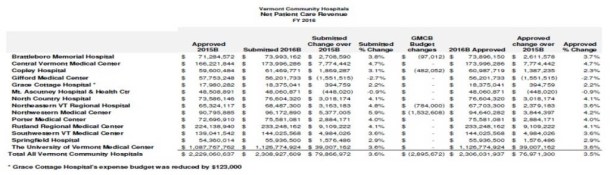
It’s the third year in a row that hospitals submitted requests within the parameters outlined by the board, and it’s also well below the average annual increase for the past 15 years of 6.8 percent. However, board member Dr. Alan Ramsay pointed out in July, at the start of the board’s budget review process, that the growth rate is a significant increase over the 1.5 percent increase approved two years ago.
“The absolute reality is a doubling (in patient revenue growth) over the last three years,” Ramsay said.
Board members voted to reduce the patient revenues requested by four hospitals by a total $2.9 million. Each of those hospitals submitted budgets with revenue increases that exceeded the 3.6 percent increase the board directed hospitals to live within.
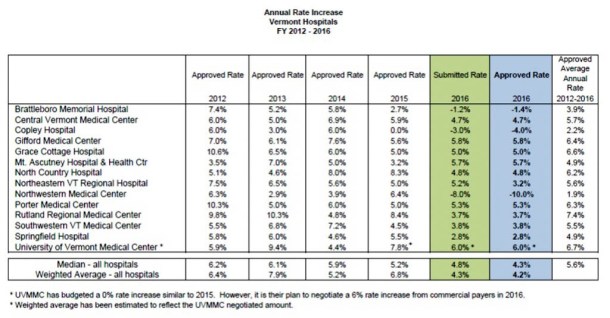
Other hospitals submitted revenue requests that exceeded the 3.6 percent cap, such as the 4.7 percent increase approved for Central Vermont Medical Center, which belongs to the UVM Health Network. Those budgets were approved because the increase was the result of new physician hires, Board Chair Al Gobeille said.
CVMC projected close to $2 million in revenue it expects to earn from newly employed doctors. New physician hires fit into a set of exceptions the board has for revenue exceeding its target, he said.
 The largest decrease was for Northwestern Medical Center in St. Albans. Its budget was reduced by $1.5 million, on a total approved budget of $94.6 million. A spokesman for Northwestern said the cut is disappointing.
“The Green Mountain Care Board identified exceptions to the revenue cap, and given our situation, we proposed additional exceptions that we hoped they would see were appropriate,” said Jonathan Billings, vice president of planning at Northwestern.
“Our team will need to look at (the cut) and determine how to adapt and move forward. It will have an impact, but we’ll have to find a way to target that impact to still be able to meet community needs and our health reform goals,” Billings said.
Northeastern Vermont Regional Hospital in St. Johnsbury had its revenue request cut by $784,000, on a total approved budget of $67 million; Copley Hospital in Morrisville had its budget cut by $482,000, on a total budget of $61 million; and Brattleboro Memorial Hospital had its budget cut by $97,000, on a total budget of $74 million.
“What we’re saying to these hospitals is, ‘Great job. Thank you for being so accountable. We just need you to come further in this year.’ We know this is a multiyear process, and we may need to cut their rate again next year if they come in over again,” Gobeille said.
Gobeille said he’s pleased that, in the aggregate, hospitals were able to meet revenue targets. However, the $2.3 billion revenue figure does not capture the challenging work Vermont hospitals are doing to change their business models in a health care system that is moving away from fee-for-service medicine, toward a system that pays based on keeping people healthy.
The board also reduced hospital charge rates by an aggregate 0.1 percent, from 4.3 percent to 4.2 percent. Charge rates are not actually paid by patients, except in rare cases. Mike Davis, director of health system finances for the board, described them as hospitals’ “negotiating number” for insurance companies.
Government programs set their own payment rates and individuals without insurance are typically given an income-based discount off the charge rate.
