


Editor’s note: This article is by the staff at the Waterbury Record, in which it was first published Aug. 27, 2015.
[O]n Aug. 28, 2011, Tropical Storm Irene swept through Waterbury, leaving 8 inches of rain in its path on already saturated ground.
Due to the heavy rains, the Winooski River flooded the area, damaging 220 homes and businesses in the town and village of Waterbury.
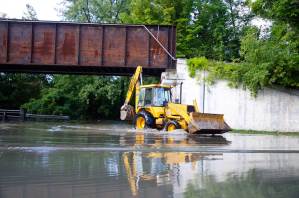
To make conditions even more devastating, 49 historic buildings in the Waterbury State Office Complex suffered a great deal of damage, causing the displacement of about 1,300 state employees.
Lives, businesses and government functions all took a hit. Recovery has taken years. Now, four years after, is a good time to see how Waterbury is doing.
Here’s a snapshot compiled by the Waterbury Floodplain Management Working Group, with special assistance from Zoe Gordon, a VISTA worker.
Construction
• The Waterbury Municipal Complex
The new complex will be an extension of the historic Janes House, which was home to the Waterbury Public Library. The $5 million complex will house the Waterbury Public Library, the Waterbury Historical Society, and municipal offices.
The former municipal offices at 51 S. Main St. were ruined by the flood. Since Irene, the municipal staff has operated on the second floor of the Main Street Fire Station.
The municipal complex is well under way, and should open to the public in January 2016.
“The biggest success was working with the local officials and volunteer groups to gain the support of the community to select and move forward with a plan for a new municipal complex, library and historical society that is cost-effective, retains the character of the community by preserving an important piece of history, and is located within the village core,” said Barbara Farr, Waterbury’s long term recovery director.

• Waterbury State Office Complex
The biggest economic investment in Waterbury following Irene is the revitalization of the State Office Complex at $130 million. About 1,300 state workers were displaced, creating a substantial gap in Waterbury’s economy. Now, the historic core is being restored, a new office building has been constructed, and a central plant has been built. The project is about 90 percent complete.
About 830 state workers will return to the restored complex, beginning in December, and will be fully moved in by April. An additional 370 state employees will also work there.
“Our biggest challenge is the size and scale of the project,” said Mike Stevens, project manager for the State Office Complex construction. The work has involved demolishing 310,000 square feet of existing buildings, renovating 120,000 square feet of existing space, constructing 86,000 square feet of new space, and building a 20,000-square-foot central plant to handle heating and cooling.
“Our biggest success is that we have been able to manage through these challenges, keeping the project on time and on budget,” Stevens said.
• The Hunger Mountain Children’s Center
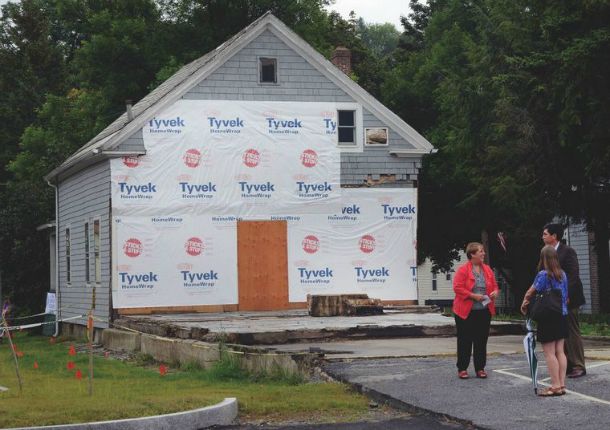
Waterbury’s oldest and largest state-licensed child care center and preschool was displaced by Irene; it had to move out of the South Main Street property it had leased from the state government since 1978.
It has been operating since in temporary space on Route 100 in Waterbury Center, at the Hunger Mountain Christian Assembly Church (no affiliation).
Late last year, the children’s center bought its former home at 123 S. Main St., along with the adjacent property at 121 S. Main St., from the state.
The children’s center has been awarded a $1 million federal grant; the money comes from the community development block grant disaster recovery fund, which is administered by the state Agency of Commerce and Community Development.
The grant, combined with a $250,000 investment by the children’s center, will pay to renovate, connect and partially reconstruct the two 19th-century buildings.
Demolition got under way this summer and project organizers hope to select a general contractor to start construction this fall. The goal is to reopen on South Main Street by the spring of 2016 in space that will allow the center to expand from 45 to 65 children per day.
The Hunger Mountain Children’s Center cares for children from age six weeks through preschool and is a partner with the Waterbury-Duxbury School District’s universal preschool program. In line with its federal grant requirements, a key focus for the center will be serving low- to-moderate income families in the community.
“Our biggest success by far was landing the disaster recovery grant,” said Lisa Scagliotti, a leader at the child care organization. “Without it, Hunger Mountain could never make this project happen in this way. When we’re finished, (we) will have essentially a brand-new, larger facility for many years to come. This is truly one of the silver-lining stories from Irene.
“The biggest challenge has been navigating the entire process to purchase the two historic buildings from the state, design the project to comply with layers of local and state regulations, and receive all of the needed permits,” Scagliotti said. “But we’ve cleared all of those hurdles now.”
• South Main Apartments
The building that is now the South Main Apartments was built in the mid-1800s by Dr. Horace Fales. The Vermont Asylum for the Insane bought the house from the Faleses in 1895 and used it as a staff residence. It became a component of the state hospital complex and later the State Office Complex. In 1951, an addition was constructed as a dorm for staff nurses. The historic building and addition were renamed Ladd Hall in honor of Dr. Henry Ladd.
The Irene flooding damaged the overall Waterbury community, including Ladd Hall. This damage qualified Waterbury for federal recovery funds, and, in part, these funds make the South Main Apartments project possible.
Downstreet Real Estate Development and Housing Vermont renovated the historic portion of Ladd Hall to preserve the historic character of the building. The 1951 addition was demolished and a new three-story addition, along with historic Ladd Hall, now provide 27 new rental units. The South Main Apartments project is seeking LEED certification through energy efficiency, building envelope and healthy home design.
“The completion of the housing is the biggest success,” said Alison Friedkin of Downstreet Real Estate Development. “Adding more affordable housing to Waterbury is a huge success.”
Community efforts
• Milone & MacBroom study
The engineering firm Milone & MacBroom has completed a grant-funded study that determines the economic potential of communities in floodplains. The study does this by evaluating possible build-out areas and mitigation measures to prevent future damage to residents, businesses and infrastructure.
The firm was able to assign actual financial figures with particular mitigation measures. For example, elevating the most flood-prone buildings to 2 feet above the 100-year flood level leads to a net benefit of $620 million per year.
The study also found that the currently mapped 100-year floodplain is inaccurate, and that the true 100-year floodplain is more aligned with the current 500-year floodplain.
• Community Rating System
Waterbury is seeking inclusion in the Community Rating System, a program of the National Flood Insurance Program. It facilitates flood-insurance discounts for residents of communities that take certain efforts to mitigate hazards. The program application process is underway.
One disaster preparedness measure that helps get these discounts is public outreach. Keep a lookout for more information regarding flood preparedness and results of the Milone & MacBroom study.
• Village to Little River State Park Connector Trail
The town, working with ORW Landscape Design, completed a grant-funded feasibility study that analyzed possible routes to connect Waterbury Village with Little River State Park. The proposed trail is intended to be family-friendly, multi-use, and not open to motorized vehicles. Collaboration with private landowners will be needed to make the trail a reality.

What are neighbors doing?
• Whitney Aldrich and Wade Hodge
They live in a lovely home on Healy Court at the south end of Waterbury village, right along the Winooski River. Irene changed everything very quickly for them.
When the storm hit, Hodge was in Germany on a business trip. When Aldrich heard Irene was coming, she took several steps to prepare for the flood. The couple’s lawn floods every year during the spring thaw, so Aldrich placed a few logs at the point in the lawn where the flooding usually stops and used the relationship between the water and the logs as a gauge for the severity and speed of the flooding.
With the help of a friend, Aldrich was able to take pictures of items for documentation and reference later on.
Before leaving the house, Aldrich shut off the power and gas, called the Waterbury Fire Department and 911 to tell them that the house would be empty and to alert them to the extent of the flooding, and then evacuated and notified neighbors that they should do the same.
Aldrich did not return to the house until the 2 feet of water that flooded the first floor had come and gone.
Having read the FEMA Flood Insurance handbook, Whitney knew two things going into the devastated home: the first was to document everything with pictures, and the second was that mold grows fast.
She began removing cabinets, drywall and flooring right away to prevent mold. With the help of neighbors, friends and volunteers, by the third day, when Hodge was able to get home from Europe, the house was mostly cleaned and ready to start being repaired. The couple was reimbursed for most of this work by their flood insurance.
Now Aldrich and Hodge are participating in a pilot program in which FEMA will pay 75 percent of the cost to have a home in the floodplain elevated; the homeowner pays the other 25 percent. The program is facilitated by the town and the state. Aldrich and Hodge decided to participate in the program because the cost-sharing made it affordable to elevate the home. They also want the house to be marketable if they choose to sell one day.
Asked about the choice to live in the floodplain, Aldrich said, “It’s different for everyone, but for Wade and me, as long as everyone was safe, it was a risk we were willing to take. At this point in my life, I feel so lucky to live where I live right now. This is an incredible community, we have great friends, and it’s just beautiful here in a lot of ways.”
• Jeremy Ayers
The Ayers family has lived in Waterbury for generations, and Jeremy Ayers and his family now live in the Elm Street home. During Tropical Storm Irene, Jeremy, his wife and young son lived in the home with his 93-year-old grandfather and were forced to evacuate during the flooding.
The family lost a great deal to Tropical Storm Irene: Jeremy’s basement pottery studio was flooded, as was much of the first floor. However, the Ayerses have rebuilt, taking flood preparedness measures.
In the home, the Ayerses have used foam insulation and elevated all electrical panels above floodplain levels. Additionally, they had tied down their fuel tank, which prevented the tank from floating away during Irene.
The family also converted a barn on the property for new uses. The barn has been insulated with strictly foam insulation, and all wiring and electrical panels are located above the 100-year flood level. The majority of the downstairs space is now Jeremy’s pottery studio, with a small adjoining store where he will sell his pottery. His wife, Georgia, will also sell home goods there.
The space is much more flexible than Jeremy’s former basement studio, and in a flood he can relocate all of his equipment quickly. The upstairs of the barn now had two two-bedroom apartments, one of which will be leased long-term and the other used as an Airbnb (in addition to the Airbnb apartment in the main house).
The new apartments and Jeremy’s studio seamlessly meld new with the old, using as artworks reclaimed wood from the barn when it was used for carriage building, a hatch in the floor once used for storage, and salvaged wood that the carriage makers used to use for testing fonts.
• Curtis Hooper and Susan Allen
They owned a rental house at 5 Parker Court when Irene hit. Though they didn’t live there, the damage was devastating to both the couple and their tenants. The basement flooded, and over a foot of water soaked the first floor.
Like many Waterbury residents in the floodplain, the tenants lost many of their possessions when the basement flooded and the foundation caved in. After taking stock of the damage, the homeowners had to decide whether to rebuild. They chose rebuilding, and began the work in September 2011.
They elevated the house above the 100-year floodplain elevation level, gutted and renovated the interior, used spray-foam insulation, and anchored newly installed fuel tanks both to the home and to the ground.
Hooper said Waterbury town officials were cooperative with permits and zoning processes that affected the construction work.
• Chris and Susan Wood
Chris Wood thought he was well prepared for a disaster. His valuables that were vulnerable to flooding were stored in plastic totes in the basement, ready to be brought upstairs. But by the time he got home from evacuating Randall Street as a member of the Waterbury Fire Department, there was no time to move those belongings.
And when Chris saw water bursting through the cinderblocks of their basement, he, his wife and daughter waded through waist-high water to get to safety. Once his family was safe, Chris returned to help his neighbors evacuate.
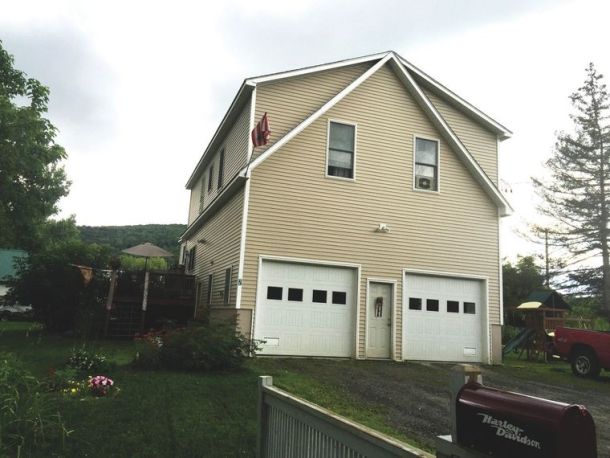
With the help of family, friends and volunteers, the Woods started their recovery work the day after Irene. They decided to demolish their home and to build a flood-proofed garage, upon which rests their new modular home, built by local contractors.
The garage is elevated by a foot, and the basement walls are concrete and steel-reinforced cinderblock to a height of 4 feet. The Woods also installed flood vents in the garage that open to allow the water to flow out if flooding occurs.
The Woods also elevated their utilities and efficient furnace to their first floor-living space. The family was able to move into their new home in June 2012, but it hasn’t been easy to get past the trauma.
“Four years later, I’m not really back to where I was before the flood,” Chris Wood said. “My neighbors always say that we’ll be glad when we can just mow the lawn and not be raking rocks and picking up pieces of debris. There are lots of little stages, and flood recovery takes much longer than most people realize.”
Wood said going through the flood insurance process was the largest challenge in recovering from Irene, and “it didn’t really help as much as I expected it to.” While his homeowners and car insurance providers were responsive and helpful, his flood insurance representatives presented more obstacles than assistance.
However, “through community support, things turned around much faster and within a couple of months we were ready to rebuild,” Wood said. With the help of the Waterbury Fire Department, Wood’s former workmates at the CTANG Civil Engineering Squadron, his motorcycle group, family, and the entire Waterbury community, the Woods were able to begin their long road to recovery.
• Heidi Hall
Hall was having a peaceful evening at her Randall Street home when firefighters came to recommend that she and her family evacuate. Hall had known a storm was coming, but thought it would be another weather prediction that fell flat.
The family got out of the house and stayed the night with friends on higher ground. The next day, Hall returned to Randall Street to find a layer of muck on the ground, and found that the front steps of many homes were out of place — the most alarming dislocation was on the roof of a parked car.
Hall found that the water had gone up about 3 feet in the first floor, which was evident in cooking pots filled with water and high-water marks on the wallpaper.
By staying in the homes of many friends, the Halls were able to string together housing for about four months while their house was rebuilt.
Volunteers did the initial interior cleaning and demolition, and then contractors got to work. Hall was pleased with the insurance company, which was committed to preserving the value and historic character of the home. Additionally, many Vermont vendors gave discounts after the flood to make rebuilding more affordable.
The Halls took floodproofing measures during their rebuilding process. They used spray-foam insulation, which is flood-resistant and can easily be removed in the event of a flood. The Halls also removed the walls that split basement into smaller rooms, which will allow water to flow more easily and creates more spaces for the water to go, should the house flood again. The contractors also installed new footings in the basement that help stabilize the structure. The fuel tank was relocated out of the basement and is now anchored to the ground.
What should a homeowner do after a flood? Heidi Hall’s advice is to carve a line on the walls above the high water mark and remove the wet material below it as quickly as possible, to prevent further damage.
In addition, it’s critical working with a contractor to develop a detailed request for the flood insurance company. Hall said the biggest challenge in the recovery was being homeless temporarily. With three kids, and two parents with full-time jobs, moving every few weeks and making thousands of decisions in the home-rebuilding process made it very difficult to maintain a sense of normalcy.
However, Hall said working with the construction company was one of the biggest successes in the process. Its attention to detail helped Hall make sure that she was building the house she and her family wanted to keep for the long term.
