

[T]he Attorney General’s Office and the Agency of Agriculture will begin the process of drafting rules for agricultural practices for all farms in the state, as directed by the recently passed water quality law.
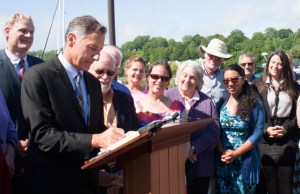
H.35, signed by Gov. Peter Shumlin this month, aims to reduce the amount of pollution that enters the state’s waterways through agricultural and stormwater runoff, among other things.
Andrea Stander, executive director of Rural Vermont, a grassroots organization that advocates for strong family farms and rural communities, said that one of the challenges of the new regulations will be coming up with a definition of a small farm, as there are many different types of farm operations across the state.
This will be the first time that such pollution regulations will be placed on small farms, Stander said. Medium- and large-sized farms are already constrained by a permitting process that’s been in place for a while, but small farms have not had any permitting process in the past, she said.
“So, there’s a general sense — whether it’s correct or not is obviously up to interpretation — that the large farms are already doing everything that they’re being asked to do and everything that they can do,” Stander said.
Stander said that there will be stricter enforcement on violations by all sizes of farms and if violations are found, there will be “swifter and more comprehensive enforcement on those situations,” as a result of the new law.
In the future rule-making process, the current accepted agricultural practices will be amended, Stander said. Instead of being called “accepted” they will now be “required.” This is because of the realizations the Legislature made during the bill consideration period that many small farms are unfamiliar with the current accepted agricultural practices and that the practices are generally out-of-date, she said.
“We have newer science and knowledge about water quality and certainly newer knowledge and science about climate change,” Stander said.
In the bill, there is a “laundry list” of things that the amended rules should include, but they are more like parameters for what rules should be, Stander said.
“In a way, the bill has a sort of a skeletal outline of what those new required agricultural practices will be, but there’s a lot of detail that has to be added in order for people to actually comply,” Stander said.
Jim Leland, director of the agriculture resource management and environmental stewardship division at the Agency of Agriculture, Food and Markets, is in charge of the division that will be writing the updated required practices. Leland said that the rulemaking process is mostly internal work right now and one part of that process will be coming up with the definition of a small farm.
It will take awhile because it’s a complete redraft of the accepted agricultural practices and Leland expects to have a draft available for informal public comment in the fall, he said.
Leland said he anticipates that officials will have to file a formal rule well before July 1, 2016, which is the date the revisions are to be formally finished, and guessed that he would file the final rule with the Secretary of State by March or April. As far as the process of collecting public comments on the fall draft goes, Leland said that they still haven’t figured out how to do it yet, but will use any method at their disposal.
“Our groups were actively involved with providing recommendations to the agency and to the Legislature over the past year,” he said. “We’ll be bringing any rules we have back to them. We’ll be bringing them to watershed groups, to farm groups, to anyone that’s interested really. But I don’t have any formally figured-out schedule or anything like that at this point.”
Leland said he hopes the state will have three or more months of interaction with people providing their input before it refines the draft.
