

Editor’s note: This story was updated at 7:32 a.m., 8:11 a.m. and 8:44 a.m. April 29. Erin Mansfield contributed to this report.
Money bills were greenlighted by Senate panels late Tuesday night, and now lawmakers are buckled into the end of session roller coaster ride.
The tax and budget bills will be on the Senate floor on Thursday and Friday and conference committees will be held next week, ensuring a mid-May adjournment.
Senate Appropriations unanimously approved a $1.5 billion general fund budget that represents a 4.8 percent increase over the fiscal year 2015 budget. The Big Bill is a mirror image of the House Appropriations legislation with a few exceptions, namely: The Senate restores funding for the judiciary, Windsor prison and an inmate education program. The Judicial Branch will increase fees to cover the cost of filling judge vacancies.
Sen. Jane Kitchel said lawmakers were concerned about the impact of the Shumlin administration’s proposed cuts on the effective delivery of justice in Vermont. A new video conferencing program, she said, will save time and money for the judiciary.
Senate Appropriations concurred with the House on a plan to continue fully funding dispatch services for the first quarter of fiscal year 2016. After that, the Vermont State Police dispatch centers in Derby and Rutland will have to find local financial support or close.
The tax bill, meanwhile, was pared down in response to criticism from the business community. The legislation, H.489, which makes changes to income and sales taxes, raises about $37.5 million, about $2.5 million more than Senate Appropriations needed to fill the remaining balance of a $113 million budget gap.
The omnibus legislation also includes $2.5 million in fee increases for medical professionals, restaurants, bakeries, real estate agents and developers who file Act 250 permits.
Senate Finance passed the bill out of committee in a 6-1 vote. Sen. Kevin Mullin, R-Rutland, voted against the compromise proposal.
Senate Finance backed off a 5 percent tax credit for $5,000 or more in charitable contributions to in-state nonprofits and ditched the implementation of a sales tax on services in the short term.
The committee kept the existing charitable deduction, but the bill now stipulates that only in-state contributions are eligible for a tax break.
The Senate version of H.489 caps the mortgage deduction at $12,000 in interest payments per year.
The House proposed a cap of 2.5 times the standard deduction for individuals, couples or households.
 The Senate bill requires taxpayers who have adjusted gross incomes of $150,000 or more to pay at least 3 percent in income taxes. The so-called alternative minimum tax would affect several hundred taxpayers.
There was a last minute push from Sen. Ginny Lyons, D-Chittenden, to tax satellite television. The 5 percent tax would generate $5 million. Cable companies already pay the assessment.
The Senate Finance bill would extend the 6 percent sales tax to candy, soda and bottled water, which would raise $11 million, $7.2 million for the general fund and $3.3 million for the education fund. (The House has a similar proposal to support health care spending, but doesn’t tax bottled water.)
Vending machine food would be taxed at the 9 percent meals rate, generating about $1 million a year in revenues. (The House has an identical proposal.)
The legislation would allow the Tax Department to garnish the wages of scofflaws, which would bring about $2.3 million into state coffers.
Under H.489, any town or city could impose a 1 percent local option tax on sales, rooms, meals, and alcohol. The local option has largely been limited to former “Gold Towns.”
Senators were hit with pushback on a proposed extension of the sales tax on consumer services. Businesses lined up to testify against the legislation this week. The proposal would have lowered the sales tax from 6 percent to 4.75 percent for all goods and services, starting in fiscal year 2017. The sales tax on goods would have dropped by $50 million and the sales tax on consumer services would have increased revenues by $65 million. Business-to-business services would have been exempt.
Sen. Tim Ashe, D/P-Chittenden, says his committee wants to solve a structural revenue problem and in order to do so must make up for lost sales tax revenues. While the state’s economy has shifted toward a service economy, the state’s sales tax system is based on goods. The state has also had more trouble collecting sales tax from goods bought on the Internet.
Ashe says the state must keep up with 21st century trends to prevent more erosion of sales tax revenues.
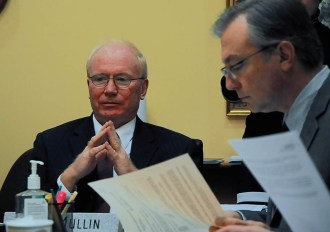
Sen. Kevin Mullin, R-Rutland, a member of Senate Finance is one of the most blunt opponents to the new tax scheme. “Clearly the purpose for raising revenue is to support an unsustainable budget, and I’m not willing to do that,” Mullin said in an interview.
In the end, Senate Finance capitulated on an implementation timeline for the sales tax on services, but lawmakers didn’t give up entirely. The committee has asked the Tax Department to produce a report, with data projections to the Legislature on Jan. 15, 2016, regarding the impact of the new tax on consumer service companies.
“We know that any implementation of a services tax comes with administrative complexity,” Ashe said. “The responsible thing to do is to ask the tax department to come back with what the rules would look like and select cases.”
“The committee is determined to establish a revenue framework for the future that doesn’t have us coming back year after year,” Ashe said.
Some committees cheer when they pass difficult legislation. In Senate Finance, lawmakers voted with little enthusiasm. “We have a sense of responsibility,” Ashe said. “And we have to walk away being able to articulate a rationale.”
Gov. Peter Shumlin opposes the expansion of the sales tax to candy, soda, bottled water and services.
“My belief is that when we expand the sales tax to services we are doing New Hampshire’s economic development for them,” Shumlin said. “We’re expanding a tax that asks those who make the least pay the most. When it comes to the deduction of home mortgage interest and catastrophic medical expenses, we have those deductions for a reason. We would be lost as a state if there weren’t the charitable giving we have in Vermont.
“Seniors most often use catastrophic medical expense deduction, and we don’t want to take that away from them,” Shumlin said. “And the home mortgage deduction is in place to drive home ownership. We’re finally seeing recovery in housing markets that were dragged down by recession and we don’t want to discourage that.”

Tom Torti who leads the Lake Champlain Chamber of Commerce, said at the governor’s press conference in Burlington on Tuesday that Vermont does not have a taxing problem. Torti advocated for cutting the state spending package for fiscal year 2016 by an additional $35 million instead of raising taxes to fill the budget gap.
“We have a spending problem and to simply tax our way out of a structural spending problem we’ve seen coming for years is irresponsible fiscal policy,” Torti said.
The House proposal, which caps all income tax deductions, targets the middle class, the elderly and young professionals, Torti said, and creates disincentives for the private sector economy.
Many of the proposals from the House and Senate have been derived from the 2010 Vermont Blue Ribbon Tax Structure Commission report.
Torti said the commission’s recommendations were not “an a la carte menu.”
“If you’re going to walk down this path, you have to radically change Vermont’s tax system, and it must be revenue neutral,” Torti said. “This is no way to raise revenue.”
Taxing the rich is not an option, Torti said, because there are fewer than 200 people in the state who make more than $500,000 a year.
Witnesses trash Senate proposal to tax services, candy
At a hearing on Tuesday, several business groups, including the Lake Champlain Chamber of Commerce, the Vermont Realtors Association, the Vermont Bar Association, and the National Confectioners Association, testified that the proposed Senate Finance tax plan is inconsistent, unfair and a compliance hassle.
Catherine Davis, from the Lake Champlain Regional Chamber of Commerce, said taxing services is a bad idea because Vermonters would have to pay taxes on essential services including child care, tutoring, and preschool.
“As someone who spends $13,000 per year on preschool for one kid, an almost 5 percent tax on that, when it’s already unaffordable, would be concerning,” Davis said.
Ashe has said education and health care services would be exempt from the sales tax on consumer services.
Dan Barlow, from Vermont Businesses for Social Responsibility, and Andy Robinson, a private consultant, were the only witnesses who supported increasing tax liability for wealthier Vermonters.

“I would pay more taxes under most of these proposals,” Robinson said. “I am good with that,” he said, because government provides essential services, and if citizens want these services to continue, they need to pay for them.
Robinson said low- and middle-income Vermonters donate the biggest proportion of their incomes to nonprofits. He suggested the Legislature let Vermonters deduct around $1,000 in donations — instead of only letting high-income Vermonters deduct donations over $5,000.
Candy lobbyist says legal definition makes no sense
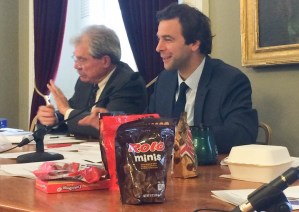
Margaret Laggis, from the National Confectioners Association, brought in several bags of candy and said under current legal definitions of “candy” brands like KitKat and Twix are not considered candy because they are manufactured with flour.
Laggis said the proposal to extend sales tax would largely apply to M&Ms, Hershey bars, gluten-free licorice, and other candy bought in bulk. She said Vermonters paying with food stamps would also be exempt from the extended sales tax.
“If you want to tax soda, that’s a completely different issue, but you do not have to tax candy just because you tax soda,” Laggis said.
