

Editor’s note: This article is by Michael Faher, of the Brattleboro Reformer, in which it was first published Saturday, March 28, 2015.
BRATTLEBORO — An expert is lauding the safety and security of so-called “dry casks” — the canisters that eventually will hold all of Vermont Yankee’s spent nuclear fuel on the banks of the Connecticut River in Vernon.
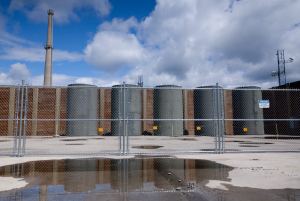
To back up his point at the Thursday night meeting in Brattleboro, Jay Tarzia, who chairs the New Hampshire State Radiation Advisory Committee, discussed natural disasters as well as simulated crashes and attacks — none of which, he said, has produced evidence of radiological leaks.
But Tarzia could not estimate the long-term lifespan of those casks. And that’s a key question, given that there currently is no permanent, U.S. storage facility accepting nuclear fuel.
“I don’t know if anybody has the capability of doing a study to prove beyond a shadow of a doubt that these canisters will last for 300 or 500 years. But they’re running computer models now to try to postulate that,” Tarzia said..
“Ultimately, the hope is that we’re going to find a long-term storage solution like France has and some of the other countries,” he added. “But we don’t have those answers yet.”
Tarzia, who also works as a principal at Stratham, N.H.-based Radiation Safety & Control Services Inc., was a presenter at Thursday’s meeting of the Vermont Nuclear Decommissioning Citizens Advisory Panel — the body set up last year to take public input and advise on the shutdown and eventual decommissioning of the Vermont Yankee plant in Vernon.
The plant ceased operations Dec. 29 and is entering SAFSTOR, a prolonged period of inactivity prior to decommissioning work. Vermont Yankee owner Entergy already is storing some spent fuel in dry casks at the site and has said it expects all fuel to be transitioned to those casks by the end of 2020.
Tarzia said dry-cask storage systems were developed in the 1980s and are licensed by the federal Nuclear Regulatory Commission. The systems employ a reinforced concrete outer shell and a sealed inner metal cylinder, with heat from radioactive decay vented from the top.
This is more stable than spent fuel pool systems, Tarzia said, because “there is no liquid in that canister. There’s nothing to leak.”
The first such system was installed in 1986 at the Surry Nuclear Power Plant in Virginia. There are now 74 licensed systems in the U.S., and Tarzia took pains to show ways in which those systems are tested including:
• A tractor-trailer carrying a dry-cask container ran into a 700-ton concrete wall at 80 mph.
• A 120-ton locomotive hit a container traveling 80 mph.
• A container was dropped 2,000 feet onto soil hard as concrete.
In each case, according to Tarzia’s presentation, “post-crash assessments demonstrated that the containers would not have released their contents.”
He also discussed the results of simulated attacks. But Tarzia said dry casks also passed a real-life test in 2011 after an earthquake and resulting tsunami severely damaged a nuclear plant at Fukushima, Japan.
“They had 408 fuel assemblies in dry-cask storage,” Tarzia said. “They were thrown around. The storage structure itself was highly damaged. But the casks themselves were not compromised.”
Overall, he said, dry-cask systems have proven safe.
“I realize that there’s a lot of concern about the safety of the fuel. And I think it’s imperative that we have a program to monitor these systems,” Tarzia said. “But there have been no known or documented releases of radiation from any of the testing that’s been done even on the earlier canisters that were installed back in the ’80s.”
That did not satisfy everyone at Thursday’s meeting. There were questions about the type of canisters used at Fukushima — Tarzia could not say specifically — and about the long-term reliability and safety of the containers.
Tarzia noted that spent nuclear fuel “loses its radioactivity over time” — after approximately 100 years, he said, “the amount of radioactivity in the fuel is about 1 percent of what it was when it came out of the reactor.” His point was that the level of protection required from dry casks decreases as spent fuel ages. But Tarzia’s radioactivity estimates also ranged far into the thousands of years, eliciting groans from some in the crowd.
“For nuclear fuel, (radioactivity) will go away someday,” Tarzia said. But he added that “we need to manage it for a long time.”
