

Editor’s note: This commentary is by David Coates, a retired managing partner at KPMG — Vermont and a member of the Vermont Business Roundtable. He was a member of the 2010 state Commission on the Design and Funding of Retirement and Retiree Health Benefits Plans for State Employees and Teachers. He lives in Colchester.
[I] wish I had some encouraging news to share with you on the status of the state’s liabilities for underfunded pensions and retiree health care benefits, but I don’t as these liabilities continue to grow despite positive, incremental changes that have been made over the last few years. Unfortunately, the changes only ended up nibbling around the edges; the size of the liabilities and the key underlying assumptions require significant structural reform.
Here is a look at the unfunded liabilities taken from the most recent actuarial reports:
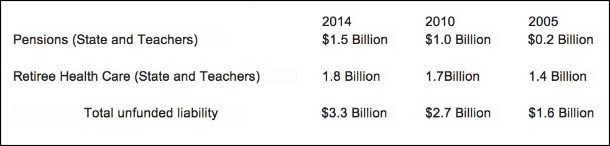
The data show that in less than 10 years, the unfunded liability has more than doubled.
Equally concerning is that the amount of the unfunded liability will likely increase in 2015 and beyond, for two key reasons.
First the state, although not required, does have the option to implement newly published mortality tables that will reflect the reality that people are living longer. In the private sector, these are required and have resulted in increases to the liability of 5-7 percent. At 5 percent, the increase in Vermont would be around $165 million.
Second, the state should revise the current discount rate assumptions (both at around 8 percent). Other states have moved in this direction and Vermont should as well. A 1 percent reduction in these rates – to 7 percent – could increase just the liability for pensions by another $400 million-$500 million. Incidentally, for comparison purposes, the private sector discount rate is around 4 percent.
These necessary updates will not only give a more accurate picture of our fiscal condition, but further require the state to increase funding to even higher levels in order to keep the pensions financially sound and maintain our current high credit ratings.
As for the impact these liabilities have on the state’s general fund, in 2005 the annual required contributions for the state workers and teachers pensions was $65 million. In 2014 it has nearly doubled to $116 million. As long as these liabilities continue to grow (and they will), so will the stress on the general fund and other state programs.
Until lawmakers acknowledge the problem and own the responsibility for solving it, no real reform is possible.
The liabilities for the retiree health care benefits (currently $1.8 billion) will also continue to increase as the state is only funding the actual health care costs incurred. Unlike the pensions, the state is not funding the amount required to amortize the liabilities. In 2014 this amount was $55 million; the amount will continue to go higher by at least another 5 percent for 2015 and thereafter, until it is fully funded. Since the state is not making this payment, because the state has no money, it will never be funded; instead, it will continue to increase unless structural changes are made. Which leads to the obvious questions … if there is no state funding available, why do we have these benefits?
What is the state to do when faced with these overwhelming liabilities that exceed twice the general fund revenues?
For starters, the Legislature should recognize the problem instead of being swayed by the vested interests of the union leaders who downplay the gravity of these unfunded liabilities. This problem has been building for many years by not fully funding the liability; by employing unrealistic cost projections of the benefit assumptions; by the lack of political will among lawmakers to insist on realistic changes; and, finally the worst offense, deferring action to let someone else deal with the problem. Until lawmakers acknowledge the problem and own the responsibility for solving it, no real reform is possible.
Many parts of the country have been facing these same issues head on, especially in cities such as Detroit and Stockton, and in states like Illinois and New Jersey. Courts are finally weighing in on these issues as, for troubled cities, bankruptcy seems like the only recourse. States can’t use the bankruptcy route, but they can use the court system and this is starting to play out. Vermont is fortunate that we are not yet like Illinois and New Jersey, but we will be if these liabilities are left unchecked. Now is the time to begin meaningful change and let me suggest just a few.
First, we need to hold harmless anyone currently receiving pensions and health care benefits. We should also, if possible, consider those who are near retirement and have planned on these benefits. We could begin the transformation by prohibiting new state employees and teachers to join the existing defined benefit plans and instead provide a 401(k) type plan similar to what the majority of Vermonters receive.
Second, have new state employees and teachers be ineligible for retiree health care benefits. Just these two reforms will at least stop the liabilities from growing unchecked and allow the state to then figure out a sustainable way to pay for them.
This is at least a start, but we have to start. Undoubtedly, union leaders will fight even these modest changes; that is what they are paid to do, and so far they are doing a great job of keeping Vermont in the red. We need to stop costing Vermont taxpayers unnecessary expenses, and stop jeopardizing other important state programs that need public investments.

