

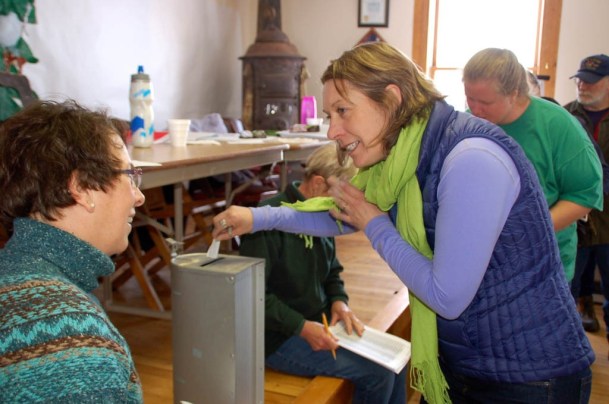
ELMORE — Voters in the last town in Vermont with a one-room schoolhouse, agreed to consider merging with the neighboring school district Tuesday.
After about two hours of sometimes emotional debate over giving up local control and school choice, Elmore residents on Town Meeting Day voted 79-19 to study merging with the neighboring Morristown School District.
The two towns, along with Stowe, make up the Lamoille South Supervisory Union.
Elmore School Board Chair Penny Jones said she was pleased, and surprised, that there was such a strong majority in favor of the merger study.
“Obviously, we’re happy with the vote,” Jones said right after Town Moderator Jon Gailmor announced the result.
A study will be undertaken with school board members and residents from both towns. If the towns decided to merge, articles would be drafted and the State Board of Education would need to approve. The merger would then go before voters in both communities.
The state is providing merger incentive grants of $150,000 to towns, so the study will not cost either town any local tax dollars.
School officials stressed that the study and a possible merger with Morristown does not mean the tiny Elmore School would close. Twenty students in grades 1-3 are instructed in the building with one teacher.
School Board member Stuart Weppler explained the options to voters.
Under a merger, taxes on a home worth $300,000 would go down $900; if Elmore does nothing and ends up next year hitting the state’s excess spending threshold, the tax rate next year would go up about 40 cents — adding $1,200 to taxes on that $300,000 house, Weppler said.
The two towns were among a few that looked at joining hands with their neighbors to address the pressing financial realities of rising budgets amid declining student enrollment, which has topped the Vermont Legislature’s agenda and the governor’s priorities this year in Montpelier.
H.361, a major piece of looming education finance reform legislation, would require small school districts to form larger integrated educational systems of 1,100 students in an effort to improve student educational opportunities and find cost efficiencies.

Speaker of the House Shap Smith, D-Morrisville, stood at the back of the meeting and listened first to concerns about lack of police coverage in town, about the town’s shoreline plans in concert with the Agency of Natural Resources, and more, before the question on the school merger study finally began. Rep. Avram Patt, D-Worcester, also attended the Elmore annual meeting.
The two representatives left copies of their 2015 Town Meeting Report, which had a section on education outlining the just released education bill.
The bill calls for:
• temporarily capping local spending increases;
• requiring school districts to merge with neighboring districts to form larger preK-12 school systems;
• restructuring of the Small Schools Grant program;
• a call for explicit ballot language where school budget warnings and ballots will include specific disclosure of per-pupil spending, percent change in the budget, and the overall budget amount;
• a pullback on the hold harmless provision which has insulated districts from the financial realities of declining enrollments;
• stopping the exodus of Vermont public education dollars to out-of-state schools except in certain circumstances, including special education placements and several more;
• a call to reform the collective bargaining process; and,
• a moratorium on new legislation that would add to the burden of property taxes.
“By the time it gets out of the House, and then the Senate has a crack at it, one way or another school districts are going to be pushed to make some changes, but in a way that can be decided locally,” Smith told voters. “We’re not telling you that you have to close your schools. We’re saying that the administrative units created by state government need to be larger.”
With larger districts, there is more flexibility with staffing and more opportunity to share resources, he said.
Smith talked for a moment about two schools not far from Elmore, which have an incoming kindergarten class of six, and 23 kids, respectively. They are 10 minutes away from each other, but because they are in different districts, they cannot work together and the school with nearly two dozen children will likely need to hire another teacher.
If those two districts were in the same, larger school system, they could move children and balance out the numbers without adding staff and costs, he said.
“That’s why I like the idea of district consolidation rather than school consolidation,” Smith said. The idea this year, he said “is really to push from the state level, and say some things have to change, but to really let people — school boards and voters and taxpayers in their communities — figure out what is going to work in their community.”
Elmore, Morristown have a history of cooperation
Elmore sends its kindergarten students, as well as its grades 4, 5 and 6 students to the Morristown Elementary School, and the town now has school choice for grades 7-12.
Morristown provides a great deal of support services to Elmore School, from professional development to special education, physical therapy services and more, said Penny Jones, the board chair.
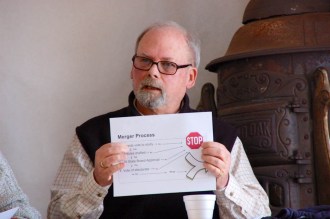
If, after the study and a positive vote by the residents of both towns, a merger of the two districts to form a Unified Union District is passed, Elmore would send its seventh-graders and eighth-graders to Peoples Academy, the secondary public school in Morrisville, and most Elmore high school students would also attend Peoples.
However, public high school choice would be afforded Elmore students, providing there is room in the desired public high school other than Peoples through a lottery system, it was explained.
Several residents at the meeting commented on the fact that merging with Morristown would cost the town its choice that now allows for students to attend independent schools, including St. Johnsbury Academy, saying their families had moved to Elmore because of that broader school choice.
Budget sails through
The $2,442,700 Elmore school budget was unanimously approved. It called for an increase of $230,000 over the present year’s spending, along with a decrease in revenue of $90,000, leading to another double-digit tax hike this year.
New tuition expenses — totaling nearly $190,000 — are the lion’s share of that increase, the assembly was told.
Elmore was one of 35 Vermont towns to defeat proposed school budgets a year ago, 35-25.
“And the reason that we heard was that property taxes were too high,” said Weppler.
The town has had a string of double-digit school budget increases which have rapidly added to the cost of property taxes in town.
After that experience, the school board conducted a survey and a majority of respondents said they wanted the school board to look into a merger, Weppler said.
“We felt we got our marching orders,” he said.
Creating an “Elmorris School District, with Elmore in the front,” Weppler said, would cut the tax rate from $1.70 to $1.40 in the first year.
That would mean, for that same hypothetical $300,000 house, that the taxes would go down $900 a year.
If the town hits the excess spending threshold next year, which it expects to, and will be penalized for, the town’s tax rate would go up to $2.09, driving the taxes on that $300,000 house to $6,300, up $1,200 from the rate this year.

