

[P]LAINFIELD — David Manning was not happy with a report on school discipline being handed out in an allegedly discriminatory manner. So Manning, principal of Johnson Elementary School, sought out the author of the report “Kicked Out! Unfair and Unequal Student Discipline in Vermont’s Public Schools,” Jay Diaz, a Vermont Legal Aid attorney who has represented students expelled from school.
After hearing Diaz speak at the Vermont Statehouse, and learning more about the intent of the work — not to attack schools and school administrators, but seek solutions in the best interests of children — Manning decided to get involved.
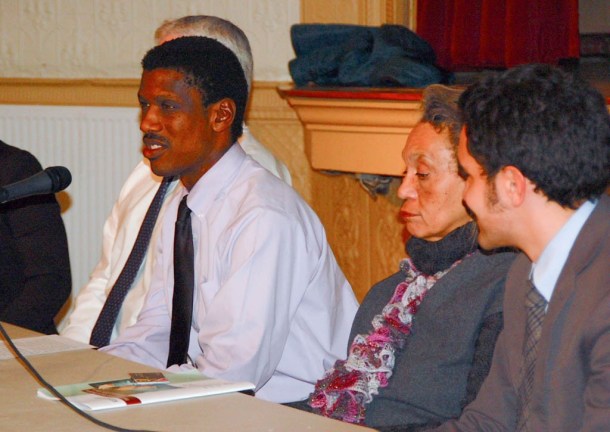
Monday evening, Manning was part of a panel at a forum held on the issue at the Plainfield Town Hall and Opera House.
About 40 adults and several students attended the forum, where speakers also included: Max Barrows, outreach coordinator from Green Mountain Self-Advocates; Mel Motel of the Just Schools Project; Sha’an Mouliert of VTers for Criminal Justice Reform; and Diaz.
The discussion focused on “What’s happening, why it matters and what we can do to stop it.”
Parents and grandparents shared stories about children being taken out of classes, allegedly having a principal put their hands on a young boy “and drag him down the hall,” refusing to communicate with the parents in that situation, restraining a child, and more.
“It’s an important conversation we should all be having,” Diaz said. “The reason I wrote the report and got together all the data is I represent students who are kicked out of school for a variety of reasons, and I wanted to know more about what was going on systematically. The same thing keeps happening over and over again.”
Diaz said expulsion often starts the school-to-prison pipeline, which he said begins at a young age for children who are excluded and separated from their peers.
“Three things happen,” said Diaz — they are more likely to end up dropping out of school, entering the juvenile detention system and becoming incarcerated and living in poverty as adults.
Diaz said data from state and federal sources used in the report shows that students of color, including African-American and Abenaki student populations, are being disciplined at two to three times the rate of their Caucasian peers.
The report shows that students with disabilities were nearly three times more likely to be suspended than students without disabilities.
Senate Ed mulls bill
A bill is being considered in the Senate Education Committee, Diaz said, that would create a new council to gather more data to examine concerns over unequal discipline in schools.
“I believe this is a great first step,” Diaz said Tuesday. “It will bring the right people together to discuss the issue, figure out the gaps in our state’s understanding of the issue, and determine ways for moving forward.”
The Senate Education Committee continued work on the bill Tuesday, where Sen. Brian Campion, D-Bennington, echoed concerns raised in the report, asking if the state was in violation of its obligations when suspended students don’t receive educational services.
“Our ultimate goal is to educate those students, correct?” asked Campion.
Sen. Ann Cummings, D-Washington, chair of the Senate Education Committee, said, “It started out as a civil rights discussion.”
“Ultimately, what we want to do is make certain that those students are educated, so let’s immediately put forward a policy that says if you expel or suspend a student, you have to make certain that student is educated while they are out of school,” Campion said.
Cummings said to do that “would be very expensive,” and adding that to the bill on the table would require more testimony.
In the end, senators decided not to establish a School Discipline Study Committee, with the committee agreeing that more data collection is needed first.
The Agency of Education will instead be asked to collect and deliver all readily available data on school discipline to the Senate Education Committee by January 2016, in a memorandum to be drafted to the secretary of the agency.
Time for change
At the Plainfield forum, Sha’an Mouliert of VTers for Criminal Justice Reform told the story of how her son was treated in schools growing up in Vermont and was disciplined instead of being helped as a result of his learning disability and emotional difficulties. He is incarcerated today, she said.
“I not only don’t see things getting a little better, I see things getting worse,” Mouliert said.
Barrows, of Green Mountain Self-Advocates, works with some 600 state residents who have either intellectual or developmental disabilities.
Barrows, who has autism and is African-American, said, “It caught my eye when the report came out about how to address issues that involve race and disability. Knowing this is happening in Vermont makes my heart ache really badly.”
Manning said many principals he knows have had the same reaction he had initially.
In his Johnson school, there is little racial diversity, but Manning said many of the students who do end up being disciplined are low-income students who bring more life struggles to the door of the public school.
“Our low-income students and students with disabilities do struggle to follow the rules more than their non-disabled peers,” Manning said. “The problem is the school is only set up for one group of children to succeed. The kids who aren’t set up for success misbehave more often.”
Panelists were also asked what unfair, unequal discipline means to them.
Diaz shared a story of a 9-year-old boy having a mental health situation that led to police coming to the school. They “slammed him on the ground and put him in a police car … I don’t blame anybody in that situation, you’re in the moment, you’re wondering what to do … [but] why was that what happened, instead of something else?”
Schools that have systems in place, such as Positive Behavioral Interventions and Supports (PBIS) have trained their staffs and are “already set up to take care of that situation,” Diaz said.
In schools where PBIS is in place — about a third of Vermont’s schools now, and growing — “people think differently about what these situations mean and how they’re going to react to them.”
Manning said students who start out with discipline issues at a young age for roughhousing, for example, in preschool and are told by the teacher “That’s not OK,” go on to have issues in their early school years.
“By the time they get to be in seventh or eighth grade, they hate school, so that kid gets to be a very unmanageable student,” he said.
Claudia Pringles, a special needs law attorney in Montpelier and the mother of 15-year-old daughter with autism, said it’s not all the school’s fault.
“You need to understand the school’s perspective,” she said. She suggested that parents ask to have a functional behavioral analysis conducted so that everyone can understand what is happening with the child’s behavior and how to best help them.

