

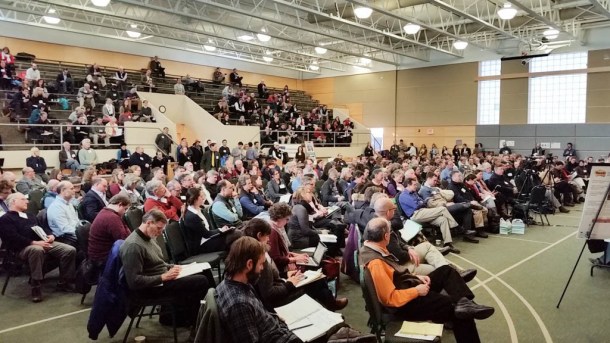
[I]nstead of warning about the effects of climate change, the Vermont Council on Rural Development took a different approach this week: how can we capitalize on climate change?
The event, which drew more than 400 Vermonters, including business leaders, policy-makers, and entrepreneurs to Vermont Technical College, was a pivot from past conferences.
“There’s really good work going on in Vermont relating to climate change,” said VCRD Executive Director Paul Costello at the conference on Wednesday, referencing the state’s robust alternative energy, green building, working landscape, and food systems sectors, “but it hasn’t been pulled together as an economic development strategy at the level that it could be.”
Describing a national movement that still hasn’t quite found its focal point, Costello and others speakers emphasized Vermont’s opportunity to seize the moment and position itself as a beacon for green businesses, investors, and advocates.
“Rather than being paralyzed or reactionary,” Costello said, “we’ve rooted this summit in what an economic opportunity this is and in how businesses can prosper in an age of climate change.”
Gov. Peter Shumlin kicked off the Summit on Creating Prosperity and Opportunities Confronting Climate Change, noting that there were five times more solar jobs in Vermont today than when he took office in 2011.
Thirteen separate breakout sessions focused on initiatives ranging from innovation in transportation, renewable energy, and recycling, to adapting Vermont’s tourism industry to changing weather patterns, and to branding Vermont as an innovative hub for young environmentally-minded entrepreneurs.
Jigar Shah, the founder and former CEO of SunEdison and author of “Climate Change Wealth”, delivered the keynote address and stressed that “the resource revolution represents the largest wealth creation opportunity of our generation.”
While common threads of resilience, innovation, and opportunity were woven throughout the summit, a wide range of approaches and priorities were discussed.
The event culminated in the launch of the Vermont Climate Change Economy Council, a 24-member council that will sift through the ideas, develop an actionable strategy, and prioritize initiatives and investment opportunities that are most likely to lead to job growth and economic development in Vermont.
Top Down and Bottom Up

Shah, the keynote speaker, who currently runs the green economy specialty finance company Generate Capital, challenged the idea that innovation had to come from grassroots efforts in the private sector and called instead for a top-down, government and utilities initiated approach to generating economic development while addressing climate change.
He urged Vermont to push for large scale, systematic innovations that would position the state to emerge at the forefront of the climate change movement, touching on the way policies that incentivize resource efficiency can mean scalable profits for businesses and therefore significant investment.
From a grassroots standpoint, discussions touched on community initiatives including light bulb exchanges, community solar projects, education, and efficient weatherization efforts. Costello described the approaches as complementary, and emphasized the importance of unity across sectors.
“There are roles for people at all different levels,” he said. “We’re going to have to be all-in to advance this as a successful economy.”
The Vermont Brand in the Time of Climate Change
The summit also explored the need for public relations initiatives in establishing Vermont’s brand as a leader in the climate change economy, and discussed the idea of hosting a similar climate change summit on a national scale.
By emerging as a leader in this industry, Vermont could attract more young people to the state, a perennial challenge.
“There are a lot of young people nationally who are entrepreneurial and mission driven,” Costello said. “They want to change the world and they want to be part of a process at a scale where they can model that kind of change.
“Are we going to have the best tax credits and the most open land with the least environmental restrictions to development? Probably not,” Costello said. “But we will be mission central when it comes to creativity in the green economy and in the climate mitigation economy.”
The Vermont Climate Change Economy Council will develop the strategies and ideas discussed at the summit and present them to the Vermont legislature, the Governor, and the public in January 2016.

