A group that includes some of Vermont’s most successful entrepreneurs is exploring the “common sense commerce” opportunities that might be created if the state were to legalize marijuana.
Organizers of the Vermont Cannabis Collaborative say they are not promoting legalization but want to be sure that if pot is legalized that it is done “the Vermont way.”
The group envisions Vermont one day playing host to an “East Coast Center for Cannabis Research, Innovation and Excellence,” that would spur economic development and job creation using the sustainable principles associated with other socially responsible companies in Vermont.
Steering the initiative are former state Sen. Hinda Miller, co-founder of sportswear company Jogbra; Will Raap, founder of Gardeners Supply; Alan Newman, founder of Seventh Generation and Magic Hat; Dan Cox, former executive at Keurig Green Mountain and now president of the testing lab Coffee Enterprises; and marketing and design expert Michael Jager of Solidarity of Unbridled Labour (formerly JDK).
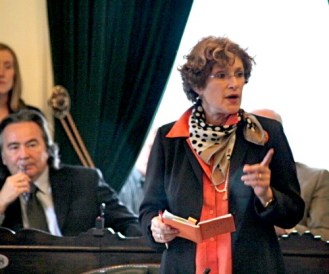
“We’ve never seen an opportunity for economic development like this,” Miller said.
Miller said Vermont is uniquely positioned to imprint its brand on the legalization of pot in ways that might look different from the retail models employed in Colorado and Washington.
“It’s not if and when, it’s about how,” Miller said. “We want to step forward and help create an economic model that works for Vermonters, that capitalizes on our entrepreneurial potential.”
Sen. David Zuckerman, P/D-Chittenden, sponsored a bill to legalize marijuana last year, and he expects to introduce a new bill as soon as this week. It will propose what he called “a modified B Corp” structure to manage the business of legal pot.
A B corporation is a for-profit company that achieves certification by a nonprofit entity that evaluates businesses on their “social and environmental performance, accountability, and transparency.” These companies generally adhere to the so-called triple bottom line principles of people, planet and profit.
Zuckerman said Monday his bill will likely propose taxing recreational marijuana at $40 an ounce. Using data provided to Vermont by the recent RAND Drug Policy Research Center, that would generate about $25 million in tax revenue from in-state marijuana users alone. He also said the bill will allow Vermonters to grow a limited amount of cannabis at home.

According to the RAND study, some 80,000 Vermonters already use marijuana. Zuckerman says his bill regulates the practice and aims to reduce the illegal trade.
“All it’s changing is how people are obtaining it,” he said.
The terroir of pot
The organizers of VTCC see a comparison between the nascent pot industry and the local food movement that has taken root over the past several years.
Raap, of Gardener’s Supply, said there are 4,000 to 5,000 people working in the local food industry and another 2,000 or so working in craft brewing.
He says Vermont could carve out its own niche in the marijuana industry by cultivating the value-added concepts already in use by artisanal cheese, beer, wine and other food producers.
“Vermont is never going to have 100,000-square-foot warehouses for marijuana production like Colorado,” Raap said. “The terroir of Vermont cannabis is not an outlandish idea. But we need the infrastructure in place.”

Raap favors creation of a center for excellence that would support “a quantitative understanding of the potential of the cannabis industry in Vermont.”
He said the Legislature might consider creating the B Corp as a “fifth dispensary,” built upon the four medical marijuana dispensaries already established by the state and overseen by the Department of Public Safety.
Medical research and testing
Marijuana is one of the most illicit drugs in the U.S. The federal government classified it as a Schedule I substance, along with heroin, LSD, Ecstasy, methaqualone (Quaaludes) and peyote, in the 1970 Controlled Substances Act.
Schedule I drugs are those “with no currently accepted medical use and a high potential for abuse,” according to the Drug Enforcement Agency.
Marijuana has been found in clinical trials, mostly conducted in Israel, to be effective in treating symptoms of pain, skin and seizure disorders, certain cancers, asthma and post-traumatic stress disorder, among others.
Two compounds found in marijuana, cannabidiol (CBD) and tetrahydrocannibinol (THC), are most studied in medicinal marijuana research. Access to the marijuana used in research in the U.S. is limited by the federal prohibition on transporting the drug. The only approved source of pot for study is a farm at the University of Mississippi in Oxford. Only federally approved studies are allowed to receive marijuana from the farm, and those tend to be studies that look at the detrimental effects, experts say.
Raap sees an opportunity for research at the University of Vermont using marijuana grown within our own borders, akin to the college’s Proctor Maple Research Center.
He says Vermont growers have established a marijuana gene pool over the years since the hippie movement in the 1960s.
“Let’s do this like we did maple syrup. We could have a research lab that would connect students with learning and science.”
“Let’s do this like we did maple syrup,” he said. “We could have a research lab that would connect students with learning and science. Start with industrial hemp and medical. Then look at testing, develop certification protocol for edibles and infused products; extraction methods; what’s the right greenhouse in a Vermont climate … it’s very exciting stuff.”
He said businesses could grow up around such an infrastructure that would “work together and in the open.”
Miller said the marijuana industry and related jobs could help keep the millennial generation in Vermont.
Action in Montpelier
The Vermont Cannabis Collaborative plans to form several working groups to prepare reports for lawmakers by early December.
Among the topics are:
• Regulation, taxes and technology, headed by Brian Leven, who recently left the Secretary of State’s office.
• Education, training and workforce development, headed by Dan Smith, president of Vermont Technical College.
• Medicinal plants innovation hub, headed by Raap.
• Economic cluster and leadership, headed by Miller.
• Judy MacIsaac Robertson will lead a team on community engagement.
Zuckerman said lawmakers would welcome the reports, saying it’s important that “all voices be heard.”
At a presentation by VTCC last week, Pat Moulton, secretary of the Agency of Commerce and Community Development, and Megan Smith, commissioner of the state department of marketing and tourism, expressed interest in the group’s ideas but also urged caution.
Moulton said it might be better to do the research hub component before adopting full legalization of recreational marijuana.
Smith said it was likely that marijuana would eventually be legalized but was concerned that it not tarnish the “Vermont brand.”
Organizers said that was another reason to approach legalization “holistically.”
“We are not pushing legalization,” Raap said. “We are pushing an intelligent approach to whatever is authorized the Legislature to optimize commercial opportunity in Vermont.”