

Why are gas prices in northwestern Vermont higher than in other parts of the state?
Lots of people want to know, but a public hearing on Thursday in Montpelier provided no clear answers.
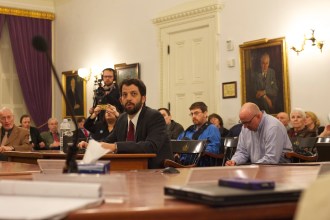
Elected officials say there is a lack of competition in the region among the six wholesalers that sell gasoline to the three distributors who control the northwestern Vermont market. Wholesalers say it’s difficult to recover the high costs of doing businesses in a region with many filling stations and relatively few people purchasing fuel.
Rep. Chris Pearson, P-Burlington, is the lead sponsor on a bill that aims to determine the reason behind the disparate prices, including whether “conspiracies” of collusion, or price fixing, among wholesalers are true.
The bill, H.30, would require wholesalers to report each year the number of gallons sold to dealers to the Attorney General’s Office, among other requirements.
Pearson read letters from taxi drivers, some of whom prefer to drive “full-size luxury Suburbans,” which puts them at an economic disadvantage to those to switch to fuel-efficient smaller cars. But he and other lawmakers say they have no explanation to give their constituents.
Pearson said that during the first two weeks of the year, the greater Burlington area saw the second-highest profit margins in the country, citing data from the Oil Price Information Service.
“This is not a new phenomenon. These are not outlier weeks by any means,” he said. “So my constituents had routinely asked me, ‘what is going on?’”
He said the bill would give the attorney general the necessary tools to “put the puzzle together.” It would require dealers to give the attorney general advance notice of any station purchases in order to keep tabs on consolidation. Lastly, the bill provides whistleblowers a payment equal to 10 percent to 25 percent of the penalties charged to a company found in violation of antitrust laws.
Lack of competition explains the price difference, according to Dan McLean of Sen. Bernie Sanders’ office. He said three wholesalers operate half the filling stations in the region.
“The Burlington market is one of the most lucrative markets in the United States to sell gasoline,” he said, “with a profit margin twice the national average.”
Sanders has criticized Burlington-area gasoline dealers for keeping prices high, including R.L. “Skip” Vallee, owner of the Maplefields chain of gas stations and convenience stores, for opposing a Costco filling station across the street from one of Vallee’s stores for environmental reasons.

High profit margins in Burlington could indicate that wholesalers are fixing prices, which is illegal according to Assistant Attorney General Ryan Kriger. He said it might also indicate there is price signaling or price following, which is legal.
“To prove there is a conspiracy, you need actual evidence of a conspiracy. Looking at your opponents’ signs is not a conspiracy. Talking to each other, that’s a conspiracy,” he said.
On Jan. 23, the price per gallon of gasoline in Burlington was $2.46, 6 cents above the Vermont average of $2.40. The U.S. average was $2.03.
But the 61 area retail dealers don’t look at the Vermont price (or the national price) when selling gasoline, according to Joe Choquette, of the Vermont Petroleum Association, which represents gas retailers in the state.
“Instead, they consider their own businesses’ circumstances: the cost of the product sold, the cost of running the business, and what competitors in the immediate area are doing. It’s easy to do, we post our prices on 5- by 12-foot signs, 14 feet above the highway,” Choquette said.
He said there are 1,400 people per retail outlet in Chittenden County. Across the Northeast, he said there are 2,800 people per outlet. He said there are more independent filling stations competing for business in those states.
He said Vermont has the lowest volume of gasoline sales than any of the lower 48 states, which means retailers have fewer gallons on which to recover the costs of taxes, property, labor and insurance.
Choquette said the costs are perceived to be higher in the northwestern side of the state. But if the majority of consumers always shopped at the lowest-cost stations, the price would go down, he said.
“Consumers have a big role to play in bringing prices down,” he said. “There is a difference of more than 22 cents a gallon between the high price and the low price in Burlington.”
He said if there is collusion occurring, the Attorney General’s Office should bring these dealers to justice. He said the Attorney General’s Office has all the tools it needs to prosecute dealers.


