



Editor’s note: This commentary is by Vermont Secretary of Education Rebecca Holcombe and Wendy Geller, data administration director for the Vermont Agency of Education.
[A] recent policy brief (Vermont Educational Reform: A Balanced Approach to Equity and Funding (January 2015)) suggests that research on consolidation does not support the current conversation Vermont is trying to have about how to provide high-quality opportunities for our children at an affordable price, in a way that reflects the values and priorities of our communities.
We feel compelled to respond, because with respect to school and district size, this report seriously misrepresents much of the peer-reviewed research on which it claims to be based. It also relies on a narrow understanding of what governance involves, appears unacquainted with existing data on Vermont, and fails to acknowledge the diversity of circumstances small towns in our state experience. Because it overgeneralizes and oversimplifies, we are concerned this report does a disservice to the powerful conversations some of our school boards and communities are having about how they can ensure stability for their schools and children — both the ones they serve today and the ones they are likely to serve in the future.
The central elements in the report that we will address separately are:
• The brief claims that research on consolidation does not support consolidation.
• The brief is not consistent in its reading or its use of the definition of “small” schools and districts.
• The brief assumes that all small towns are similar.
• The brief claims that schools in rural states must play a dual role: education and community development.
Consolidation
First, we need to clarify how the term “consolidation” is being used currently in Vermont. “Consolidation” sometimes involves merging schools, but it often refers to merging governance without merging schools. The recent Chittenden East Supervisory Union (CESU) merger is a good example. Voters in this region decided by a large margin to consolidate governance; however, their plan does not include closing or consolidating schools.
This is an important distinction. Prior to the vote, representatives of several towns in CESU had told us that if the merger was not approved, they expected to have to close their local schools. By merging governance, however, they collectively expect to keep open more buildings than they could afford individually as towns. Similarly, the Mountain Towns RED was intended to preserve depth and quality of options at the secondary level without closing elementary buildings.
We believe that in the future, given both our projected continued declines in enrollment and very real fiscal constraints, we are more likely to see small schools in large districts, than we are to see small schools in small districts.
The new partnership in CESU has created opportunities in several ways, including:
• small units are insulated from some of the shocks associated with changes in enrollment;
• reporting and accountability for federal and state purposes is streamlined, substantially reducing demands on staff;
• PK-12 programs gain continuity as well as a greater capacity to develop specialized expertise and solutions for kids with high-intensity, low frequency disabilities;
• towns can pursue regional solutions together, rather than competing for students at the town level; and
• some specialization and public school choice becomes possible across schools in the now larger district.
The research cited by the brief actually suggests, in fact, that this kind of consolidation of small districts is likely to free substantial resources, which could either be returned to taxpayers or, as districts usually choose, used to improve educational opportunities for children. We examined the district sizes discussed in every article cited by this brief, as well as several more, and this body of research clearly suggests that there are substantial inefficiencies and costs with operating districts as small as many of the districts we have in Vermont.
In fact, the author of one of the articles, when speaking to a staff member at the agency, noted that it would be hard to find a district in Vermont that would not find financial benefits in a larger partnership. (See the Appendix for detailed clarification on district sizes in several of the articles cited in the brief.)
Small Schools and Districts
One thing that must be made abundantly clear for any meaningful discussion of the context of Vermont’s education system, student performance, and spending patterns is that the overwhelming majority of national and international research discusses schools and districts much larger than ours. When stakeholders cite national research on “small schools,” the small in the research typically refers to an elementary school of 300 or fewer students, or at the high school level, 300-600. Being clear about the parameters within which we study this is of paramount importance for us to come to any useful conclusions about our experience as a state. Careful, methodologically rigorous attention to how variables are measured helps us have these conversations. Sweeping generalizations and broad statements do not.
The overwhelming majority of our high schools in Vermont already fall into what is broadly understood as the “small” (301-600) or “smallest” categories (<300), while some are within the lower “medium” range (601-900 students). We currently have about five high schools in the state that break the 1,000-pupil mark, putting these schools in the “upper medium” range (901-1,200). By national standards, none of our high schools are “large.” While there is some variation on these category sizes across the body of research, most studies agree that any high school with an enrollment below 500 students can be understood as a “small” high school. Again, most of our high schools fall into this range. We even have high schools with about 50 students in attendance — micro high schools.
Other national literature cited by the brief, including the work of Ready and Lee (2006), suggests that the overwhelming majority of our elementary schools fall within the “small” (<275) and sometimes “medium” (276-400) school categories. While there is some variation in this literature on the cut-off point for “small,” most research agrees that if an elementary school has an enrollment below 300 students, it is a “small” elementary school. Most of our elementary schools fall into this range.

As such, we as a state don’t have the student population to discuss our schools as “small” or “large” but rather, in the majority “small” and sometimes “medium” compared with national and international research. This extends to our class sizes even more so, with nearly all of ours falling into the “small” range (i.e. below 15-17) for elementary schools, and some (mostly at the high school level) being in the “medium” category (17-25). On the whole, most are small (below 17) on average across the state.
Similarly, districts in Vermont are also small, on average, compared to districts discussed in the national research. Of the articles cited by the report, we were unable to find one that defines “small” the same way we do in Vermont.
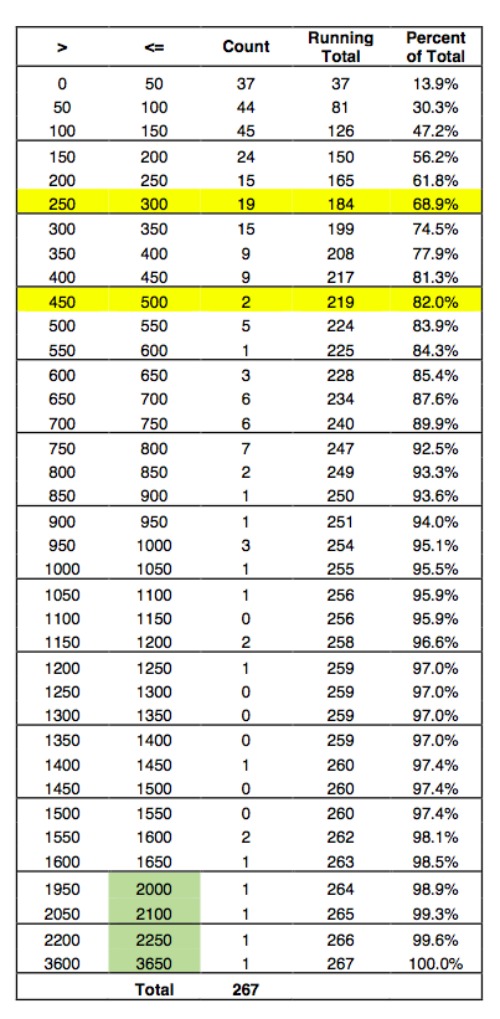
The smallest districts discussed in the literature were districts of 275 students or less. We have districts in Vermont of 15 students that need to meet all the same federal and state obligations as our largest districts. Almost 70 percent of our school districts have an average daily membership of 300 or less. Nearly half our districts have a membership of 100 or fewer pupils.
See table on following page for a breakdown of Vermont school district size:
The peer-reviewed articles on district consolidation (as opposed to school consolidation) clearly suggest that the relationship between district size, cost, and student performance is curvilinear, with optimal efficiencies and performance found at different places depending on local circumstances, but generally 1,500 students or more. This means that there are substantial efficiencies and economies of scale to be found by consolidating districts up to 1,500 students, with continued benefits above that mark, but at a declining rate. (See Duncombe and Yinger, for example, cited in the brief.)
Transportation is an issue in some states, but in some regions of Vermont, we note that consolidation of governance and perhaps consolidation of high schools might actually reduce travel times and preserve more high school options in the long run. We are moving towards regional monopolies at the high school level in Vermont, and not all the programs likely to be standing are located close to the communities they serve.
The challenge in Vermont is that, given our finite resources, declining student base, and declining number of taxpayers, we are left with the question of how we can support all those ends in a way we can actually afford. This cannot happen unless Vermonters in rural communities think intentionally about regional strategies for our future and make their decisions based on solid evidence (which the brief in question is not).
Understanding our conditions vis-à-vis the wider research is important because it establishes two things for us:
1. We are dealing with a very small environment that isn’t adequately covered in most of the national research when it talks about the negative impact of “large” classrooms, schools, and districts.
2. There isn’t really any research that specifically examines Vermont’s unique “small” conditions.
This clears our path to start to have some meaningful discussion about our conditions, what we can know about them, and how we should think critically about what the research can tell us to help inform these conversations.
Not All Small Schools are the Same
A major challenge for our state is figuring out how to support our schools. Because of its longstanding commitment to equity and to the rural nature of our state, we have long supported our small schools, and particularly those in less affluent communities.
In any discussion of these matters, it is essential to remember that not all small rural towns are the same. For example, the town of Cabot, cited in the report, has about 179 students as of last year. It operates its own high school, and has about 60 students in grades 9-12. Because its number of students has been declining, our funding formula treats it as if it had about 15 more students than it actually has. Without those “phantom students,” its tax rate would be about $.13 higher than the $1.57 rate it had in FY14. Education spending in Cabot is up about 15 percent over the past five years, while its tax rate is up 20 percent. In FY15, Cabot raised just under $2 million a year from its education property taxes, but will spend just over $3 million a year on its schools, not including the approximately $93,000 the state pays to career and tech centers on behalf of Cabot students. The difference is paid by towns across the state with bigger business bases, including the more affluent town of Dover (also mentioned in the report).
In contrast, in Dover, which has a growing population, the FY14 tax rate was just under $1.50. The approximately 49 Dover high school students choose which high school to attend, and increasingly, they choose Burr and Burton Academy, an independent school almost an hour away — and certainly much farther than some of the smaller high schools nearby. Overall, equalized per pupil spending in Dover is only up about 9.8 percent over the past five years, and tax rates are up 15 percent. Dover is fortunate to have a ski mountain in town, and it generates about $13 million in education property taxes, yet spends about $2.4 million on educating its children. The difference goes to support education in other towns across the state.
Neither of these towns is like Concord, in the Northeast Kingdom. Not counting money paid directly to career and technical centers for students, Concord spends about $3.2 million a year on education, only $1.6 million of which is raised off its local tax base. Of Concord’s 200 students, only about 56 were in grades 9-12 last year. A few years ago, in response to parental pressure, the Concord School Board agreed to tuition interested children to St. Johnsbury Academy, located a few miles away. As a result, Concord now both operates a high school and tuitions secondary students to a nearby independent school, and the price of this decision is increasingly reflected in its tax rates.
All three of these towns are very different, despite all being small and rural. These towns have different circumstances and different prospects. What works in one is not likely to work in the others. Two of the towns are quite heavily subsidized by the property base of other towns, while the property base of the remaining one supports towns across the state. There is no one size fits all in Vermont, beyond concern in these small towns that their tax rates are too high and growing.
Moreover, we note that a strategy that competitively awards small schools grants to those communities that can demonstrate strong school-business partnerships, as described in the report, is a strategy that rewards more affluent towns and towns with more human resources at the expense of the less affluent and more isolated rural towns that need support the most.
Community Development Purpose of Schools
Of all the claims made in the brief, this is the one that is actually supported by some of the research the authors cited.
Essentially, the authors claim that in rural areas, schools serve community development purposes that go far beyond education. Particularly in communities that have lost their economic base, schools are often the largest employer in town. Indeed, they may be the only shared institutions left that bring folks from different generations and different walks of life to share in social, cultural, and civic activities together.
Increasingly, solutions in education are regional by default, with enormous regions of the state served and supported by very few schools at the high school level. Most of our small schools provide school choice to students at the secondary level, and as a result, most of them are already sending secondary students long distances, by choice, to a handful of schools that while large in the Vermont context (500 to 900 students), are still small to medium in the context of national research on school size.
One byproduct of choice at the secondary level is that primarily in the small towns in the northeast and southwest of our state, our secondary students are increasingly choosing schools of 500 or more pupils as their high schools. They choose to bypass closer but smaller high schools, which leaves those small high schools struggling to support their operations. When tuitions rise at receiving high schools, towns that tuition their students out have no place to cut spending but at their elementary level. In turn, this raises costs and leads to program cuts at the elementary level, which makes the elementary school less attractive to new families.
Historically, our rural towns have tended to rely on choice, and choice is progressively reshaping our school market into one dominated by a few larger institutions that have the scale to provide robust programs. Like it or not, given our current way of delivering education as a state, rural high schools that do not respond to this trend or find a niche within this market that is attractive and affordable will simply not be around in the future, because of the changes in our student enrollment and our declining tax base.
Vermonters can choose to recognize these patterns, and shape and direct these trends positively for the benefit of our children and our communities, or let them happen and react to the outcomes they bring. However, despite what we say about our small towns and sense of place, what we see in Vermont is that for high school students, “community” is where they go to high school, and given choice, students tend to pursue larger schools that offer greater opportunities for choice and specialization as well as a larger social community.
In contrast to the choices of many Vermont towns, the brief tasks schools with supporting and driving community and economic development, improving the tax base, and bringing new business investment to town. We feel this is too much to ask of some buildings and towns with only 15 to 40 elementary students actually educated.
We ask that we not put the responsibility of saving our rural towns purely on the shoulders of our schools and students. What the authors are calling for is not just an educational solution, but a strategy for rural economic development that makes it possible for families to live and thrive in small rural towns, and that will bring new families to our small rural towns.
We argue that schools are not enough. Families need jobs, and the most effective way to support community development may be targeted economic investment that supports business development in our rural regions. We question, however, whether this is an activity best managed out of the Education Fund, and if economic development is possible at the level of a very small town, or better pursued at a regional level.
Moving Forward
We submit that a key challenge in Vermont has been an unwillingness to consider change, which has prevented us from finding sound solutions to the hurdles we face as a state and as communities. What our current demographic trends suggest is that we are looking at a future with both fewer children and fewer taxpayers statewide. If we do nothing, we will lose many of our schools, particularly in our less affluent communities, after paying a high price and in some cases, not educating our children as well as we could.
Our communities are deeply engaged in conversations about how to best provide for their students — the ones they serve today and the ones they are likely to serve in the future. Over the last year, we have worked hard to support this conversation and to encourage our local partners to think broadly about how to achieve their goals locally, given the specifics of their situation, and on the basis of solid, rigorous empirical analysis. This brief does not contribute to these discussions in an accurate or empirically sound way.
As we have worked with communities around the state, we have stressed that this is a conversation not just about education, but also about community development and community identity in the Vermont of the future. Without this hard discussion, we will not be able to target our resources where they matter the most for our children, and separately, where they make the greatest difference in revitalizing the economics of our rural communities.
Appendix can be found at the end of the attached document, starting on page 10.
