

The November election that unseated a number of Democratic lawmakers and nearly cost Gov. Peter Shumlin his job was not a referendum on the state’s plans for a single payer health care system, according to proponents of reform.
Historically low voter turnout and frustration with rising property taxes were larger factors on Election Day, said Peter Sterling, director of the health care reform group Vermont Leads.
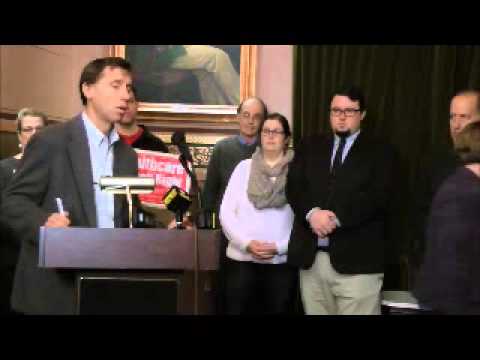
Sterling and others held a press conference to counter the narrative that the election amounted to a vote of no confidence on health care reform.
On the contrary, Sterling and others said, the public demand for a universal, taxpayer financed health care program in Vermont has not waned. Sterling emphasized that most Democrats and Progressives in competitive races prevailed. Rep. Mike Fisher, D-Lincoln, chair of the House Health Care Committee, and a key proponent of single payer, however, was voted out of office on Election Day.

Representatives from labor, consumer and health care advocacy groups gathered at the Statehouse in Montpelier on Tuesday to call on elected leaders to press forward with Green Mountain Care, as the so-called single payer program is known.
“Get the insurance companies out of our exam rooms and get our hard-earned money out of administrative waste and exorbitant CEO compensation,” said Mari Cordes, a nurse and member of the American Federation of Teachers, which represents many health care workers in the state.
“A universal, publicly funded health care system is the only way to do that,” she added.
The election is an “enormous wake-up call” for the governor and legislative leaders to take action and “move forward in bold ways to address the health care crisis,” said James Haslam, director of the Workers Center, which coordinates the Health Care as a Human Right campaign for the advocacy group.
Elected officials have a clear, moral choice, Haslam said — they can either continue to support a market-based system to drive insurance company profits, or they can lead the country by transitioning to a universal system that is “adequately and equitably financed through taxes.”
Martha Allen, president of Vermont’s chapter of the National Education Association, said it’s time for leaders to begin the conversation about what health benefits Green Mountain Care will cover.
The state should model the Green Mountain Care benefit on the state employee health plan, according to Leslie Matthews of the Vermont State Employees Association.
“We believe that every Vermonter deserves the same level of care that we receive,” Matthews said. The state employee health plan “can and should serve as a baseline for Green Mountain Care,” she added.
The state employee health plan offers a more generous benefit than many other states, according to a recent Pew study.
Pressure to set the Green Mountain Care benefit at a high level could meet resistance from fiscally conservative Democrats who will likely question taxpayers’ ability to pay for more generous benefits. Many Republicans oppose the concept of single payer altogether.
Members of the American Federation of Teachers and the National Education Association stand to lose generous health benefits — or pay more for them — when an Affordable Care Act tax on high-value health plans takes effect in 2018.
Both unions fund health reform advocacy groups that helped sponsor Tuesday’s news conference.
Matthews said any universal health care program should be transparent and accountable, and for that to happen it should be administered by the VSEA.
Shumlin has said the program is likely to be administered by a third party, and many people close to the reform effort believe that Blue Cross Blue Shield of Vermont, the state’s largest health insurer, is a likely candidate to fulfill that role.
Concerns raised about the involvement of MIT economist Jonathan Gruber in developing Shumlin’s financing plan won’t prevent it from being debated on its merits, Sterling said. Gruber has come under fire for disparaging remarks he made about the intelligence of the American public.
Sterling also dismissed the idea that the governor’s process of developing a financing plan has not been transparent, acknowledging that Shumlin may be late delivering it, but that once it’s released, he expects a robust public debate.
The governor delayed a self-imposed deadline for his financing plan last legislative session and is now expected to release the plan in January. Since the election, Shumlin has promised an inclusive and transparent process for vetting it.
Progress for Sterling and other reform proponents would mean the Legislature passing a financing plan this year. Despite other priorities for lawmakers, such as education reform, the group appeared optimistic the state could position itself to move forward with Green Mountain Care in 2017.
Haslam said the proposal will impact every Vermonter, and the public should demand a role in its development.
“This is something that’s only going to happen if thousands of people come out and push for it,” he said.
The proposal won’t get a rubber stamp from advocates, Haslam said; they are eager to see if the governor’s plan is worth defending.
Editor’s note: This story was updated at 6:52 a.m. and 9:06 a.m. with information about Rep. Mike Fisher losing his seat in the House on Election Day.

