

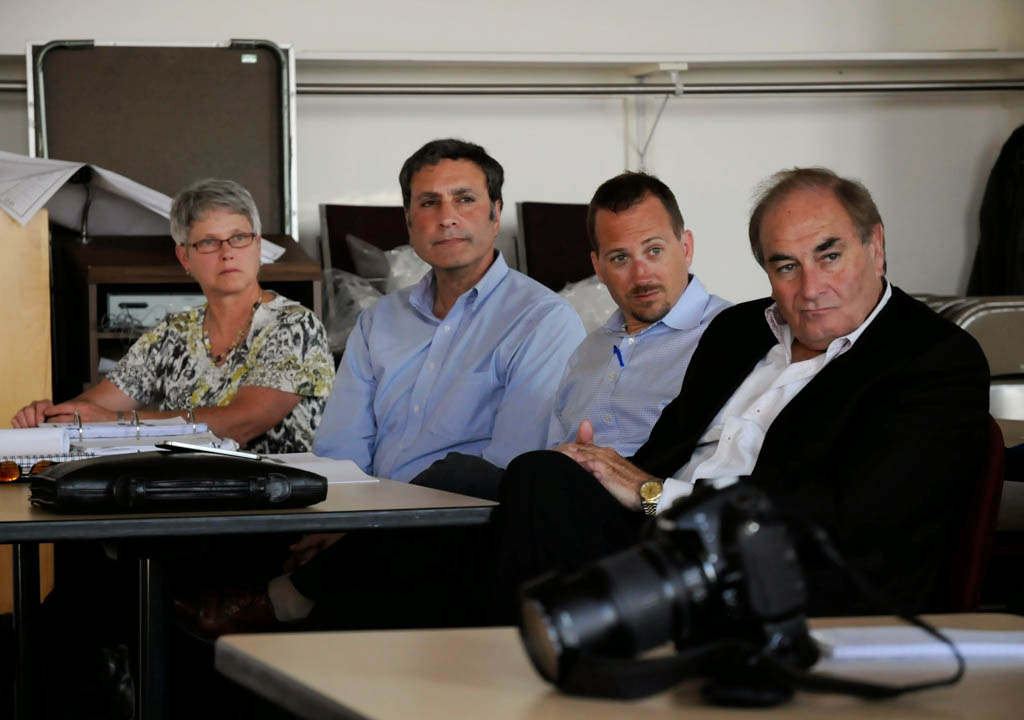
NEWPORT — The proposed AnC Bio biomedical research park in Newport was under an environmental spotlight Monday evening. Health and safety concerns and traffic burdens dominated discussion at a two-hour public hearing convened by the District 7 Environmental Commission.
Five Newport residents were given party status to the Act 250 deliberations — meaning they are granted the right to appeal the commission’s decision of whether to issue an environmental permit for the four-story, 84,000-square-foot facility. Official state and municipal interests, such as the city of Newport and the Northeastern Vermont Development Association, are granted party status automatically.
Jay Peak developers Bill Stenger and Ariel Quiros say the project will create about 400 jobs at the now-vacant industrial site. They plan to establish a medical device manufacturing subsidiary of a Korean biotech firm in which Quiros is already involved. The facility also will include “clean rooms” for academic and commercial research.
The project is one spoke in a multi-stage development plan funded by immigrant investors through the federal employment-based visa program known as EB-5. Jay Peak Resort has used EB-5 capital for a massive expansion since 2007, including construction of the Tram Haus Lodge, the Pump House Indoor Water Park and the Stateside Hotel and Baselodge, among other accommodations and amenities.
Aside from the residents who are now officially engaged in the proceedings — four with concerns, one in support of the proposal — attendance at the public hearing primarily consisted of city officials, press and people involved with the project.
Stenger, Jay Peak’s president, attended the hearing via impromptu teleconference. The project’s chief spokesman for the night, Bill Kelly, put his cellphone on speaker settings at a table in the front of the room, with Stenger on the other end. Stenger did not testify, and the connection lasted less than 30 minutes.
Kelly summed up the proposed campus as a medical device manufacturing facility, with rooms to be leased by academic or commercial third parties for their own research or contract manufacturing.
ANC Bio would manufacture medical equipment, including an artificial heart-lung pump machine and a portable dialysis unit. Kelly said the company could make artificial organs as well.
Newport residents are most concerned about the academic and research space. Anne Chiarello is worried about third parties that might lease the facility. If a leasing entity were to surreptitiously develop an infectious virus, what’s to stop them, Chiarello wanted to know.
“What are the controls by this company (AnC Bio) on what can happen in the clean room and what cannot happen in the clean room? And how is it policed?” Chiarello asked.
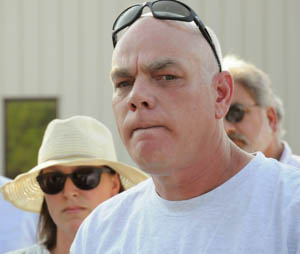
Eugene Reid, who chairs the District 7 Commission of the state’s Natural Resources Board, replied: “That’s an excellent question.” Reid said he would consider the issue under the air pollution criterion.
The facility would be operated by an accredited biotech management company to ensure compliance with all local, state and federal regulations, Kelly said.
“I hate to bad mouth the FDA,” Chiarello said, “but you’d be lucky if the FDA came out once a year.”
She cited a July 19 New York Times article condemning weak oversight and enforcement of labs that work with dangerous microbes like anthrax, flu and smallpox.
“I can tell you that the air cleanliness coming in and going out is the highest concern of the company,” Kelly said.
He said federal inspections for construction and the facility’s operations are rigorous, and the company has its own vested interest in ensuring contaminant-free operations — for public safety, product quality and the health of employees and contractors.
The on-site control room would be staffed 24 hours a day, Kelly said. It would monitor temperature and humidity, plus airflow and any leakage in the pressurized clean rooms. An alarm would sound to notify the control room staff of any irregularities.
In the event of an emergency, Reid said, he was concerned about first responders’ ability to reach the site due to traffic congestion. The former manufacturing operation on the site has not operated for years, but traffic in downtown Newport remains problematic, he said.
Project organizers said the site’s pre-existing Act 250 permit covers traffic from about 200 employees coming and going for work shifts, plus truck traffic from AnC Bio’s operations.
“From a statistical perspective, we are a net-zero increase in traffic compared to what was there,” Kelly said.
Reid said he didn’t accept at face value their contention that allowance for the traffic flow would be grandfathered from the prior permit.

But Mayor Paul Monette said any traffic problems would have nothing to do with AnC Bio. He said downtown traffic had been a bottleneck for years, due largely to the city’s orientation on a narrow peninsula in Lake Memphremagog.
“The only impact I see is the impact of putting people to work,” Monette said. “I really don’t see traffic as a snafu. I really don’t.”
Debra Bell, of Trudell Consulting Engineers, which is working on the AnC project, said developing the site would resolve unaddressed stormwater issues that have lingered for years, since Bogner, a ski clothing company, left town.
Trudell said the new design would reduce runoff from the roof and parking lot between 60 and 90 percent.
Aesthetic considerations were also discussed. Reid questioned how the building would appear, both night and day, from the lake and other major viewing spots in town.
Fred Grossfeld, director of architecture with the North Carolina-based firm NNE Pharmaplan, said the building’s exterior glass, which would make up about 31 percent of the surface, would have a blue tint with reflective qualities to minimize the profile of the facility while maximizing the building’s thermal efficiency.
Although it looks very similar to AnC Bio’s original facility in South Korea, the building design was customized for Newport’s climate and surroundings, Grossfeld said.
The commission’s timing for deliberations is complicated by the Act 250 requirement that permits from other jurisdictional bodies overseeing several aspects of the project’s construction be submitted prior to the commission’s decision. The whole process could take a year or more.

