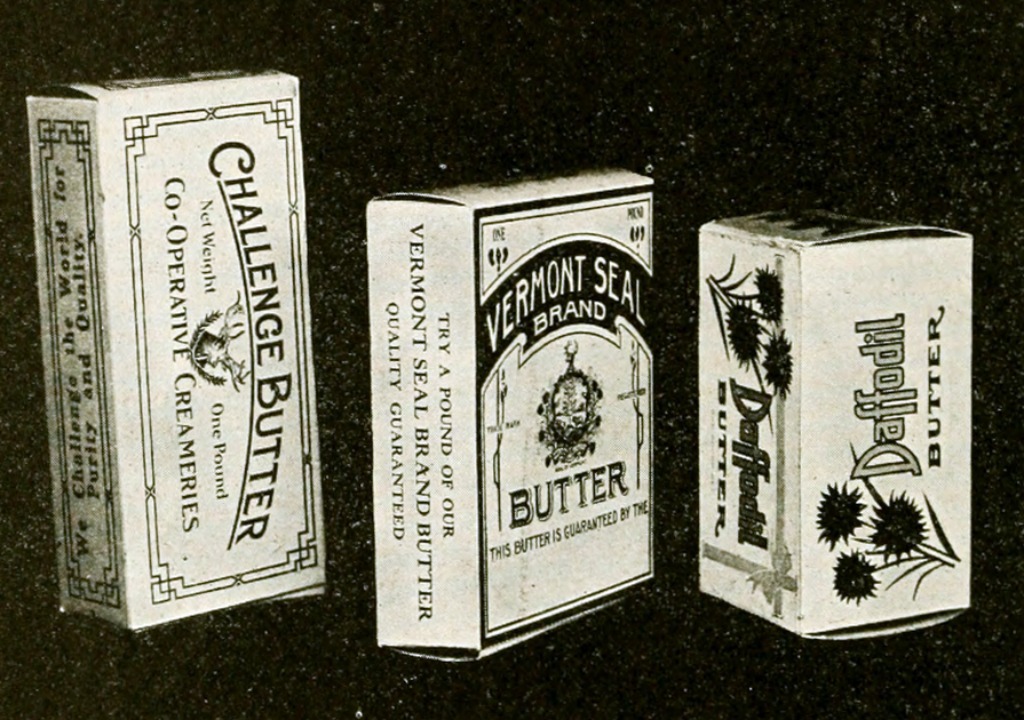
Editor’s note: This article is by Gregory Sanford, who was the Vermont’s state archivist for 30 years, retiring in 2012.
Vermonters have traditionally sought government assurance about the food they purchase and consume. They turn to government to prevent or punish fraud, to protect the public health from potential harm, and to advantage Vermont agricultural products.
As E.H. Jenkins told the 1903 Vermont Dairymen’s Association convention, “The subject of this talk is no new one. Fraud in food is as old as Adam. The Serpent introduced the business into the Garden of Eden. By a gross deception regarding the nature of the fruit which he offered, he cheated the agricultural community into which he came and ‘brought death into our world’ …”
Jenkins argued that consumers have a right to know, expressed through labeling, about what was in the food they ate. He articulated two concerns. The first was adulterating food to fraudulently pad profit margins. The other was the use of preservatives and other additives to extend the shelf-life of foods. Underlying both concerns were questions about the consequences to the health of the consumer.
Vermonters’ concern about fraud dates back, if not to the Garden of Eden, to at least a 1787 law regulating weights and measures. The state treasurer was to maintain a set of scales and other measures to standardize the sale of locally produced goods. Pecks, bushels, ale quarts, wine gallons, gills, etc., had to conform to these standards. Municipalities elected officers charged with applying these standards. Weighers of coal, sealers of leather, inspectors of hops, and other municipal officials provided quality control assurances. By 1797 the quality of the food also came under government regulation through laws such as “An Act for the inspection of meat, pork, flour, and kiln dried meal.”
As Vermont’s dairy and maple industries emerged as significant cash crops after the Civil War they turned to state government for protection. Butter and cheese quality were protected by an 1865 law establishing fines for anyone selling adulterated milk to a creamery. Act 108 of 1888 and subsequent laws further regulated milk quality.
By at least 1884 the Vermont maple sugar and honey producers received similar protection through laws against the adulteration of “maple sugar, maple syrup, and bees’ honey.” A push was made to regulate the increasing use of corn syrup and glucose as adulterants. The maple sugar producers wanted the state to assure the purity of their products by outlawing the use of any substitutes.
After 1873 the dairymen faced a new threat — the use of oleomargarine as a substitute for butter. An 1889 law required that margarine be labeled as such in letters at least one half inch in size. An 1886 law required restaurants offering margarine to post, in letters at least three inches high, a notice that “oleomargarine used here.” By 1890 margarine had to be colored pink.
A similar New Hampshire law was struck down by the U.S. Supreme Court in 1898 as a violation of the Commerce Clause. Congress, urged on by the dairy state delegations including Vermont’s, responded in 1902 by enacting a law leaving the regulation of oleomargarine to the states.
The maple sugar producers also turned to Congress for protections from adulterated products. Annually the Vermont Maple Sugar Producers Association passed resolutions calling on Vermont’s delegates to support a federal pure food act. The pure food act passed in 1906 and Vermont maple products began to carry labels asserting compliance with the act.
Vermonters initially focused on protecting the purity, and economic success, of their agricultural products. E.H. Jenkins’s 1903 address to the Vermont Dairymen Association brought public health concerns to the mix. For 10 years Jenkins had tested a wide range of agricultural products in Connecticut. He told the dairymen of his findings on milk, meat, seafood, cereal, pepper, sugar, tea and coffee, etc. Pepper, for example, often contained, as “make-weights,” starch, wheat, buckwheat balls, coconut shells, charred vegetable matter, sawdust and chaff.
“These modern drugs make no sign. An oyster pickled in vinegar can never pass for a fresh oyster just out his shell. But an oyster pickled with borax may be a week out of his shell, dead for some days and saved from spoiling only by the embalmer’s art, and yet pose before the public as if he was quite in the bloom and freshness of youth.”
E.H. Jenkins, 1903
Jenkins found that maple syrup, honey, and sugar were often adulterated with glucose (corn) syrup. While he did not believe this to be a health threat, Jenkins felt glucose was added to “deceive the purchaser.”
Jenkins was particularly concerned by the use of preservatives to extend the shelf life of food. “[B]orax, formaldehyde, boric, salicylic and benzoic acid” were typical preservatives.
Part of the concern remained fraud. “These modern drugs make no sign. An oyster pickled in vinegar can never pass for a fresh oyster just out his shell. But an oyster pickled with borax may be a week out of his shell, dead for some days and saved from spoiling only by the embalmer’s art, and yet pose before the public as if he was quite in the bloom and freshness of youth.”
Of particular interest to the dairymen was Jenkins’ work with milk. A small but significant percentage of milk tested by his Connecticut lab was adulterated with borax or formaldehyde.
These practices raised public health issues with Jenkins: “Whether or not these preservatives, which have come into extensive use of late years, are proved to be harmless when administered in moderate amount to healthy adults, it is necessary in the interests of public health that the purchaser be informed in all cases of their presence in the food products which he consumes, as he is informed when salt, vinegar, or wood-smoke are used.”
Jenkins cited a Jan. 2, 1897, article in Lancet, the British medical journal, that asserted whether or not preservatives were known health risks, “vendors of food products containing them nevertheless be required by law to state, on labels or otherwise, the name of the preservative and also the quantity used.” To this Jenkins added, “Let these chemical additives be used so long as it cannot be clearly shown they are decidedly injurious to health, but insist that when they are used, the seller in every case be informed of their presence.” Jenkins cited Vermont’s oleomargarine laws as an example of appropriate labeling.
Jenkins felt that it was easy to bring perishable goods to the consumer without preservatives as long as sufficient care and cleanliness was used in their production. The use of preservatives simply shielded the producer from the consequences of poor management in food production. To Jenkins the use of preservatives without labeling was “immoral.”
Over the years many of the preservatives Jenkins cited, such as borax and formaldehyde, became associated with health risks and prohibited from use in foods.
Science and technology have blurred definitions of what is an additive or preservative. Agribusinesses emerged that have the resources to vigorously defend their products, as Vermont discovered when trying to label bovine growth hormones.
The purity of “Vermont” products has become more difficult and expensive to regulate. In 2010 the state had to drop its Vermont Seal of Quality program for lack of resources. There are now a host of economic interests, legal protections, regulations, etc., that complicate questions about food safety. Yet the original question from 1903 remains: Do consumers have a right to know what is in the food they eat?