


Editor’s note: This article is by Nancy Price Graff, a Montpelier freelance writer. In This State is a syndicated weekly column about Vermont’s innovators, people, ideas and places.
The National and State Registers of Historic Places list more than 40,000 buildings in Vermont of historical significance. This is more in proportion to the total number of buildings in the state than in any other state. They are so common that it’s hard to travel anywhere in Vermont and not pass at least one important historical structure.
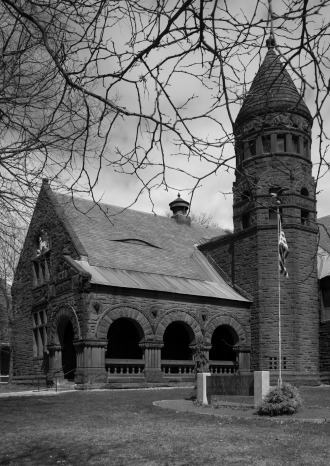

But, according to Glenn Andres, professor of the history of art and architecture at Middlebury College, Vermonters are largely uneducated about their architectural heritage. They know of the Statehouse, built between 1857 and 1859, but not of the spectacular Federal-style B. F. Langdon House, built in 1823 in Castleton by Thomas R. Dake.
They have heard of the circa 1783 Hyde log cabin in Grand Isle, a rare representative of the type of house built by isolated early settlers in Vermont, but not of Stowe’s ski lodge the Hob Nob, built in 1938 and featured as a national model for ski lodge design in the early years of the skiing industry.
Tourists suffer from an even more crippling myopia when it comes to the state’s built environment. The image of Vermont as a place of red barns and church spires, general stores and white capes has been a hard nut to crack since the late 1880s, when Americans, buffeted by urbanization and industrialization, thought the state represented some kind of Eden that was vanishing elsewhere.
In fact, for well more than a century, Vermont has done everything it could to promote that pastoral image. Even today, the state’s economy and image are inextricably bound. Vermont Life’s 2013 calendar features 11 farm scenes.
“Vermont’s self image is very important. It’s our economic engine,” says Andres, who is the co-author of a new book, “Buildings of Vermont.” To prove the worth of that image, Andres points to National Geographic, which “ranks Granada, Kyoto, and Vermont in a tie as the sixth-most compelling tourist sites in the world. The National Trust for Historic Preservation has chosen Vermont twice, in its entirety, as a “national treasure.”
Why, then, is Andres pained by the cover his editors chose to grace this tome, one of the most important books on Vermont culture and history to be published in the last quarter century? Because it features the top half of a red barn, a rolling meadow and a mountain. Vermont, he insists, deserves better.
“Vermont is more than its stereotypes,” he says. He and co-author and photographer Curtis Johnson of Calais lobbied to use Johnson’s photograph of the Windham County Courthouse on the cover. The courthouse, built over the course of 80 years, is a spectacular example of Greek Revival civic architecture in a community setting.
That focus on community, according to Andres, is as characteristic of Vermont as its stereotyped images.
It is a focus that has both served the state well in preserving its town centers and downtowns and thwarted a better understanding of Vermont’s architectural heritage.
“Vermont’s history is told by its communities,” Andres says. “Each town has its own historical society writing its own story, but if you step back and take a larger view, you can see patterns. The patterns tell the state’s story.”
To make his point, he cites the Salisbury Congregational Church, Old Chapel at Middlebury College, the Follett and Wheeler houses in Burlington, the Statehouse in Montpelier, and Alexander Twilight’s massive Old Stone House in Brownington. In the past, they have been considered individually as gems, widely scattered, but Andres’ statewide research suggests the influence of the same early Vermont architect, Ammi B. Young. This, in turn, suggests how ideas and culture flowed through a state hampered by poor roads.
“Buildings of Vermont” is the 18th in a series of state guides to the nation’s built environment. The series was inspired by English architectural historian Nikolaus Pevsner, who completed a similar survey of English buildings between 1951 and 1974. Pevsner challenged the Society of Architectural Historians to produce a similar series in the United States.
Andres’ and Johnson’s book was 20 years in the making. It draws extensively on the survey work of architectural historians who worked on both the State and National Registers of Historic Places, but the new narratives — half written by Andres, half by Johnson — bring new research and perspective to the approximately 650 entries.
An accompanying exhibition called “Observing Vermont Architecture” will run through March 23 at the Middlebury College Museum of Art. It represents an even more ruthless culling of the astonishing list of Vermont’s architectural treasures, highlighting just 20 images framed on the wall and another 50 featured in a slideshow.
“It was a great honor to take all the photographs and bring consistency to the project,” says Johnson, who began working on the book almost two decades ago by using film. As the project stretched over the years, however, camera technology went digital. To bring consistency to the project, he returned and re-photographed the early images on his new Nikon D800.
Fortunately, it was a labor of love, and that shows. Johnson’s style was to shoot in black and white, closely crop each image for the book, capture most structures from the front, avoid as much clutter as possible from neighboring buildings and landscaping, and use sun and shadow to draw out each structure’s detail.

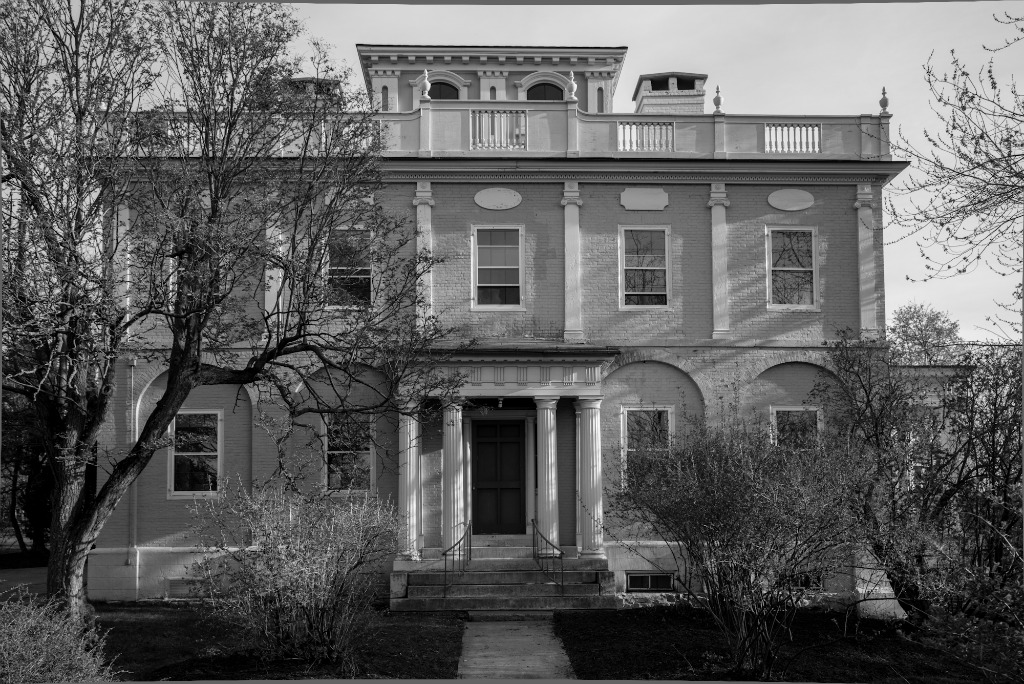
As a result, the images portray these buildings with a surgical precision that reinforces the book’s usefulness as a reference guide. In the photographs for the exhibition and slideshow, however, Johnson enjoyed greater freedom.
“The beauty of the exhibit is that I could do creative, dramatic processing,” he says. To capture these images, Johnson spent much of 2013 once again traveling the state. By the time he finished taking tens of thousands of photographs for the book, exhibition, and slideshow, he had acquired enough experience to pursue full time the life of a freelance photographer.
The value of the book, on the other hand, is to create a visual and narrative record, says Johnson. “These buildings may be 100 years old, but we still need to talk about them.”
According to Andres, Vermont is blessed with such a rich architectural heritage in great part because of its historic “slow economy.” The old adage ‘to use it up, wear it out, make it do, or do without’ has served the state’s built environment well over the years.
Today, though, argues Johnson, issues regarding the state’s natural environment often eclipse issues regarding its historic structures. He and Andres hope the exhibition and the book will inspire greater stewardship.
“It’s so important that people know what they have so they can be informed before they make decisions,” says Andres. “People need to know what they’ve got, get proud of it, and start looking.”
