

Legislators are not just staring down a $70 million General Fund shortage in 2014. Pressures on education funding and retirement health care benefits for teachers will need to be balanced against the cost of tax incentives and economic development initiatives as Vermont continues to pull itself out of the Great Recession.
An uptick in economic activity and job creation is generally regarded as the solution. But economic growth has been slow — in particular for already challenged low- and middle-income populations, as a recent report from the Public Assets Institute underscores. The think-tank’s study found that despite Vermont’s low unemployment rate, highly educated workforce and relatively high median household incomes, wealth is more concentrated now than before the recession.
A number of options for restructuring education finance and pension funding await legislative debate when lawmakers return to the Statehouse on Tuesday.
Competing proposals for encouraging broad-based economic activity promise to generate lively discussions.
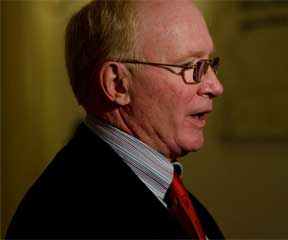
Sen. Kevin Mullin, R-Rutland, and chair of the Senate Committee on Economic Development, Housing and General Affairs, summed up much of the tension that will play out this session. In a comment about a proposal by Sen. Anthony Pollina to use cash reserves to fund local loans through the Vermont Economic Development Authority, Mullin said, “I agree with where he wants to go, but not always on the best way to get there.”
Education finance
Tax Commissioner Mary Peterson has recommended a 7-cent increase in property tax rates in 2015. The suggested bump follows a 5-cent increase in 2014, and has fueled some fear that, while education is essential for economic development, school spending is funded at the expense of economic growth.
In her recommendation, Peterson urged schools to curb costs. She also suggested that the state’s education finance structure is antiquated. Soon, the statewide average homestead rate will surpass the nonresidential rate, triggering a re-evaluation of the funding system.
That eclipse prompted Peterson to review the financing structure. Shumlin joined her call for serious discussion of alternative funding structures. The administration plans to hold a symposium on Jan. 14 at St. Michael’s College to jump-start the debate.
Rising rates raise hackles with some property taxpayers, but many lawmakers deflect criticism by pointing out that local voters continue to approve school budgets that drive the upsurge in Vermont education costs at a time when student enrollments continue to decline.
Property tax exemptions and Current Use
While the state struggles to keep its education and other major funds in the black, Vermonters and some lawmakers are eyeing property tax exemptions that divert cash from state coffers.
The Current Use program, for example, is a tax exemption that was established in 1978 to encourage conservation of property kept in “current use” as part of Vermont’s working landscape of farms and forests. Enrollment in the program spiked to more than 17,000 parcels, or 2.3 million acres, as of December 2012. The “price tag” was about $54.6 million.
Whether the cost of Current Use is considered to be a savings for property owners or lost revenue for education depends on who you ask.
Some property owners who rely on the program to keep taxes on their working land affordable are wary of any changes. But other observers feel the tax break is abused by developers who “park” undeveloped land in Current Use until they’re ready to cash in. The penalties for withdrawing land from the program should be higher, they argue. Rep. Alison Clarkson, D-Woodstock, has sponsored H.329 a bill that would increase the fines. A Senate study committee will review public input from a series of related hearings, held in fall 2013.
Clarkson also sat on a special committee that studied the possibility of rolling back other property tax exemptions for nonprofit, charitable and pious organizations. They’ve drafted legislation that would tighten the net on such exemptions; committee members expect to recommend more significant changes next year, when the value of exempt properties must be included on the statewide Grand List. For the time being, committee members say, there’s simply not enough data to be sure of the impact proposed changes would have.
Pensions and retirement health care benefits
State Treasurer Beth Pearce spent time in 2013 prepping lawmakers for action this year on health care benefits for retired teachers. Over time, ever-larger payments for retirees’ medical expenses have eroded the corpus of the teachers’ retirement fund. Prior reforms to teachers’ pensions have helped to stabilize the fund, Pearce says, but the current pay-as-you-go method of supporting health care for retired teachers is unsustainable.
The state is falling about $20 million short each year, she estimates, based on the current cost of health care and demand for services. The bills have added up to about $25 million per year lately, Pearce said. But the state is only making a sort of “downpayment” of nearly $5 million and taking out a mortgage on the rest.
“By spreading it out, that $20 million will cost the taxpayers $58 million,” Pearce said.
While state workers pensions are funded at 80 percent, the teachers’ retirement system is funded at 60 percent, well below actuarial recommendations.
She convened an ad-hoc work group in fall 2013 to examine the problem and recommend options for the Legislature’s consideration in 2014. No firm recommendations are forthcoming as of the first week of January, but Pearce expects formal discussions with the Legislature to start soon.
While Pearce is tight-lipped about what the group might recommend, one item won’t be on their list: pension obligation bonds. That mechanism essentially would borrow money to pay down the health care fund’s unfunded liability, betting that any interest the bonds earn will outshine the cost of borrowing.
“That’s an arbitrage bet,” Pearce said. “We do not recommend that approach.”
Pearce also advised against looking to pension benefits restructuring as a solution: Even if it would save money down the road, she said, the new arrangement wouldn’t pay off for at least 15 years, which doesn’t alleviate the urgent situation at hand.
In the consumer protection realm, Sen. Mullin has proposed restricting so-called pension lending companies with S.223. The industry persuades retired state employees to sign over pensions at exorbitant interest rates in exchange for quick cash loans — a practice he described as predatory.
Mullin’s bill has the support of Pearce and the AARP Vermont.
Telecommunications
The Vermont Telecommunications Authority reported in December that 2014 will be a “pivot” year for broadband and mobile service.
The entity’s fate will be debated, as it was set up largely to secure “last-mile” broadband coverage and expanded mobile telecommunications services for rural areas. With the statutory goal nearing completion, legislators will revisit the agency’s mission to determine if it should be updated.
Telecommunications director Jim Porter has said he will issue a comprehensive update to the state’s telecommunications plan — the first full update since 2004, although it’s statutorily required every three years.
A separate telecommunications bill is expected, as well. Porter said the centerpiece likely will be reconfiguration of the Universal Service Fund. The fee attached to phone bills was designed to ensure equitable access and pricing for telephone service to rural areas. In 2011, the FCC allowed the fee to be redirected toward similar goals for broadband. Porter wants to take a closer look at Vermont’s USF “to see if it’s time to activate that for our companies here,” he said.
Finally, an important clause in the state’s telecommunications law will expire in 2014: Section 248a, which allows telecommunications projects to apply for a certificate of public good from the Public Service Board, will sunset July 1.
Business and economic development
A Comprehensive Statewide Economic Development Strategy is slated for completion by June. Lawrence Miller, secretary of the Agency of Commerce and Community Development, said he will update lawmakers on the state’s plan, which will incorporate existing regional plans and address disaster resiliency. The Comprehensive Statewide Economic Development Strategy is funded through a grant from the U.S. Economic Development Agency.
House Commerce Chair Bill Botzow, D-Bennington, said he’d like to see more of a regional approach to development rather than incentives in silos directed toward specific entities.
The Vermont Yankee Nuclear Power Plant, which will be winding down operations in Vernon over the course of next year, will be a central focus of economic development policy this session. The facility is a major economic driver in southern Vermont. In a recent agreement between Entergy Corporation and the state, the company agreed to pay the state $2 million a year for five years to boost economic development in Windham County. The facility contributes more than $10 million a year to the local economy. At an editorial board meeting with VTDigger in December, Shumlin said the decommissioning of the plant over the next 10 to 15 years will defray the economic impact of the plant’s shutdown in the short term.
Some changes might be in the works for the state’s growth center designations. Miller said the goal is to make it easy to develop in places where infrastructure already exists, in order to preserve farm and forestland on the outskirts of towns.
The Department of Tourism has been selected for the Legislature’s pilot Results-Based Accountability process, meaning that legislators will be looking for evidence of a return on taxpayer investment in tourism. Botzow said he’s hopeful his committee can be part of determining what the Results-Based Accountability metrics for tourism will be.
At the Department of Financial Regulation, captive insurance regulators are crafting a proposal to establish a “dormant” captive insurance license. Vermont is an international leader in the captive insurance market, which allows high-risk companies to create insurance entities to cover their own risks.
In the face of increasing competition from other states that have caught on to the captive insurance program, regulators have come up with the concept of dormancy for companies that might want to put their captives on hold temporarily. If they can maintain seamless licensure in Vermont, the dormancy would give the state an edge in retaining the company’s captive registration.
Unconventional capital and investments
Vermont conjured a new way to encourage clean energy investments in May 2013. Act 87 authorized the state treasurer’s office to establish a short-term credit mechanism to loan up to $10 million to VEDA to finance commercial sustainable energy projects. Now Pearce and VEDA are suggesting an expansion of that program, to allow both parties more leeway in negotiating the lending terms.
Sen. Pollina, P/D/W-Washington, has proposed a related initiative called “10 percent for Vermont.” It would move one-tenth of the state’s cash reserves, or roughly $35 million, from commercial banks to VEDA for investment in local economic development initiatives such as renewable energy, affordable housing and agriculture.
Pearce said she supports the general concept, but that “the devil’s in the details.”
Miller is pondering the impact of new federal regulations for online equity-raising mechanisms and crowd-funding platforms such as Kickstarter. He said the agency is not issuing any specific recommendations at this time, but he’s encouraging lawmakers to schedule testimony on the topic, with an eye toward any laws or regulations might help start-ups take full advantage of the unconventional equity while still protecting Vermont investors.
Meanwhile, the federal Immigrant Investor program is on the radar for potential expansion to broaden its applicability to small business ventures. The state’s EB-5 regional center, named for the employment-based visa it affords foreign investors and their families, is the nexus for immigrant-funded business capital in Vermont.
Most projects that successfully raise capital through the program, however, are looking for about $10 million or more, due to the intensive costs of participation. Botzow is looking into the feasibility of restructuring the program in some way to make it more affordable for start-ups and ventures that just need $1 million or so to reach their next stages of growth.
