

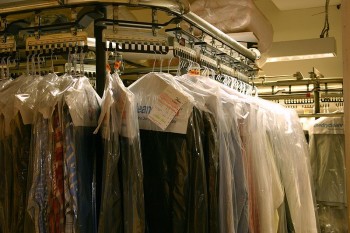
The state is paying to clean up the former Fillipo Dry Cleaners site in Rutland, and it’s no small budget item: $1.2 million.
The remediation must be undertaken within the next 12 months in order to stop migration of a plume of tetracholoroethylene, a dry-cleaning solvent and known human carcinogen, toward a residential neighborhood near 84 Woodstock Ave., where the dry-cleaning business was located.
Remediation of the site is an “environmental emergency,” state officials say. The plume of tetracholoroethylene, or PCE, has already spread to an adjacent lot, and state officials are testing to see if it has moved underground from Woodstock Avenue to adjacent Route 4. The migration of the toxic chemical complicates the cleanup, which involves building an impermeable barrier and removing contaminated soil and water, state officials say.
The Department of Environmental Conservation recently sought authorization from the Legislature to spend $1.2 million on the cleanup — more than 10 times the statutory cap of $100,000 on such projects. Members of the Joint Fiscal Committee reluctantly agreed in July to foot the bill for the remediation of the site. The money will come out of the Environmental Contingency Fund.
George Desch, head of the Waste Management and Prevention Division of the Department of Environmental Conservation, told lawmakers the cleanup work must be conducted within the next 12 months in order to keep the PCE from migrating through the soil from two adjacent lots on nearby Harrington Avenue to an abutting residential neighborhood.
The concentration of the PCE in groundwater at the Rutland site is 22,000 micrograms per liter, or 4,400 times the accepted drinking water limit of 5 micrograms per liter. In Williamstown, where PCE off-gassed in homes and seeped into groundwater and bedrock in the 1980s and the state engaged in a massive cleanup effort, the concentration of PCE is now 20 times the drinking water standard, according to Gerold Noyes, who monitors the Unifirst dry-cleaning spill for the state. The mitigation efforts in that instance did not prevent spillage from the uniform plant from contaminating wells and off-gassing into residential homes.
Matthew Becker, the brownfields specialist who is directing cleanup of the Rutland site, is concerned about PCE “volatizing” out of groundwater into the indoor air of the residences of the Harrington Street neighborhood, but he says the state will be able to prevent a public health hazard stemming from the toxic contamination of 84 Woodstock Ave.
“It is an environmental emergency, and, yes, if we don’t take this action within the next year’s timeframe we do expect to see potential threats to the residential neighborhood across the street,” Becker said. “This is one of the rare cases where we’re able to take care of something before a problem arises. We usually find out when it’s too late. Usually, after the fact, it’s a lot messier.”
The department will begin mitigation efforts early next year. The first step is to dig a 2-foot wide, 20-foot deep trench. Contaminated soil and water must be removed. Then workers will fill the trench with iron filings. Becker says when the contaminated water passes through the filings it will undergo a chemical reaction that will purify the water.
How the contamination happened
Fillipo Dry Cleaners was in operation from the 1970s to 2001. The building and quarter acre parcel went up for tax sale in 2006 and was purchased by John Ruggiero, who owns a number of properties in Rutland, many of which are held by his company, Second City LLC. Ruggiero hoped to use the commercial property for a retail operation.
Ruggiero tore down the building in 2008 and 2009. The demolition, which was not ordered by ANR, exposed the site to rainwater, which has percolated through the soils, likely hastening the migration of the PCE onto an adjacent parcel owned by JAMAC, Becker said.
“The build was demolished by John in anticipation of redevelopment and that never occurred, so, yes, things have gotten worse,” Becker said.
In 2010, the property was considered for the brownfields program. An engineering report from that year showed the PCE could be cleaned up for $161,000. Engineers found a large “source” area of the chemical under the foundation of the building. Becker hypothesizes that the contamination came from decades of activities by the dry-cleaning operation including PCE spills, intentional dumping of waste down floor drains and dripping clothing that was hung to dry in a particular room.
Ruggiero couldn’t afford the six-figure cleanup costs. The former lawyer, who went to jail for mail fraud in 2006, recently had difficulty paying his taxes on property he owns in the city. In 2011, he owed about $68,000 in delinquent taxes on 20 properties in Rutland including 84 Woodstock Ave.
In 2011, the Agency of Natural Resources issued a “stipulated emergency order,” demanding that Ruggiero clean up the property immediately. When he didn’t take action on the remediation order, the agency fined Ruggiero $25,000 and took him to court. In February 2012, the Environmental Court authorized a $5,000 fine and allowed the state to obtain a lien on the property. The court also determined that “any reasonable costs ANR incurs in carrying out the CAP [corrective action plan] are fully reimbursable” by Ruggiero and his company.
Desch told lawmakers the Environmental Court decision is favorable to the state. “They basically said he was found in contempt,” Desch said. Because Ruggiero has refused to pay for cleanup, the state must go ahead with mitigation, he said, and then refer the case to the Vermont Attorney General’s office, which would sue to recover costs.
Becker said the state could get as much as $600,000 for the property because of its location off a busy stretch of Route 4; Ruggiero estimates it’s worth about $100,000.
Lawmakers, who are concerned that the case could set a precedent for financing other hazardous material cleanup at privately owned sites, want the attorney general to pursue cost recovery if necessary. Though the court gave the state the authority to place a lien on the property, and Ruggiero says he would allow the state to put a lien on the property, an agreement on the matter has not yet been reached, according to Becker.
Ruggiero, who says he hadn’t been notified of the state’s latest plan for cleaning up the site, was “in shock at the price.” The property is not worth $1 million, he says. But then the owner, Ruggiero said, “is not really part of the process.”
The cleanup costs have escalated nine-fold since the 2010 corrective action plan was developed. Becker says the engineers who produced the original study didn’t take into account the cost of “dewatering” the trench, i.e. removing and disposing of toxic water from the site.
A large part of the cost increase is related to dewatering, Becker says. “We’re going to be digging trenches and excavating soils up to 20 feet deep. We need the holes to stay open.”
“We don’t care if he does it for $1 or $1 million, but now that we’re paying for it we’re going to make sure it’s done the right way and that it’s successful,” Becker said.
