


BERLIN — In a research lab next to the E.F. Knapp Airport, two lab workers and Vermont state entomologist Alan Graham are examining mosquitoes to be tested for Eastern equine encephalitis (EEE) and West Nile Virus (WNV).
They are particularly interested in culiseta melanura, the only one of the 45 mosquito species in Vermont that carries the EEE virus.
Two Vermonters died of EEE a year ago, but no samples have tested positive for the virus this year, state officials say.
However, the Department of Health reported late Friday that West Nile virus was detected in mosquitoes collected July 10 from a trap in Leicester. It was the first detection of West Nile this year in Vermont.
“Although West Nile virus tends to be less severe than Eastern equine encephalitis, it can still cause significant illness,” said Erica Berl, an epidemiologist for the Health Department.
Three people became ill with West Nile in Vermont last year. This year, more than 110 batches, with roughly 20 bugs in each, have been tested for both viruses, according to the Department of Health.
Because of last season’s EEE fatalities, more state funding was added for mosquito sampling and testing. With a new vector management coordinator starting next week, the Berlin lab, called the “Barre lab” by the staff, has four people working over the summer. Two are seasonal workers.
The lab analyzes mosquitoes sampled from more than 50 sites in Vermont. The mosquitoes are sorted by species and the culiseta melanura insects are sent to New York state for EEE testing. Several mosquito species, primarily in the culex family, carry West Nile.
“Last year it was only me (sorting),” said Graham, who was appointed state entomologist in February 2013.
“Personally, my goal is to get through as many mosquitoes as possible,” he said. “It’s a very time-consuming thing.”
Prevention
At a town meeting in Brandon this month, more than 100 people showed up to hear Graham and other experts answer questions about EEE and West Nile. The meeting was organized by the state Agency of Agriculture and the Health department.
During the meeting the “Arbovirus Surveillance and Response Plan,” an updated version of the 2012 plan, including information about how to respond to the EEE virus, was introduced. It also included information about West Nile virus, updated from the 2003 version. According to information in the plan, West Nile virus peaked in Vermont in 2003, with a resurgence in 2012.
The plan, together with other information about individual protection, is available at the Health department’s website.
In 2012, two people, one in Brandon and one in Sudbury, died after being infected with the EEE virus. They were the first fatal cases of human infection in Vermont.

The deaths and positive samples of EEE, led the Agency of Agriculture and the health department to conduct aerial pesticide treatments. The pesticide Anvil was used in the spraying, which lasted for a couple of days in September.
No aerial treatment are planned this summer -“Unless it’s a public health emergency,” Graham said.
“By declaring a public health emergency, we acknowledge risk and the need to reduce the number of mosquitoes that demonstrate a risk to human health,” Graham said. “If we need to do it we hopefully have everything in place to do it faster than last year,” Graham said.
Vermont doesn’t have a statewide system for pesticide spraying against mosquitoes – it’s done by local Insect Control Districts, Berl said.
The control districts in Vermont are the Brandon, Leicester, Salisbury and Goshen Insect Control District (BLSG); the Lemon Fair Insect Control District, which includes Bridport and Cornwall; and the Weybridge Insect Control District.
The largest, and the only one that conducts regular spraying from trucks, is the BLSG district around Lake Dunmore.
Several Vermont towns have shown interest in conducting their own spraying. Graham said a number of towns asked if they could conduct public spraying. The state requires that sprayers be experienced and trained personnel and have insurance, Graham said. Municipalities can conduct spraying on town-owned property, and homeowners can spray on their own property.
Dealing with it
In the Brandon area, where a man infected with EEE died last year, people don’t seem too afraid of the viruses — it is rather the amount of mosquitoes that worries.
“They are at the lake, they are everywhere,” said Aaron Kernis, owner and manager of Brandon Motor Lodge, a motel on U.S. 7, between Rutland and Middlebury. Kernis has not been able to walk his dog in the woods for the past few weeks.
“It’s not because of Triple E, it’s because of the mosquitoes – there are swarms of them,” he said.
He and other business owners around Lake Dunmore have experienced more bugs than usual this year.
“We’ve had record rain, so I’m not surprised we’ve had record mosquitoes,” Kernis said.
“There are more mosquitoes this year, but I think it’s bad everywhere,” said Janet Mondlak of the Brandon Chamber of Commerce. She doesn’t think it has affected tourism in the area.
“I’ve met tourists and they say it’s bad here and it’s bad there – but they’re not going to stay in because of that.”
She tells people to wear long sleeves, use insect repellants and avoid going outside at dusk.
“If you take precautions, there are still ways to enjoy the outdoors,” she said.
There’s a reason mosquitoes seem to settle around Lake Dunmore, Graham said.
The wind typically comes from the west, and even if larvae have been killed in one area, mosquitoes might be blown in from another area. The wind can’t blow the pests over the Green Mountains, so a lot of them get deposited at Lake Dunmore, he said.
Back at the lab
Graham’s team has been analyzing mosquito samples for a couple of weeks. The first batches were sampled June 17 and Graham expects to continue every week until the second heavy frost, which is usually in the beginning of October.
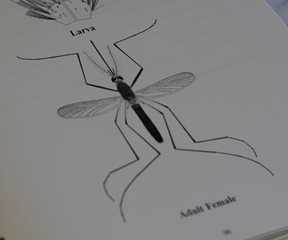
The mosquitoes are collected in different kinds of traps, and are kept in a freezer before they are sent away for testing. Under the microscope, the lab workers use freezing plates to keep the dead mosquitoes cold. If they go through too many heating cycles the viruses will die.
It’s difficult, even for experts, to make predictions about the likelihood of finding EEE this season. The virus was detected in mosquito samples taken July 10 in Voluntown, Conn., according to the BLSG Insect Control Center. But indications that the virus is alive in New England doesn’t mean it will be found in Vermont.
“It’s still early in the season, and I don’t want to make any predictions whether we’re going to see EEE viruses this year or not,” said Berl, the state epidemiologist.
The Health Department has made a risk assessment, which is available as a map on its website. The maps shows a moderate risk stretching from Middelbury down to Brandon.
“We might see something where people got exposed but didn’t get sick, if you have the antibodies it won’t hurt you, and antibodies can stay in the system for up to 10 years,” Graham said.
“The best we can do is to test as many samples as possible,” he said. “But we’re looking for a needle in a haystack.”
