

Editor’s note: Jon Margolis is VTDigger’s political columnist.
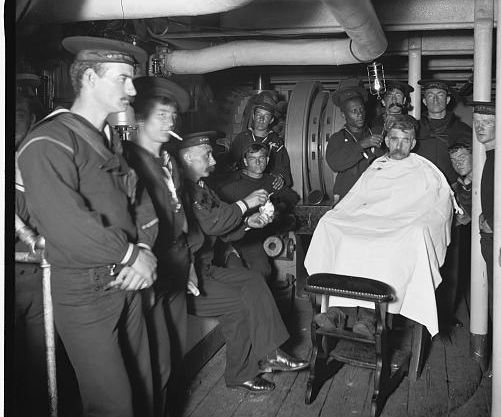
Back in March, Gov. Peter Shumlin appointed Randy Peace of Northfield to the Board of Barbers and Cosmetologists, raising an interesting question.
Not about Randy Peace, whose ability and worth may be stipulated at the outset.
But about the Board of Barbers and Cosmetologists, “a five member Board created by the Legislature whose members are appointed by the Governor to administer the laws for this profession,” according to the website of its parent agency, the Office of Professional Regulation (OPR), which in turn is part of the Secretary of State’s Office.
The question is: Does Vermont need a Board of Barbers and Cosmetologists?
Or to put it another way, do barbers and cosmetologists have to be licensed and regulated by the state?
One need not be an Ayn Randian libertarian to wonder whether, in a market economy, the market couldn’t do a perfectly good job of regulating barbers and beauticians without the accursed government butting in.
The market should quickly put bad barbers out of business. A few butchered haircuts, a few unhappy customers, complaints at the local coffee shop (these days accelerated by tweets and whatever it is that people do on Facebook), and pretty soon that barber has hardly any customers.
Brain surgeons, to be sure, should be licensed and regulated. The consequences of incompetent brain surgery are death or brain damage. The consequences of an incompetent haircut is that the “victim” looks a little odd for two or three weeks.
For this we need the state to get in the way, spending the taxpayers money in the process?
As it turns out, no taxpayers money is spent.
“We do not take one dollar of general fund money,” said Christopher Winters, who heads the Office of Professional Regulation.
Instead, Winters said, his office’s entire budget ($3.9 million in Fiscal Year 2012) is financed by the fees paid by the licensed and regulated businesses. In fact, he said, each regulated profession has its own budget, financed by its own practitioners. Thus the fees paid by barbers and cosmetologists ($120 for two years per barber plus $200 for two years per shop) raised the $314,239 spent on policing their businesses. Similarly the fees paid by nurses, acupuncturists, tattooists, osteopaths, funeral directors, veterinarians and other professions (there are 35 in all) each pay for their own licensing and inspecting.
As it turns out, a bad barber can do more harm than simply make a customer look dumb for a while.
“Barbers use straight edges to shave,” Winters said. An untrained barber can cut a customer’s throat. If he does, and does not have the required sanitary equipment on hand, the customer could die.
So barbers – and beauticians, who often apply chemicals to women’s scalps – can have an impact on “the public health, safety, and welfare,” which Winters said are the only criteria that justify his office’s existence.
Even Realtors?
Well, maybe not, Winters acknowledged, speculating that here the rationale is that buying a house is “the biggest financial transaction most of us will ever make.”
True. An unscrupulous Realtor could do lasting damage to an unsophisticated buyer. No doubt there are unscrupulous Realtors (because there are unscrupulous everythings) with state licensing and inspection. But probably fewer.
For all the sensible arguments in favor of licensing and regulation, though, there is little debate (and none from Chris Winters) that such activity is not entirely consistent with free enterprise.
This is neither a new discussion nor one limited to Vermont. It’s the subject of a recent book, “Licensing Occupations: Ensuring Quality or Restricting Competition?” by Morris Kleiner, a professor at the Hubert H. Humphrey School of Public Affairs at the University of Minnesota. Kleiner points out (as reported by Adam Ozimek of the “Modeled Behavior” website) that states license and regulate businesses as varied as frog farming and fortune telling (the latter Vermont used to do, Winters said).
The two occupations are quite different. Frogs can be raised on farms. Fortunes can not be told. But in both cases, the licensing-regulation policy has two common consequences: it pacifies the public; it limits supply.
Americans – and this includes Vermonters – may say they want government to do less and leave them alone. But they also want it to protect them from incompetent and unscrupulous practitioners, and often from their own weaknesses, such as a propensity to believe fortune-tellers.
So the general public benefits. But it also pays. With licensing, prices are higher because supply is lower. If Vermont barbers did not have to be licensed and inspected, more people would set up shop as barbers. Many of them would no doubt be awful. But they’d be cheaper. So would the current barbershops. Unfettered competition will do that. It’s Economics 101. Assuming demand stays the same, more supply means lower prices.
Vermont and other states do not license and regulate professions because government bureaucrats hunger to expand their power. They do it because the public wants it and the professions want it even more. Almost all professions have some kind of society or organization (though Vermont barbers no longer do, said Kara Shangraw, who oversees that board for the OPR). Every one of those organizations is, among other things, a guild. Deny it though they might, one of their purposes is to restrict entry into their fields. The fewer the practitioners, the more they can charge.
That explains why Winters said his office is regularly petitioned to add more professions to the list of those to be licensed. The requests for consideration – the OPR calls it a “sunrise process” — come from practitioners in those professions.
One of them now is from dental therapists, sort of a dental version of physicians assistants, people with more training than a hygienist, less than a dentist. If the OPR recommends their inclusion and the Legislature agrees, they could open practices independent of dentists. They would presumably charge less, thereby giving low-income Vermonters who often forgo dental care because they can’t afford it, a better chance to get their teeth fixed.
Come to think of it, why can’t dental hygienists set up shop independent of dentists? They might charge even less than the therapists. You could go to the hygienist and get your teeth cleaned. She (most are women) would also check you out to see if you had a cavity and refer you to a dentist to have it filled.
They can’t do it because it’s against the law here and in most other states.
Not surprisingly, the Vermont Dental Society opposes licensing the therapists. Nothing against the therapists, says Vaughn Collins of the Vermont Dental Society, but the dentists have what he claims is a better plan for enhancing dental care opportunities for the poor.
Collins said the Society supports legislation (H.328) that would create “a Community Dental Health Coordinator that would be more of a social worker to help educate people and help to fill dental chairs.” The Society also supports an “Action for Dental Health Initiative” of the American Dental Association.
For now, it makes no difference who has the better argument here. Either way, the Dental Society is acting as a guild, just as the medical associations and bar associations do. None of these professions want more competition. All of them want less.
Free enterprise? Well, kind of. Call it constrained or buffered free enterprise. It’s the only kind that works.

