

Editor’s note: This op-ed is by award-winning journalist Telly Halkias. It first appeared in the Portland Daily Sun.
Judging by reader response to last week’s column on T.E. Lawrence, it’s apparent the man known as Lawrence of Arabia is popular worldwide, and deserves a sequel.
One of the most learned and validating replies was from Jacob Rosen, a veteran Israeli diplomat and former ambassador to Jordan. Ambassador Rosen sent along a 2011 article of his on the subject of Lawrence, in which he astutely noted the visceral importance of “Seven Pillars of Wisdom” as it applied to doers – soldiers and diplomats – on the ground:
“Lawrence taught that the first step is to map as soon as possible the tribal composition in one’s theater of operations. One should be acquainted as closely as possible with the intricate and delicate interrelations between the various tribal confederations. It is no less important than being acquainted with the order of battle of the enemy on the other side.”
Spoken like someone who had walked in Lawrence’s sand tracks.
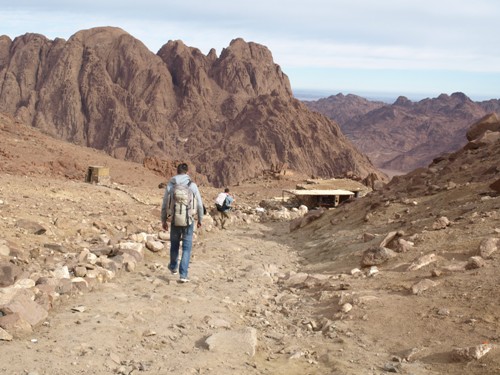
More than two decades ago, as an Army captain during the Gulf War, I was deployed to Sinai, where my unit’s mission was to support the Camp David Accords between Egypt and Israel.
Small successes which led to collective peace were everywhere, given the willingness of both countries to hold the line. Despite Saddam Hussein’s frequent SCUD missile strikes and chemical threats, restraint ruled the border. Credit for this was shared with the native Bedouin tribes, who had also been key players in “Seven Pillars.”
The multinational force employed Bedouins, and their local influence was considerable; many had relatives in different tribes – something I noticed immediately. One of those was Walid (not his actual name, for security reasons) a supervisor who could grind any operation to a halt. His father was a tribal elder.
In 1991, when the monsoons diverted desert wadis from their streambeds, several convoy routes were washed away and our engineers needed help with repairs. As my unit’s operations officer, I went to Walid to find a solution.
It was a mutual audience. Following local custom – Lawrence’s dictum to know your tribes — I brought an offering of coveted American cigarettes.
A generation later, I’m not sure how much I really understood the Bedouins. They were human beings like the rest of us. They wanted to have a connection with foreigners, but were too proud to be open about it on their home turf.
After some chit-chat, local pastries and coffee, I explained the need for action. Walid looked at me through a tobacco haze, glanced at the name on my uniform, and blurted: “Halkias — this is not Smith — what is this?” Sensing an opening, I replied the name was Greek.
Walid found his own foothold: “Ah, so you know our people! I will get the workers you need, but I need something from you in return!”
The bazaar was in full swing. Walid continued: “My father has terrible ulcers. I need this American drug, Zantac. It’s the only thing that works, and no one gets it for me! Two years I try; every American says no! You go, Captain. I know you will get this for me. Your engineers will have their help!”
He picked up a phone to bark commands, vanishing back into nicotine fog.
Beating feet to headquarters, I grabbed a satellite handset and called my girlfriend in the States. Waking her in the middle of the night, she thought I had lost my mind when I told her to get her hands on Zantac, and ship it ASAP.
When the package arrived, I delivered it to Walid myself, and the Bedouins celebrated his father’s intestinal relief. From that day forward, our American battalion could do no wrong with the Bedouins. When they needed to resolve “muddy boots” issues, they often asked for “the Greek captain; he understands us.”
A generation later, I’m not sure how much I really understood the Bedouins. They were human beings like the rest of us. They wanted to have a connection with foreigners, but were too proud to be open about it on their home turf.
When they saw an American with darker skin and black hair who talked with his hands and knew their customs, they jumped on my friendship to fill a need, and help control their destiny. The key was trust, something T.E. Lawrence couldn’t emphasize enough in “Seven Pillars.”
Later that year, when I redeployed to the genteel life of a northern California graduate student, Walid humbled me with a farewell gift — an Egyptian cartouche. For the next few winters, I mailed him Zantac until learning his father had passed away.
Still, Walid assured me the American officer with a Greek name would always be welcome and have safe passage in Sinai. While I fell out of touch with my Bedouin comrade, I still consider this diplomatic episode one of my greatest achievements in uniform.
Two men, an American and an Arab, found common ground and mutual respect. If it worked then, it can work now — one person at a time. In the end, this was T.E. Lawrence’s message to us, and why “Seven Pillars of Wisdom” remains a mandatory Middle East primer, worldwide.
You may email Telly Halkias at tchalkias@aol.com.

