

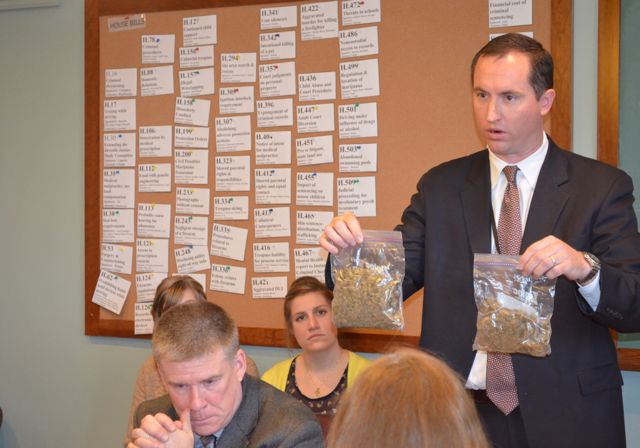
A House panel’s review of a much-anticipated marijuana decriminalization bill began with show and tell.
The House Judiciary Committee examined two Ziploc bags of marijuana on Thursday — one contained a single ounce, the other held two.
H.200 makes it a civil penalty, instead of a criminal offense, to possess “two ounces of marijuana, two mature plants, or seven immature plants.” This means people would no longer face jail time and a criminal record for a first-time offense. The penalties for people under the age of 21 would mirror those for underage possession of alcohol.
Rep. William Lippert, D-Hinesburg, chair of the Judiciary Committee, is confident the bill will pass out of committee, and he expects it to do so quickly — within two weeks. The bill was one of the pieces of legislation that was given an exemption from the crossover deadline, which otherwise would have prevented it from possible passage this year.
The point of the bill, according to the lead sponsor, Rep. Chris Pearson, P-Burlington, is to do away with the disproportionate collateral consequences people face after being arrested for minor marijuana possession.
Every year about 1,100 Vermonters are arrested for marijuana possession, which costs the state about $750,000 in judicial and law enforcement costs, according to a Joint Fiscal Office estimate.
Under current law, a first-time offense for possession of less than two ounces of marijuana is a misdemeanor, and convictions come with six months in prison and/or a $500 fine. Under H.200, the same offense would warrant a civil penalty — the equivalent of a traffic ticket — and a $100 fine.
“This uses up a lot of time and energy for our justice system,” Pearson said, adding that, H. 200 “could free law enforcement up to handle more serious crimes.”
The committee, Lippert said, will hone in on the bill’s finer details rather than debate the concept of decriminalization, which already has the backing of the majority of committee members.
“It’s an ongoing concern for the Judiciary Committee that Vermonters who are convicted of very low-level nonviolent crimes should not suffer inordinately throughout the entirety of their life because they have a criminal conviction on their records,” Lippert said.
One of the central questions the committee will grapple with is, one ounce or two? The bill on the table would decriminalize possession of up to two ounces of marijuana.
Public Safety Commissioner Keith Flynn supports the premise of the bill, but he said he would rather see the limit reduced to one ounce.
“Two ounces may not be consistent with some of our other laws,” Flynn said, “and it’s inconsistent with other states.”
Flynn brought in both bags of marijuana to show the committee that two ounces is a substantial amount. He also cautioned, “not all marijuana is created equally,” noting that marijuana with more potent concentrations of THC is becoming increasingly common.
Among the 15 states that have decriminalized marijuana, the median threshold for possession is one ounce. Ohio is the most lenient state — it allows three and a half ounces.
Pearson told the committee he thought two ounces was an appropriate threshold because current law differentiates between the penalties for possession below and above this amount.
Another point of contention will center upon marijuana plants, and whether or not cultivation should be decriminalized.
“That would be groundbreaking, but I think the logic is compelling,” Pearson told the committee. It doesn’t make sense, Pearson argued, to charge someone with a misdemeanor for possessing a plant when it is still “simply leaves and a stem” and has yet to produce any marijuana. H.200 mirrors the possession limit — for plants and product — for medical marijuana, which is already established in state law.
But Flynn said he has reservations about this part of the bill also. One mature plant, according to Flynn, produces between three quarters and one pound of marijuana. Should H.200 pass, the same criminal penalties for possessing over two ounces would stay in place.
By decriminalizing mature plants, Flynn argued, “we are essentially walking people right into a felony conviction.”
Lippert said he was surprised to see plants included in H.200, and it may mean that the Agriculture Committee will need to weigh in on the matter.
