



Editor’s note: Jon Margolis is VTDigger’s political columnist.
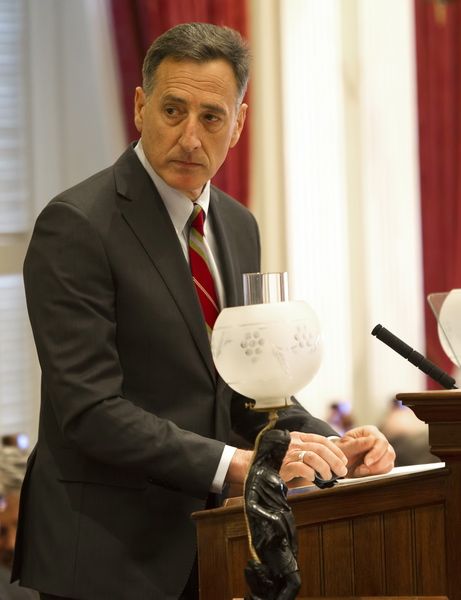
Flanked by business and education leaders, Gov. Peter Shumlin presented a plan Thursday that would allow high school students to take college-level courses at their schools and at both the public and private colleges in the state, with state and local governments paying the tuitions.
Under the governor’s plan, the state would pick up the $800,000-a-year tab for the first two years, and then share it 50-50 with localities, presumably school districts, though that was not spelled out in the initial statement.
This would not be new spending, Shumlin said, but would “take money we’re spending right now” and spend it more wisely. If the Legislature goes along, the governor said, Vermont students would be able to take “up to a year of college credit while in high school.”
Making the announcement at a press conference – with, among others, University of Vermont President Tom Sullivan, Education Secretary Armando Vilaseca, and leaders of the Chamber of Commerce and the Vermont Business Roundtable behind him – Shumlin added more detail to his education-based “Path to Prosperity.”
That path is based on the conclusion – or perhaps assumption – that nothing holds back economic growth in Vermont more than an apparent shortage of workers capable of filling the high-tech jobs of today’s economy.
It’s a questionable assumption. Old-fashioned economic theory suggests that Vermont’s economy might also suffer from insufficient demand, and that when employers have trouble finding enough workers, the remedy is to offer higher pay and better benefits.
Shumlin said even higher wages would do little good for the young worker who “can’t do basic math,” and noted that he keeps hearing from employers who have job openings but can’t find qualified workers to fill them.
Either way, the announcement also allowed the governor to spend as little press conference time as possible on what looms as his major problem of this legislative session: whether the lawmakers will accept his ideas on how to finance his major initiatives.
So far, they don’t seem to be going along with him, although most of them approve those initiatives – greatly expanding pre-kindergarten education, more aid for UVM and the state colleges, and other increases in education spending.
But when it comes to the way Shumlin wants to pay for all this, the silence from the Legislature – including the leadership and the chairs of the relevant committees – has been deafening. He has gotten no endorsements, especially for his plans to divert $17 million of Earned Income Tax Credit funds to early childhood education, and to cut $6 million from the “Reach Up” welfare program for poor women by limiting how long they could continue to draw benefits.
Shumlin declined to assess his chances of getting these proposals approved, noting that it was still early in the session. It is, and these central dispute commonly get resolved at its end, probably in May, in private negotiations among the governor and the top lawmakers, an arena in which this governor rarely loses. Still, it is no longer that early in the session, and the reluctance of those leaders to embrace his spending plans has now become a factor.
Not that anybody else’s plans are meeting with a warmer reception. Just before Shumlin’s press conference, a groups of Progressive and Democratic lawmakers offered an alternative – raise the money for Shumlin’s education proposals by increasing taxes on the wealthy.
Standing in front of a poster showing that, when adjusted for inflation, the income of most Vermonters earning less than the median income fell, while the income of the wealthy rose as much as 156 percent (for the few earning $1 million or more), Rep. Chris Pearson, a Burlington Progressive, said modest increases in the bank franchise tax, the estate tax and income taxes on the wealthiest earners would raise enough money to finance Shumlin’s education initiatives and still maintain the present EITC level and the Reach Up rules.
These same lawmakers have been making similar proposals almost every year, to no avail. Avail seems no more likely this year. The state’s two major power centers – the governor and the business community – are convinced that raising taxes on the wealthy will encourage many of them to leave the state. The weakness of the evidence supporting this speculation rarely diminishes its political strength.
Besides, legislators rarely like to raise taxes, on the assumption that voters don’t want their taxes raised. As Shumlin said for the umpteenth time Wednesday, he has never met a Vermonter who complained about taxes being too low.
On the other hand, most Vermonters, not being wealthy, probably favor raising taxes on those who are. Most Americans do, and if anything Vermont voters are economically to the left of their countrymen.
But this dispute will not be decided by plebiscite. It will be decided by legislators who are not likely to embrace the Progressive (and progressive) tax hike proposals.
More significantly, though, at this point they don’t look much more likely to accept Peter Shumlin’s fund-diversion and budget-cutting proposals. He might have to start thinking about a Plan B.
