

Alicia Freese contributed to this report.
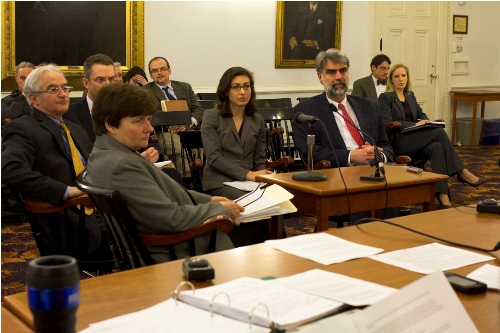
Details on the Shumlin administration’s push to confiscate pensions from public employees convicted of financial crimes emerged on Wednesday at a Statehouse hearing.
The proposal requires the attorney general or a state’s attorney to file a civil action to revoke or reduce retirement benefits for those convicted of financial crimes, like theft or embezzlement from public coffers, and bribery, or any abuse of public office for private financial gain.
State officials also made clear that the circumstances surrounding financial crimes would be considered by the courts, who would determine the extent of reductions to pension payments. Innocent dependents affected by pension reductions, the length of honest public service, and the seniority of the employee would all be factors.
Attorney General Bill Sorrell, who testified before the joint meeting of the House Judiciary and the House Government Operations committees, said he hoped the measure would deter employee wrongdoing. But, he said, that wasn’t the main point.
“Certainly, I think if it’s enacted, there’d be greater public satisfaction that someone who’s violated the public trust is not sort of adding insult to injury, by retiring on a generous public pension,” said Sorrell.
Administration Secretary Jeb Spaulding also called the proposal more balanced and less aggressive than laws in some other states, which require a mandatory confiscation of all pension benefits.
This proposal gives discretion to prosecutors, who can decide whether to request total pension forfeiture or only reductions, and in specific amounts.
Sorrell, however, argued that there should be no particular dollar threshold for the theft below which pensions could not be touched, saying that the rarity and seriousness of such financial crimes made a threshold unnecessary. He said any financial crime should automatically give prosecutors discretion to attempt to wrest back a pension.
According to state Treasurer Beth Pearce, about half of the states have some sort of law allowing them to partly or fully confiscate public pensions after breaches of public trust.
Vermont now does not have any legal authority to revoke public pensions after criminal convictions. Any restitution paid to taxpayers over financial crimes must come through a voluntary court settlement, arranged between the state and the defendant.
Rep. Bill Lippert, D-Hinesburg, and Rep. Donna Sweaney, D-Windsor, chairs of the House Judiciary and Government Operations committees respectively, both support the legislation, saying they would work hard to speed it to passage. Gov. Peter Shumlin first aired his proposal in a press conference earlier this month.
Spaulding said he wasn’t aware of any opposition to the bill. It was drafted with several interested groups representing public employees, he said.
The legislative director for the Vermont State Employees Association also expressed support, but said he would track the legislation closely to ensure it would not harm state employees unduly or have unintended consequences.
“While we understand the need for the bill, and we are working with the administration to address the issue, we want to make sure there are safeguards in the bill that protect our members, so it doesn’t become an overzealous proposal,” said Steve Howard.
Howard supports the concept as well as the bill, but added the support came with the “understanding that these things with state employees are very rare; we don’t have a lot of corruption in our state government,” a point echoed by state officials like Spaulding and Pearce.
Other legislative technicalities include whether the crimes triggering the process would be felonies only or include both felonies and misdemeanors. Sorrell favors including misdemeanors, because several small misdemeanor thefts, of amounts under $900, could come to a large total, but could be prosecuted as many misdemeanors, thus preventing the possibility of pension forfeiture.
Sorrell also raised the question to legislators of whether they wanted to focus exclusively on financial crimes. On this proposal, he said, offenses like DUIs or excessive use of force by police would not trigger a forfeiture of pensions, but that it would be up to legislators to debate that aspect.
The legislation comes two days after former Vermont State Trooper James Deeghan pleaded guilty to two felony counts — for timesheet padding — and two misdemeanor counts for neglect of duty.
Investigators say Deeghan’s fraud amounted to $213,000. Under the plea deal, he was ordered to pay $202,000 in restitution from his pension over the course of six years. Deeghan received a sentence of four to seven years; he will spend a minimum of two years in prison and will remain on probation for another two to five years.
Chittenden County State’s Attorney TJ Donovan, the prosecutor for the Deeghan case, said the restitution terms reached during this case were unusually fruitful for Vermont taxpayers. “It is really unprecedented to get that amount of money paid back in that short of a period of time,” he said. “We are pretty satisfied with the outcome.”
But, Donovan explained, the restitution deal hinged upon Deeghan’s cooperation. “He could have fought us on this issue, tooth and nail. … We didn’t have any legal tools to get at the pension. That’s why this pension forfeiture bill is so important because it’s another tool to use in those cases.”

