

Editor’s note: This story was originally published by The Commons. Anne Galloway contributed to this edited version of Peters’ report.
BRATTLEBORO — The Brattleboro Retreat announced sweeping changes Nov. 14, which was met with scorn from the union that represents caregivers at the state’s largest private not-for-profit mental health and addictions treatment hospital.
The Retreat management eliminated 31 positions last week in the middle of tense contract bargaining with the United Nurses and Contract Professionals, which represents hundreds of workers. In all, 27 employees will lose their jobs and four positions will remain unfilled.
The retreat eliminated the Therapeutic Activities program, cut inpatient chemical dependency counselors, and reduced teaching positions at the Meadows School.
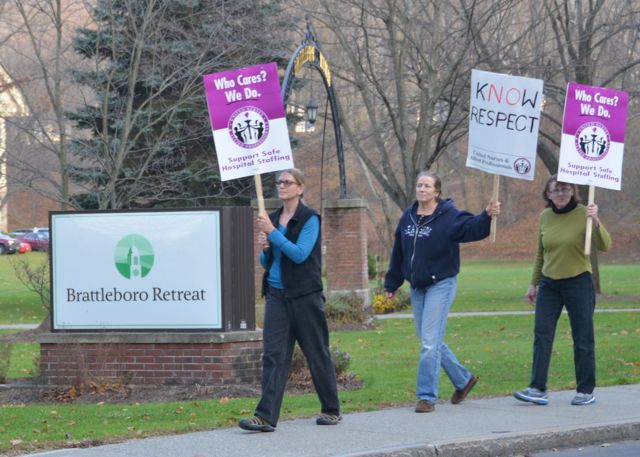
The reduction in force was announced a few days after union members began picketing the Retreat over demands for higher pay and health insurance benefits.
Representatives of the Retreat management say the cuts are necessary in light of a projected 2013 deficit and changes in the health care reimbursement system.
According to the press release, the Retreat, which provides in-patient and out-patient services, faces “significant economic challenges related to meeting the increasing needs of our patients who present with significant medical, mental health and addiction illnesses. This along with changes in how heath care is delivered and reductions in government funding. Any staff reductions are regrettable and very difficult for all of us given the incredible dedication that our employees have for their work on behalf of patient care.”
Union members say the management’s decision is unfair. They point to a disconnect between the profits the Retreat made over last two years on the one hand, and cuts to staff and programs on the other.
“We are not planning for a strike and we don’t want a strike,” said Jack Callaci, director of collective bargaining and organizing for the United Nurses & Allied Professionals (UNAP).
If management “provoked a strike, that’s their deal,” added Callaci.
UNAP held a strike in the early 1990s. It lasted one day. UNAP represents approximately 6,200 registered nurses, technologists, therapists, support staff, and other health care workers. Its 15 local unions are located in Connecticut, Rhode Island, and Vermont. Members of union Local 5086 held the second of two informational pickets in front of the Retreat on Nov. 16.

The hospital and union have completed 12 bargaining sessions. According to Callaci, the sessions have yielded no significant progress.
No canary in the coal mine
Rob Simpson, the CEO of the Retreat, says the union is seeking a 20 percent pay raise for workers over the next three years. Retreat management has offered a 4 percent annual increase for the same period.
Callaci, the union organizer, said the Simpson’s claim is “misleading.” He said there are two types of pay raises — an across the board cost of living increase, and a “step” increase for workers who receive a raise based on their pay grade.
A 5 percent raise could break down into a 3 percent cost of living raise and a 2 percent step increase. Not all employees receive a step increase, Callaci said, and not all employees would receive the same raise based on where they are on the pay scale.
The union gave up pay raises and some pension contributions in 2009 as part of negotiations, Callaci said, when the Retreat faced financial problems. The union met management part way. The Retreat gave workers 4 percent raises in 2010 and again in 2011.

The union feels its members deserve a higher pay raise this year to make up for their sacrifices in 2009, particularly in light of the Retreat’s recent profits.
Callaci says he doesn’t claim to “be a numbers guy,” but said in his experience, hospitals in trouble have a number of patients who don’t pay their bills, are not receiving proper compensation from commercial carriers, or the number of patients, the census, has dropped dramatically.
“What you have here is the opposite picture,” he said.
At the Retreat, revenues have held and the patient census has increased, he said. The hospital has also added programs in recent years, such as a unit to take state patients, a program for LGBT youth, and a program for uniformed officers.
Callaci added that usually, in a financial crisis, institutions make cuts across the board. The brunt of the Retreat’s cuts fell on the “front line,” he said.
The Retreat’s specialized therapeutic services set the Retreat apart from other psychiatric hospitals, he said. Eliminating them will hurt the quality of care at the facility.
It’s about the numbers
The Retreat, founded in 1834, is one of Windham County’s largest employers. In recent years, the hospital has been in dire financial straits. The Retreat burned through $20 million in savings from “retained earnings” over a 10-year period from 1999 to 2009, and no longer has a financial cushion. Meanwhile, management deferred maintenance at the facility in order to pay its bills.
Last summer, the Retreat faced decertification from the Centers for Medicare and Medicaid Services and possible loss of funding for a third of its patients because of the drug overdose and death of a 29-year-old male patient last January. The Retreat hired more staff to oversee nursing and drug dispersement and changed protocols in a number of areas that CMS said were deficient. The Retreat satisfied CMS officials and funding was reinstated in late July.
During his tenure, Simpson, who was hired in 2006, and the management team have tried to create an operating margin for the facility and have set aside the $2.5 million in recent profits as a buffer. In addition, the Retreat has borrowed $8 million to renovate the facility and to address deferred maintenance issues, including $3 million in roof repairs.
A few years ago, health insurers would pay for longer stays at the hospital, according to Simpson. Then the Retreat had about 1,900 patients a year. Now, Medicaid and insurance reimbursements for hospital stays are limited to fewer days and the Retreat has made up the difference by increasing the volume of patients to 3,000 a year. In 2010, the Retreat made a $1 million profit and in 2011 saw a margin of $1.5 million. The hospital bills out $100 million a year; it is reimbursed for $50 million to $55 million in services, Simpson said.
The cuts to staff, Simpson says, are necessary as the facility adapts to changes in the health insurance reimbursement system.
“There’s no smoke and mirrors,” said Peter Albert, LICSW, spokesperson, and senior vice president for Government Relations & Managed Service Organization. “It’s about looking at the numbers. We’re pretty transparent.”
Albert said if the Retreat doesn’t cut the therapeutic, education and chemical dependency programs the Retreat will run a deficit.
In a press release, the Retreat touched on its plan going forward. “By continuing to focus on access for emergency care, by providing critical psychiatric care throughout a continuum of services, by creating partnerships with other providers that will assure seamless transitions back to community care, and by investing in technology, the Retreat will remain a strong partner with Vermont and the region.”
The Retreat has focused its energies of late around emergency care and transitioning patients back to the community, Albert said.
“[The Retreat must] be good stewards of the resources we have,” Albert said. “The layoffs are not a statement of the quality of [employees’] work.”

Rather, the layoffs reflect the Retreat’s desire to stay sustainable, he added.
According to Albert, 2012 started well for the Retreat’s budget sheet. The hospital added staff. The patient census dropped as it usually did over the summer. But as the Retreat saw reimbursements decline and the number of patient days shorten, management began to worry.
Declining revenues continued in September and October, according to Albert, and projections for the remainder of 2012 and the new year pointed to a deficit.
“We felt the need to get on this sooner rather than later,” he said.
The Retreat also needs to adapt to state health care reforms, he said. Fee for service reimbursements will end and will be replaced by payments based on health outcomes. Patient care will also move to a system in which medical partners will work across disciplines.
This shift will “refocus treatment in a positive way,” said Albert. “[But] hospitals as we know them may be changing so we have to fine tune what we’re doing.”
Albert didn’t shrink from the impact of the Retreat’s decision to close programs and lay off employees.
“That’s just sad,” he said. “There’s no other way to put it.”
“[But] Unless we do something,” he added, “we put the entire organization in jeopardy.”
More job cuts on the table?
Callaci said the union and Retreat view the situation surrounding the layoffs differently.
“Offended,” summed up Callaci’s perspective.
According to Callaci, the Retreat management had referred to the now-deceased programs as “non-essential.”
“Not essential,” said Callaci. “It’s an insult to the individuals who provide those services.”
“It’s a sad way for the administration to look at its own facility,” he said. “[The programs are] important services and they ought to be restored.”
The hospital made a “conscious decision” to eliminate programs rather than the previously reported staff reduction.
According to Callaci, management has said more job cuts are on the table.
“The Retreat has been a center of excellence,” said Callaci. But “excellence” become past tense, he continued, when the hospital eliminates programs it has promoted and skilled staff providing direct care to patients.

“They proudly and rightfully touted these services,” said Callaci.
Callaci said the layoffs were not about low patient numbers or insurance reimbursements. The hospital is full, he said. The Retreat made millions in 2010 and 2011. It also expanded programs. Now it can’t pay its bills?
“The status [of negotiations] at this moment are unchanged to the extent when we left bargaining on Tuesday we had not made progress,” Callaci said.
Callaci said the union will leave addressing the layoffs to the eight-member bargaining team composed of Retreat employees.
Callaci said he hoped the community understood that the employees and union members “are standing up for the right things.” He said he wasn’t sure the same could be said for the administration.
In the past, when faced with financial issues, management has found a way to support “core benefits” such as pensions, he said. This year, the response remains no.
“It’s their [management] job to make sure the resources coming to the Retreat are apportioned properly,” said Callaci.
