


If you’re looking for Gilbert Rhoades’ salvage yard, you’ll find it after Route 7 makes its wide turn north toward Milton proper. Right onto Middle Road, left onto Shirley Avenue and there it is at the end of the quiet, block-long, residential street.
The yard feels abandoned. The entrance to the dirt parking lot is blocked off by four orange cones and a red plastic shopping cart in which a battered piece of wood is propped, advertising “Gil’s” cell phone number in black permanent marker. Beyond the parking lot is the office, a jumble of metal structures with “ABC Sales” spray-painted in white above the door. The former salvage yard, in operation since the 1950s, was shut down in 2009.
If you peek under the blue gate to the left of the office, you see what was once the center of operations at ABC Sales: a 5-acre dirt yard with a few scattered vehicle carcasses.
In the back corner, distant but clearly enormous, is a mountain of tires. Thirty feet high, 90 feet wide, 150 feet long, and no one knows how deep, this tire pile contains what the state estimates as 200,000 tires, though neighbors say it could have as many as one million.
This mountain of tires is the symbol of an issue the state has been grappling with for decades, and of a battle being fought out in the courtroom, neighborhoods, the Vermont Agency of Natural Resources (ANR) and the legislature over who is responsible for paying to clean up such unavoidable kinds of scrap.
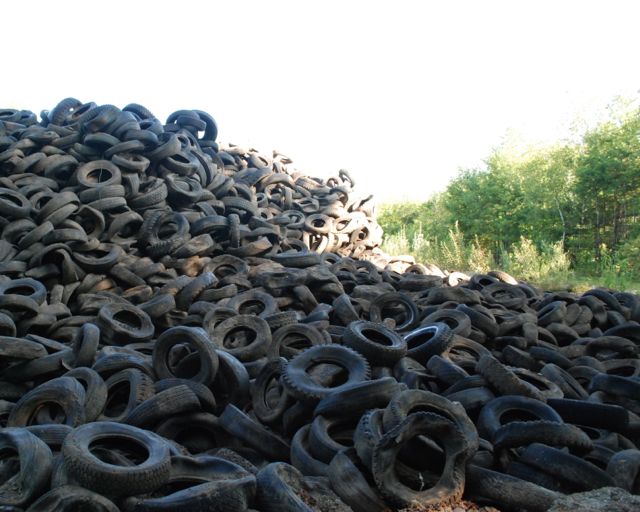
A disaster waiting to happen?
According to the U.S. Environmental Protection Agency (EPA), large piles of tires are at risk of catching fire because they retain heat. Tire fires release toxic smoke, oils and heavy metals and can lead to the evacuation of the immediate area. These toxic fires can burn for months and pose such a risk to public health and the environment that the sites where they occur may merit Superfund designation. A million burning tires can release about 55,000 gallons of liquid oil.
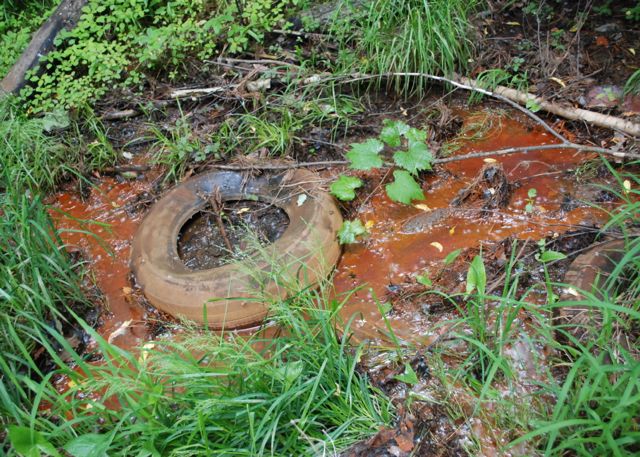
In the case of Rhoades Salvage, this contaminant would run directly into Hobbs Pond, a Class II wetland just a few steps from the tire pile — especially because of a culvert Rhoades said he installed several years ago to drain water out of the pile into the wetland. Hobbs Pond drains to Colchester Pond and then to Lake Champlain.
“That pile needs to be cleaned up immediately,” said John Brabant of the Agency of Natural Resources’ Salvage Yard Unit. “We can’t wait ten years.”
In fact, it’s been much longer than ten years already. Rhoades said he started the stockpile in 1970, when he took ownership of the salvage yard. In spite of disgruntled neighbors and court orders over the last six years, no one has done anything to deal with the tires — until now.
A first step to a solution came when ANR committed to pay BDS Waste Disposal $75,000 to load and truck the tires to Maine where they will be recycled. ANR estimates this will reduce the pile by a third, but Rhoades believes that will only take care of 17 percent of the pile. Work on tire removal began on Monday.
After two days in a row during which two tractor trailers equipped with mechanized loading arms were filled with tires and driven away, the tire mountain is only slightly diminished.
“That’s $10,000 worth of work right there,” said Rhoades, gesturing to the hole in the pile where four tractor trailer loads used to be.
BDS Waste Disposal began removing tires on Monday. By the end of today, they’ll have trucked out eight loads, which equals roughly 12,000 tires. Accounting for disposal fees, at this rate they’ll dispose of about 70,000 tires before the money runs out.
The tires will be used either as Tire-Derived Fuel or recycled into products for civil engineering projects, such as landfill lining, said ANR’s Solid Waste Compliance Specialist Barb Schwendtner.
Rhoades said BDS Waste Disposal will charge the state $80 per ton. Rhoades — or taxpayers — will have to pay nearly $200,000 to get rid of the tires. That is, unless there are more than 200,000 tires there.
When asked why BDS wasn’t removing all the tires this month, Schwendtner said the $75,000 was what ANR “could wring out of the budget at the time.”
“Mr. Rhoades is still obligated to pay that money back,” said ANR’s Brabant. “We’ll just go in and clean up and back-bill the responsible party.”
Meanwhile, a Chittenden Superior Court judge is deliberating over the state’s charge of civil contempt against Rhoades for failing to remove the tires after an October 2011 Vermont Superior court order to remove the tires within 90 days.
Rhoades’ tire pile is one of the largest and most controversial in the state, but ANR officials say many others—no one is sure just how many—exist in salvage yards, on farms and even in backyards. Sources identified piles in Bristol, Hardwick, Montpelier and Wells. Solid waste regulations prohibit the storage of more than a tractor-trailer load of tires (about a hundred) outside of a registered solid waste facility.
Vermont House Representative David Sharpe (D-Bristol) commented, “We have at least two in Bristol. These piles need to be removed and the tires recycled as much as possible.”
Where the mountain comes from
ANR’s Brabant said the tire stockpiles in Vermont grew out of a change in waste management practices.
In the early 1980s, “the municipal dumps were free and people would just dump stuff at the dump, which was usually a wetland. Then they would just throw dirt on top to keep the animals away…. As we shut down these unlined landfills, it drove folks to fewer and fewer lined landfills and the cost started going up fairly quickly. Even in the early ‘90s they charged $120 a ton.”
But even as the cost of dumping went up to fund more sophisticated waste management, tires were prohibited from landfills, Brabant continued.
“There was a ban to dispose of tires in landfills because unless they are cut up in small pieces they tend to have a buoyant effect, they tend to float to the top and it makes it difficult to compress the trash.”
What to do with scrap tires, then?
“There was a discussion in the early ‘90s to have a fee added to the cost of new tires to cover their disposal. This was under the Dean administration and the administration did not support the fee structure, but they supported the ban and so there was no legal alternative,” Brabant said.
In other words, as Brabant put it, tires were not allowed at landfills but neither were they allowed anywhere else. “So there were these fly-by-night guys who would pick up tires for a cost, maybe $2 a tire, and they’d get a truckload and dump them out in the woods. But where many people took them was salvage yards.”
Rhoades tells a similar story. As the cost of dumping increased, people would fill their scrap vehicles with trash and take them to salvage yards.
When vehicles came into his salvage yard, they “would invariably be loaded with household goods, anything that was made of metal and often many, many unusable tires. The front seat, back seat, trunk were loaded with tires. So that’s what began to increase my pile of tires.”
What’s the solution?
Rhoades said he hoped to one day sell the tires as fuel to a paper mill in New York or as retreads to foreign markets. He sold off tires here and there over the years, but he never found a market that would make the cost and effort involved in dismantling the whole pile worthwhile.
In response to hazardous waste violations, the state issued a court order in 2009 prohibiting Rhoades from taking in anymore scrap material. Rhoades sold off most of his scrap vehicles that year and the next. He said he used the income from that to pay for lawyers, consultants and labor.
“All of my inventory has been sold for scrap and the money used to fight off the issues, which I was expecting to be successful at until we knew in 2009 that the state of Vermont had only one thing in mind, which was to put me out of business,” Rhoades says.
“The state knew about him (Rhoades) for years and did nothing,” neighbor Lynn Caldwell said. “That has been a problem all along, the lack of enforcement.”
In spite of an October 2011 Vermont Superior Court order to dispose of the tires within 90 days, Rhoades left the tires in place. Assistant Attorney General Scot Kline said the state is now charging Rhoades with contempt for failing to remove the tires.
“My perspective on that is that we’re dealing with a state that has absolutely no commonsense whatsoever,” said Rhoades. “In 2009 I had a deal cut with a generating plant that would have allowed me to get rid of every tire I had, but it would have required Vermont to let me stay in business.”
Rhoades asserts that in order to pay for labor and equipment to transport the tires to the generating plant, he needed income. But because the state prohibited him from operating his business, he couldn’t pay to remove the tires.

From Rhoades’ perspective, his right to run a business has been violated.
“What kind of a world are we living in? Are we actually already in Iranian control? Are we already in the Korean area, where nobody has any rights? That’s what burns me the most, the lack of civil rights,” he said.
“It’s all about politics, power and position, with special interests at work in the state of Vermont…. When you want to scare the population to death, you pick one person and you put them on a cross and you drag them down the street and you ruin them.”
Neighbor and environmental advocate Lynn Caldwell, whose property is just 400 feet from the tire stockpile, is angry too but for a different reason.
“Mr. Rhoades needs to be held accountable for this mess,” she said. “We all learned in kindergarten that if you make a mess you clean it up.”
Caldwell, founder of Milton Citizens Looking for Environmental Action Now (Milton CLEAN) has been fighting to have the tires at Rhoades Salvage removed and the salvage yard cleaned up for six years, to little avail.
“The state knew about him for years and did nothing,” said Caldwell. “That has been a problem all along, the lack of enforcement.”
Caldwell is concerned about accountability but mainly wants the tires gone, regardless of who pays for the removal.
“It’s legally not [the state’s] responsibility to remove the tires, it’s Mr. Rhoades’ responsibility. And while I don’t want my tax dollars to go to removing the tires, they are an environmental hazard and they need to be removed.”
Caldwell continued, “The problem is that cases like Rhoades will happen again and ANR is not going to do anything to prevent them and intervene. It is a statewide problem.”
When asked about the future, Caldwell is firm in her commitment to making sure the tires are cleaned up.
“I don’t want it to end like this. I will push for all the tires to be removed.”
While Caldwell writes letters and the Attorney General argues a case of contempt in court, ANR grapples with what to do with stockpiles like the one in Milton.
The cost of disposal
Tire stockpiles fall under the purview of ANR’s Department of Environmental Conservation, where the problem is juggled by several divisions and programs. The Solid Waste Program, which oversees disposal of tires, is part of the Waste Management Division. The Compliance and Enforcement Division works to ensure that regulations are followed, including in salvage yards where tire piles are most common.
For now, ANR has committed to remove $75,000 worth of tires from Rhoades’ stockpile.
For now, ANR has committed to remove $75,000 worth of tires from Rhoades’ stockpile and the salvage yard’s lead-contaminated soil, said Assistant Attorney General Scot Kline. According to Rhoades, the work began on July 9th. ANR has 30 days to complete the job.
A company called BDS Waste Disposal will truck the tires from Milton to Maine, where they will be used either as “Tire-Derived Fuel” (TDF) or recycled into products for civil engineering projects such as landfill lining, said ANR’s Solid Waste Compliance Specialist Barb Schwendtner (she is part of the Waste Management Division of DEC).
Rhoades said BDS Waste Disposal will charge the state $80 per ton. Rhoades—or taxpayers—will have to pay nearly $200,000 to get rid of the tires.That is, unless there are more than 200,000 tires there.
When asked why BDS wasn’t removing all the tires this month, Schwendtner said the $75,000 was what ANR “could wring out of the budget at the time.”
“Mr. Rhoades is still obligated to pay that money back,” said Brabant. “We’ll just go in and clean up and back-bill the responsible party.”
Where do we go from here?
According to the EPA, Vermont is the only New England state that has no legislation exclusively for scrap tire management, though laws about tire disposal are integrated into other state legislation.
Funding tire stockpile disposal was brought up in the last legislative session, a discussion that Brabant said was triggered by the ongoing difficulties at ABC Metals.
“There was legislative effort this year to deal with the tires at Rhoades. Though they didn’t say it was Rhoades, it was clearly the focus of this discussion. They proposed a surcharge on the purchase of every tire. That sounds great in a non-political discussion. But there’s a huge lobby against it in the retailers and wholesalers. They were successful here in beating it back.”
Schwendtner said that the legislature wanted to know more about the problem before committing to any action.
Vermont is the only New England state that has no legislation exclusively for scrap tire management.
“The legislature will likely give further direction on how they want us to address these tires in Vermont,” she noted, especially after ANR has determined the number and size of stockpiles and estimated the cost of disposing of them. The legislature asked ANR to conduct a study on what they call “problem tire piles,” or those greater than 100 tires.
To do that, Schwendtner and colleagues have created an online survey through which the public can report stockpiles. Schwendtner hopes to visit as many piles as possible and get field measurements. ANR is required to report the results of their study to the legislature by January 15. The survey link is https://www.surveymonkey.com/s/SWP3D9B.
Once they know the scope of the problem, the legislature will have to decide if and how to fund cleanup.
Today’s tire consumer, yesterday’s tires
Sources agree that tires pose two management questions: how to dispose of tire stockpiles, which are legacies of previous waste management practices and how to dispose of tires as they come off of vehicles now. Everyone seems to agree that stockpiles should be dismantled, but there is a difference of opinion on how to handle current tire disposal.
Representative Tony Klein (D-East Montpelier/Middlesex) said that disposal of relatively new tires is not currently a problem in Vermont.
“Most people dispose of the tires they can’t use anymore in a proper manner,” said Klein.
Representative Sharpe recommended an e-tire program, similar to the e-waste program.
For example, the owner of Jeff’s Auto & Salvage, another salvage yard in Milton, said of the tires in his facility: “There’s probably 100 of them in the yard right now, but if it gets up to 150, 250, we have them removed. I like to keep things clean…. The environmental laws are not difficult to follow.”
Jeff’s Auto & Salvage won the Governor’s Award for Environmental Excellence in 2003.
Representative Klein noted that it’s the old tires in stockpiles that no one knows what to do with.
“These are really old tires…. There is a problem with trying to get today’s consumer to pay a fee that would go to cleaning up the problem, because it’s not today’s consumer that has created the problem. This is a very old problem that is going to be very expensive to solve,” he said.
But State Representative Dave Sharpe noted that during the last legislative session, “We heard the estimate that roughly 600,000 tires per year are removed from use in Vermont. It seems to be commonsense that under current practices illegal used tire piles will recur if no change is made.”
In other words, it’s possible that the cost of dumping will go up again and illegal stockpiles will crop up once more.
Representative Sharpe recommended an e-tire program, similar to the e-waste program. The e-waste program, which began in 2010, allows for the collection and recycling of electronic waste at no cost to the consumer.
“I expect that this problem will not go away and that some alternative source of funding may be found such as a $1 increase on the per-ton tipping fee paid at landfills,” said Sharpe.
But Brabant said this $6 fee, which is paid by those who deposit their junk at landfills, is not enough to fund even a quarter of what his Salvage Yard Unit, a subset of the Compliance and Enforcement Division, needs.
“We already have a program in place where we surcharge every ton, bumping it up to $7/ton, which still doesn’t cover our costs…. My program is a four-person program which has one person running it, so I can only do 25% of what I’m supposed to do.”
Although tire piles have been illegal for years, Brabant said enforcement has been lacking. He cited the situation at ABC Metals as evidence.
“We knew people were taking tires to junkyards but the Solid Waste Program refused to do anything about it. Mr. Rhoades took all the tires from a junkyard in Hinesburg that closed. Rhoades told me about it. We did nothing. His stockpile grew. He had this belief that someday those tires, because they have a gallon, two gallons of oil in them, they would be hugely valuable. It didn’t come to pass…. The Solid Waste Program did nothing about it and we continued to do nothing about it.”
Brabant believes that it was the state’s actions over the last three administrations that crippled the ability of ANR to enforce environmental regulations. This lack of enforcement is precisely why piles like Rhoades’ are still around after years of court orders, he says.
“ANR turned a blind eye to these [stockpiles], but we do share responsibility…. So much is political dancing and totally inappropriate. It’s not appropriate to say to you support cleaning up salvage yards and then your action is totally contrary to that. There’s what you say and what you do. I’m hoping they’ll be embarrassed into doing the right thing.”
In spite of his frustration with the lack of enforcement, he is looking forward to a change in the state’s action on this issue.
“Hopefully next session they’ll get something done.”

