

Editor’s note: This article is by Sandy Vondrasek, a staff writer for The Herald of Randolph, where it was first published on May 24, 2012.
“Bethel and Randolph Center were catapulted into the middle of a national controversy the past few days by a charge made on the floor of the United States Senate that depicted the towns as Communist hotbeds and the center of the ‘Alger Hiss area of Vermont.'”
That was the lead sentence of the top story in the Aug. 3, 1950, edition of The White River Valley Herald, published a few days after Sen. Joseph McCarthy made these accusations. The paper’s editor/publisher, John Drysdale, moved just as quickly to editorialize on the situation: “No Witch Hunts” on Aug. 3, and “Baloney!” the following week.
It was a tense time in the country, stunned by the Soviet takeover of Eastern Europe, fearful of a looming revolution in China, and engaged in a new war in Korea. Paranoia was running high, fueled by the charges of Sen. McCarthy and nationally prominent columnists such as Westbrook Pegler, and tireless efforts of J. Edgar Hoover’s FBI.
Central Vermont’s brief chapter in the so-called McCarthy era is a convoluted tale with a colorful cast of characters, including Arctic explorer Vilhjalmer Stefansson, a Mongolian Buddhist leader, a China expert denounced twice by McCarthy, a Red-hunting Bethel woman who fed tips to Pegler — and the local papers that reported the news and took strong editorial stances.
The fascinating story has just been told in well-researched detail in the new edition of “Vermont History,” the semi-annual journal of the Vermont Historical Society.
Author of the 17-page article, “A Sinister Poison: The Red Scare Comes to Bethel” is Rick Winston of Adamant, former owner of Montpelier’s Savoy Theater. Winston, who wrote the piece last year, told The Herald that selling the theater a few years ago has given him time to research a period that has long fascinated him.
Father denounced
Winston’s own parents, union- supporting, left-leaning public school teachers in New York City, were themselves victims of the “New York teacher purges” of the 1950s. His father, denounced by a former student who became one of McCarthy’s paid informants, lost his job. Although his mother ended up with a 60-page file — she refused to supply names during an interview with the commissioner of education — she kept her job, as, by that time it was 1956 and McCarthy had already been censured by the U.S. Senate.
Winston said he first heard about the Bethel/Randolph Center chapter of the Red Scare while he was helping to organize a 1988 conference entitled “Vermont and the McCarthy Era.” At the time, Winston interviewed Bethel’s Marshall Dimock, one of the conference speakers.
“He said,” Winston recalled, “‘And then there was that business with the Arctic explorer Stefansson — but he moved to New Hampshire.’”
At the time, Winston had never heard of Vilhjalmur Stefansson, and he now laments that he waited until last year to delve into the story, as some possible sources — including Stefansson’s widow — have since died.
The project took months of research: “You pull the piece of thread, and before you know it, it’s a ball of yarn,” he said wryly.
The article that Winston ultimately wrote offers both context, by setting the scene nationally and in Vermont, and detail, including the run-up and aftermath of McCarthy’s public accusations about Bethel and Randolph Center and their alleged subversives.
Arctic explorer
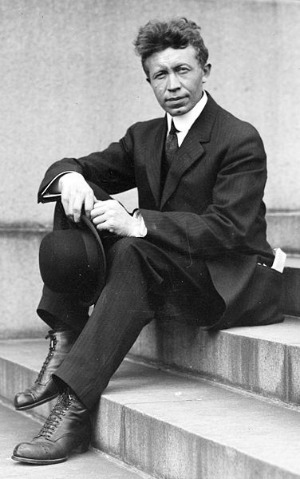
“The story begins,” as Winston writes, “with Stefansson, a renowned veteran of several Arctic expeditions,” who first came to Bethel in 1941, when he and his wife Evelyn bought “the Dearing place in what is known as the ‘Lympus’ area of Bethel.”
In 1949, the Stefanssons had an opportunity to buy an adjoining property — the Stoddard farm — which they purchased jointly with their good friends, Owen and Eleanor Lattimore. Lattimore was a noted expert on China and Mongolia, who had in 1940 been appointed by President Roosevelt to serve as a personal emissary to Chiang Kai-shek.

Both men were already in McCarthy’s sights: Stefansson because of his suspect collaboration with the Soviets in researches about the Arctic; and Lattimore, because he began speaking against the U.S.-supported Chiang Kai-shek as turmoil in China increased.
Suspicions about Lattimore grew when a few of his Mongolian friends, including a “Living Buddha” named Dilowa Hutukhtu, came to the Stoddard farm in the summer of 1949. The FBI believed Lattimore was plotting for a Communist overthrow of Tibet; in fact, he was “working diligently with his network of contacts in Asia to save rare Tibetan cultural manuscripts from the Chinese Communists,” Winston wrote.
Unbeknownst to Lattimore and Stefansson, an FBI agent was assigned to the case. He intercepted the two men’s mail, listened to their phone conversations, and sent photographs of letters, some in Chinese and Mongol, to Washington for translation.
The following year, in March 1950, McCarthy publicly denounced Lattimore, while he was on a U.N. mission to Afghanistan, as “the highest-placed Soviet spy in the State Department.”
Disproving that wild claim was not difficult — Lattimore was not even a State Department employee — but mounting a defense was costly, and the Lattimores decided to sell their half share in the Bethel farm.
The Stefanssons agreed to sell and the property was advertised. Unfortunately, the only interested buyers to step forward, Ordway and Mary Southard, were card-carrying Communists — something they did not disclose to the sellers.
“The FBI was not alone in watching the Lattimores and Stefanssons,” Winston noted at this point of the story.
The sale might have passed unnoticed, “if not for the attention of a local Bethel woman, Lucille Miller, who was known for her extreme anti-Communist views.”
Pegler informant
Miller regularly wrote letters to the influential columnist Westbrook Pegler and she “often sent ideas for investigative articles to the Hearst newspaper chain.”
She was also keeping an eye on four summer residents of Randolph Center who owned or had owned property there.
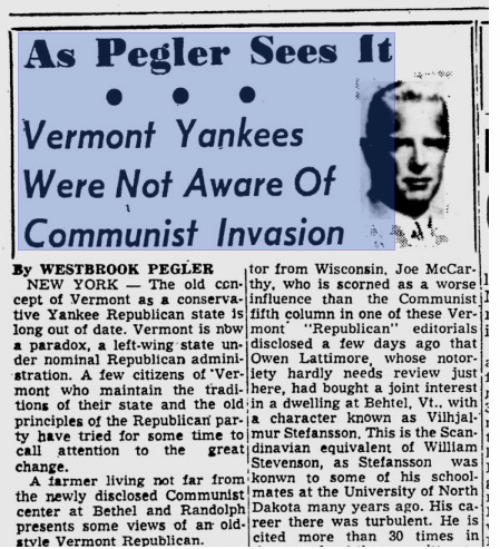
Pegler quoted Miller in a July 1950 column, “Vermont Yankees Are Suckers for Commies,” and a Hearst reporter accepted her invitation to investigate the central Vermont communist hotbed.
The reporter quickly uncovered the Southards’ affiliations and rushed to press on July 27. The same day McCarthy falsely charged on the Senate floor that the Communist Party had paid an inflated price to buy the Bethel farm, as a “pay-off” to Lattimore.
McCarthy, in a bit of geographical confusion, also charged that Randolph Center was in the “Hiss area of Vermont.” Alger Hiss, a government official accused of being a Soviet spy and subsequently convicted of perjury, owned property in Peacham.
Vermonters, in fact, were not particularly suckers for commies, and Winston in his history pays tribute to those who fought against the “witch-hunt” activity in the area.
“The most public and persistent Vermont critics of the ‘Red Scare,’” Winston wrote, “were two newspapermen” — Robert Mitchell, who grew up in Randolph and was editor/publisher of the Rutland Herald, and John Drysdale, who bought The White River Valley Herald in 1945.”
Drysdale wrote the 3,000-word story that topped the WRVH’s front page on Aug. 3, 1950. It was a lively account that quoted Lucille Miller and Mary Southard, and included statements from Evelyn Stefansson and the Bethel town clerk, who presented the facts of the land sale.
Of Miller, Drysdale wrote, “Mrs. Miller admits that her list of suspects is quite wide, and she is out gunning for them with a crusading zeal that will be satisfied with nothing less than cleaning up Randolph Center.”
His editorials are equally direct: “The quiet White River Valley towns of Randolph and Bethel have had an introduction in the past week to the slander technique of a certain section of the American press and of Sen. Joseph McCarthy.
“Those who will examine the McCarthy accusations, in the light of evidence available to them in the official records of the town of Bethel, can see a perfect case history of the manner in which individuals can be smeared and slandered in attacks against which they have no defense except the cool, common sense of their neighbors.”
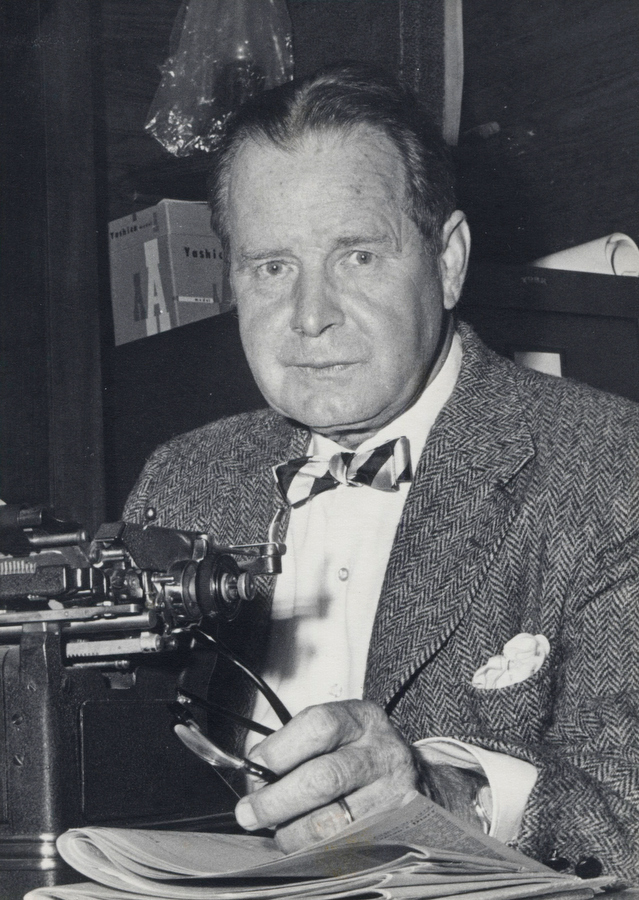
M. Dickey Drysdale, John Drysdale’s son and the current editor/ publisher of what is now called The Herald of Randolph, recalled that his father, who died in 1990, often talked about that summer.
“He’d been here only five years when the story broke,” Drysdale said. “He was the down-country guy with funny pants (a good Scotsman, John Drysdale loved his knickers) and hadn’t had time to win the trust of everybody in town.”
But John Drysdale was also an experienced reporter, who wrote for years for the Springfield (Mass.) Union and was “good enough for them to send him to Boston as their legislative reporter,” his son noted.
Recognizing the limited clout of his weekly paper, John Drysdale in August of 1950 approached Robert Mitchell, urging him to give the story more coverage. Mitchell, who wrote numerous editorials attempting to debunk McCarthyism in the early 1950s, readily agreed.
Mitchell and the editor of the Brattleboro Reformer commissioned an investigative report by a nationally-known journalist, William Gilman, who produced a five-story series.
Help from outside
The first article, an overview of the Bethel/Randolph Center situation headlined, “Red Stronghold in State Mostly Hotbed of Gossip and Rumor.”
In “Randolph Center Residents Reply to Communist Charge,” the fourth in the series, Gilman interviewed locals, including farmers Harry Cooley and Morris LaFrance, who had been targeted by Miller due to their public support of Henry Wallace in the 1948 presidential race.
M.D. Drysdale noted that his father reported and editorialized on the local Red Scare episode with “a little bit of humor, a philosophical detachment that put him in good stead at that point.”
But it was a troubling, fear-filled time, Drysdale said, adding, “I felt it could have gotten very ugly. Nobody knew what the truth was. If you are hearing Washington and the big news sources talking about such an infestation—how do you know it’s not true?”
The lesson of the episode, Drysdale feels, is “You can really make a difference in the climate of the town and the whole area.”
Drysdale credited Winston for creating “a readable package,” one that “emphasizes the importance of the story.
“It was an important story,” Drysdale said. “You have the most visible senator in the country specifically talking about your hometown on the Senate floor. And Pegler was perhaps the best-read columnist of the time.”
Looking back at his account, Rick Winston sees two important sides to the tale.
“There were things that were scary and things that were impressive. It is scary to see how easily hysteria can be whipped up — in that sense nothing is terribly new — it’s the fear that people have.
“Very impressive,” he added, “is what people like John Drysdale and Robert Mitchell did in saying, ‘We can do something about this. We can fumigate and let people know what really happened.’’”
