

Editor’s note: This is the second in a three-part analysis of the Shumlin administration’s plans for a single-payer health care system.

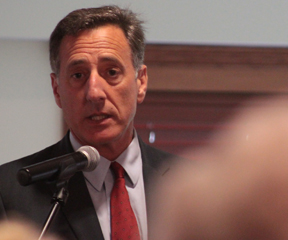
In a speech in Rutland earlier this year, Gov. Peter Shumlin described his reasons for seeking to establish a single-payer health care system in Vermont. At the conclusion of his remarks, he touched on the most critical issue embedded in the whole project — controlling health care costs in the future.
“If we can’t do that,” he said, “we’ll pick up our marbles and go home.”
For the last year and a half, while public attention has been focused on the insurance exchange and the individual mandate and the politics of the whole process, a quiet but extensive effort has been under way to refashion both the way that health care is delivered in the state and how it is paid for.
Carrying that off will be exquisitely complex for several reasons. The Shumlin administration will have to remake the delivery system and figure out how to pay for it — at the same time. That will require a good faith effort on the part of several major players: the doctors and hospitals in the state; the Shumlin design team, which includes several different sections of state government; the federal government, which pays for Medicare; the insurance industry, mainly Vermont Blue Cross and Blue Shield and MVP, the Schenectady, N.Y., insurer that operates in New York, Vermont and New Hampshire.
Each of those elements will have to change the way they carry out their businesses, which will be difficult both technically and culturally, and they will have to do so in a way that maintains the support of an array of political constituencies — the general public, the Legislature, the business community — and, not incidentally, their own members.
That is why the players are so circumspect when asked what they are doing and whether they are getting anywhere. What we can see at this point is the major issues they are tackling. The public will begin to see some of the fruits of the exercise by mid-summer, mostly around hospital budgets, but much of the work won’t come to fruition till much further down the road.
“I am cautiously optimistic,” said Anya Rader Wallack, the Green Mountain Care Board chair who is leading the state effort on this part of the project. “Health care cost containment, done right, is incredibly complex at many levels,” she continued. “But I think that we all — providers, payers and the board — share some long-term goals: excellent patient care, a healthier Vermont and a cost trend we can afford.
“We’re having great conversations about how, specifically, we can achieve those goals. We’re working through the details and the details are important, but at some point we’ll have to join hands and move forward together.”
Dr. John Brumsted, president of Fletcher Allen Health Care, says that we are in a transformative time for health care in Vermont and that “all providers need to find new and inventive ways to collaborate and integrate to better serve the needs of our patients, their families and the broader community.
“Fletcher Allen,” he continued, “is partnering with other hospitals in our region to improve quality, increase access and reduce costs.”
Several of the community hospitals in Vermont are likewise involved in the restructuring discussions. Paul Bengston, president of the Northeastern Vermont Regional Hospital in St. Johnsbury, is one of them.
“We’re excited to be working on these reform issues,” he said. “We expect this process to be very important to our hospital in serving our region.”
The Vermont Medical Society, which represents the state’s doctors, has not been directly involved, according to Paul Harrington, president of the society. “But we are certainly supportive of payment reform and delivery system reform as a way of getting improved medical care to all Vermonters.” He also added, however, that these system reforms should be “specifically subordinate to making sure that all Vermonters get high quality care at an affordable cost.”
None of this will be easy. Health care reform is the most intractable domestic public policy conundrum in the modern era, and Vermont is on the cutting edge of it — no other state is attacking the central issues so rapidly and aggressively. Whether they succeed will determine the fate of Pete Shumlin’s marbles.
The cost containment juggernaut
As we noted earlier, the single most important driver of the process is the need to control costs in the system. In approximate terms, we are spending a total of about $5 billion on all health care. The medical core of this is the $2 billion spent by the state’s 14 hospitals. That figure includes the cost of about 60 percent of the state’s doctors; they are employees of the hospitals. In the decade from 2000 to 2009, every hospital in the state more than doubled its budget.
The average increase was around 10 percent per year. Historically, that was no anomaly. From 1966 when the federal government markedly increased demand by establishing Medicare and Medicaid to the present the percentage of U.S. gross domestic output going to health care increased from about 6.5 percent to around 18 percent. Hence, the consensus that the system is not sustainable.
That inflation rate began to tail off in 2009, probably owing to a drop in demand in the wake of the 2008 recession. The trend was accelerated in 2010 when the Vermont Legislature ordered hospital budgets capped at 4.5 percent in 2011 and 4 percent in the current fiscal year, 2012. The Green Mountain Care Board continued the trend when they ordered a cap of 3.75 percent for fiscal 2013, which begins Oct. 1.
In the face of these declines in medical inflation, in both Vermont and the United States, some analysts have declared the cost explosion over. If that turns out to be true, then some of the pro-reform pressure is likely to fade.

There are two important caveats to this sanguine outlook. The first is that the 2008 crash is still weighing heavily on medical demand. The U.S. economy is growing again, but very slowly. Unemployment is still high, and fear of unemployment is higher still. Full recovery could ramp up demand markedly and that would put upward pressure on costs.
Even more important is the prospect of an increase in demand when health care reform begins to eliminate the problem of the uninsured as well as the underinsured. There are nearly 50,000 uninsured in Vermont and a significantly larger number who are underinsured — they have coverage, but they have very high deductibles and copays and they pay very high premiums.
In the absence of very powerful new constraints, absorbing that new demand would be like putting a blowtorch under a tea kettle. It’s all speculative, of course, but a return to the inflationary track followed by health care from the early 1970s through 2009 would increase Vermont health care spending by hundreds of millions of dollars by the mid-teens.
The horns of the dilemma? Shumlin can get the costs to the public down, but the whole thing will blow up if people don’t get the care they need; it will also blow up if doctors and hospitals deliver the care, but that care isn’t cost efficient.
Shumlin has said bending the health care cost curve is job No. 1. The Green Mountain Care Board has already taken an important step in that direction by its establishment of the 2013 cap, which is just 1 percent or so above the current rate of inflation, 3.75 percent compared to 2.7 percent growth in the consumer price index. This move is having a double effect. It is keeping costs down, and it is sending a very powerful message to the medical community that the days of huge budget increases is over.
Still, the really hard work on cost containment is nowhere near complete, because just cramming down the inflation rate, by itself, will not make the changes in the delivery system that will enable doctors and hospitals to deliver consistent, high quality care with fewer resources.
The horns of the dilemma? Shumlin’s team can get the costs to the public down, but the whole thing will blow up if people don’t get the care they need; it will also blow up if doctors and hospitals deliver the care, but that care isn’t cost efficient.
Every problem going forward will have two variables, not one.
Given that this part of the process is going on in private meetings, there is no way yet to assess how much progress is being made, and where the potential sticking points might be. The outlines of the individual challenges, however, can be seen.
The hospital investment question
Call the first and most critical challenge the “investment issue.” In outline form, it looks like this:
Fletcher Allen Health Care is the only tertiary care facility in Vermont. It delivers half the total care in the state, but its more important function is that it delivers most of the very expensive sophisticated care. The only comparable facility in the region is Dartmouth-Hitchcock Medical Center in Lebanon, N.H., which delivers tertiary care to Vermonters in the eastern half of the state. The Dartmouth situation is so complex and important that we’ll consider it separately.
In practical terms, the Shumlin team and Fletcher Allen have to agree on reform and that won’t necessarily be easy.
The world from the Fletcher Allen perspective looks generally like this: Fletcher Allen, and in fact the whole Vermont medical community, deliver some of the relatively lowest cost and tightly managed care in the country. They understand that the cost is nevertheless high and that reform must be carried out. What they think they need to do that is to invest in their physical and technical plant so that they can deliver care even more efficiently. But they need to invest in things like increasing the size of hospital rooms to accommodate modern equipment; many rooms in the Medical Center Hospital are too small for that. They also need to convert double rooms to single. All of which costs money. Fletcher Allen so far has not formally asked state permission to carry out projects like this, but officials say they believe they need it.
The normal way organizations get investment capital is to earn a profit, or in a non-profit system, an excess of revenue over expenses — a margin. For the last several years, state regulators and now the Green Mountain Care Board have limited Vermont hospitals to a 2 percent margin. One way to direct more investment at Fletcher, assuming the GMC board agrees on the need, is to increase the margin beyond 2 percent.
Doing that would not be that easy for the state because the central idea in the whole enterprise is to get costs down, not up. Moreover, the board would have to deal with community hospitals, who would have to live with 2 percent margins, and with their legislative supporters, who far outnumber Fletcher Allen’s legislative supporters.
Nevertheless, the Shumlin team needs Fletcher Allen on board for reform. So, if they decide to let Fletcher Allen increase its margin by a point or two, how might they do that, and how might they ensure that the state enjoys the increased efficiency at its major medical center.
The Department of Financial Regulation databases show that the charges at the state’s small hospitals are often higher than in, say, Fletcher Allen or Dartmouth.
One way under consideration would be to get a commitment from Fletcher Allen to reduce their costs in the out years so as to deliver a return on the investment. That way, Fletcher Allen couldn’t just spend the money and hope for greater cost efficiency, they would be at risk for actually getting it done.
This is a critical decision node in the process, and it is one of the first that has to be resolved. For the answer, one way or another, which would add somewhere between $15 million and $25 million to the Fletcher Allen budget, will have to start showing up in the 2013 budget. That document will be delivered to the Green Mountain Care Board sometime in early July and the board will have to rule on it in before Oct. 1 of this year.
The Shumlin team could refuse, they could go directly to some final margin cap, or they could phase in a higher margin over two or more years. It is a difficult decision. Both the state team and Fletcher Allen badly need to get it right.
Community hospitals prone to overuse
The 13 community hospitals together constitute a reform and reorganization problem as knotty as any other in the whole single payer effort. Rutland Regional Medical Center is a pretty good sized hospital, while the rest are small. Yet, they are critical to the economic and social lives of their communities. They are often the biggest employer in town, and in a rural state their basic services are vital to the local people. A woman having a baby, a farmer who rolls his tractor, a logger who nicks an artery with a chain saw, a teenager who drives into a tree on his or her way home from the prom — all need medical care fast.
But the way that local hospitals have evolved in the post World War II era has taken them well beyond these roles and given them characteristics that are problematical in an era of reform.
One of the problems is that they are prone to overuse, as years-long data have demonstrated.
Anya Rader Wallack, chair of the Green Mountain Board, noted that if Vermont’s utilization rates are compared to national criteria, there appears to be little or no overuse in the state’s community hospitals.
“But if you look within the state,” she said, and “compare use rates to a tertiary center like Fletcher Allen, there is some quite wide variation.”

It is true all over the United States — the Boston area, one of the most medically rich communities in the world, is rife with it. But we can’t afford it anymore, if we ever could. Beyond that, in an effort to build financial strength, many local hospitals have spent years inching up the sophistication ladder, adding a hand surgeon here, a hip replacement specialist there.
There are two problems that arise from that trend. One is the temptation to overuse. If you are the only subspecialist in a small area, you have to justify your existence by doing cases which can be a powerful incentive to do too many. The second is that whether or not the service is both fully justified and competently executed, the per unit cost can be high because there are no economies of scale.
Actual per capita payments for these specialist cases are proprietary, but the Department of Financial Regulation databases show that the charges are often higher than in, say, Fletcher Allen or Dartmouth. And the anecdotal reports on the issue make it clear that some of that care is much cheaper at the tertiary centers than in community hospitals. A state spending 20 percent of its gross state product on health care can’t afford that.
So, what to do? Well, it’s not yet clear. In the near term, the state is likely to move toward a global budget for each hospital. Each hospital has been operating under an increasingly low cap over the past two fiscal years, and as we have shown earlier they must limit their increases to 3.75 percent for the coming fiscal year. A “global” budget would go beyond that to establish a floor for the hospital revenues in a given community.
In the near-to-medium term future, that would mean that a hospital could begin to reshape itself to drop care that can’t be provided at a competitive price and to bolster its ability to offer essential local care, even if it is too expensive. Exactly how that would work is not known, but many community hospital leaders are trying to figure it out.
Global budgets, however, would not solve all the problems. In the short term, they could bake in excess utilization. They might also discourage any consideration of what no one wants to breathe a word about — the possibility that some local hospitals simply don’t make sense as fully elaborated acute care facilities and should be downscaled to urgent care centers.
Global budgets undercut integrated care
The most serious drawback to the global budgets is that they don’t get at the central need for a 21st century health care system, which is sufficient integration of the medical resources available to make a reality the mantra “the right care at the right place at the right time.” We are a long way from such a system, but the need for it must be on the agenda.
There have been some movements toward integration, but they have been limited. One step was the merger agreement between Fletcher Allen and Central Vermont Medical Center in Berlin. Another would be an increase in the number of participants in Vermont Managed Care, which now has only about 5,000 lives, but which could accommodate far more.
If hospitals like Rutland would join VMC, which is operated by Fletcher Allen, more extensive cooperation and coordination would be possible. One of the most potentially efficacious moves toward integration could come from some sort of operating between Fletcher Allen and Dartmouth-Hitchcock.
That step would link tertiary care for the most of the state in one operating entity, although it would probably be impossible to actually merge the two institutions. It would move the delivery system much closer to an ability to “take risk,” for large cohorts of patients, the holy grail for health care reform.
Insurance carriers in the brave new world of reform
Two of the major state’s insurance carriers — Vermont Blue Cross and Blue Shield and MVP, a Schenectady, N.Y.-based health management organization — have been full participants in the discussions. That may seem anomalous, given that a full-blown single-payer structure could eliminate insurance carriers altogether. The reality, however, is much more complex.
For one thing, both firms expect to participate in the exchange for the small group portion of the customer base, and they have to work closely with the state reformers at that level. Beyond that, however, is the fact that health care reform doesn’t mean just single payer.
“We do support working toward delivery system reform and payment reform.” ~Leigh Tofferi, BCBS
The exchange itself is a major step toward simplifying the system and markedly changing how insurance works, not just whether insurance carriers exist. The rules for the exchange aim directly at eliminating cherry picking of the healthiest residents, as well as building big pools of patients rather than small ones. The exchange also dramatically shifts insurance company competition by risk adjustment, which means that if Blue Cross has a healthier pool than MVP they have to actually pay the excess income to MVP in order to level the playing field.
Moreover, it is possible to fully support much of the reform content of the state effort, without endorsing single payer as the end state system. Blue Cross and MVP, for example, think it makes sense to work toward integration of the delivery system in order to control costs and improve quality; they also understand that cost containment may require a move away from fee-for-service reimbursement to some sort of capitation system.
Dave Oliker, president of MVP, said that his firm appreciates the opportunity to participate in the Vermont process, and that while single payer could be the final outcome the other issues are very important. “We think that as long as we remain a respected participant, we’re going to have an opportunity to weigh in on the issues along the way,” he said. “It’s way too premature to throw in the hat — who knows what’s going to happen?”
MVP has had a good relationship with the governor, regulators and the Legislature in Vermont, he said, and his firm has too much invested to give up now.
“The people we are dealing with are thoughtful people,” he continued, “they are doing what they think are in the best interests of the state, and we need to respect that, they confer with us on issues. We think we have too much invested in the state to throw in the towel.”
Leigh Tofferi, the government relations chief for Blue Cross, said that his firm does need reform, that it is unaffordable for many purchasers. “We do support working toward delivery system reform and payment reform,” he said.
“Those are the kinds of reforms we would like to see,” he said. “The whole idea of what is the best way to finance that system — we try to not let that distract us from the reforms that we need in the delivery and payment systems.”
What neither MVP nor Blue Cross talk about is the belief that is fairly widespread in the policy community that the reform effort will never actually get to the single-payer level. Shumlin has cast the whole health care reform effort in terms of single payer, but as noted, both payment reform and system integration can be established without.
Taking risk
The key to the explosion in health care costs from the late 1960s through the first decade of the new millennium was the fact that doctors, who actually run the system, never really had responsibility for its costs. The costs were “managed,” if you could call it that, by insurance companies. Insurance companies are very good at managing insurance but utterly incompetent at managing health care.
The days of regular pay raises and big bonuses for doctors, especially specialists, have gone glimmering.
Relying on them to manage the system was bad for the public, which had to come up with huge amounts of new money every year, and bad for the insurance companies, which were pilloried for not doing what they had no chance of doing.
In the long run, it was even bad for doctors and hospitals. Those chickens are now fluttering down onto the whole enterprise. And a major part of reform is shifting risk to the doctors. It is perverse but true that competition among units of the delivery system drove costs up, while cooperation and reduction of competition reduced that dynamic. But shifting risk to medical providers is a difficult issue.
The days of regular pay raises and big bonuses for doctors, especially specialists, have gone glimmering, but the profession, with the exception of primary care providers, is very well paid.
But what happens if we get new demand in the system and more and more patients are lining up for more and more care? Are doctors and hospitals going to be willing — or able — to simply absorb them when regulators have them capped at just a bit above underlying inflation, which nobody can avoid? Light, heat, electric power, fuel for vehicles — those prices are going to rise. And what happens in the unlikely event there is an epidemic?
The reality is that the public would have to come up with new money for that. So, how do you strike a balance? The state and the medical community are going to have to figure it out.
Is capitation the answer?
Virtually all of the players agree that you can’t shift risk to medical providers without changing the way you pay them. In the current system, a doctor or a hospital provides an episode of care to a patient, determines a charge for it, sends a bill to someone. It could be the patient, or it could be an employer or an insurance company.
It is called fee-for-service and it has driven us ever closer to ruin and despair. Everyone knows we need to change it, but the “how” is very difficult.
If fee-for-service goes away, then reimbursement of doctors and hospitals will have to be on some sort of bundled method.
Somebody needs to assemble cohorts of patients, all the state employees, for example or the employees of a company, or the members of a union — something that clusters them. It could theoretically be a whole state in a full blown single-payer system, but that is down the road. An integrated health care delivery system would agree to provide all the necessary care for the group at an agreed upon total cost.
Doctors and hospitals would then not benefit by doing extra services or extra tests and they would suffer from any mistakes they made, from cutting off the wrong leg to messing up patient scheduling. Policy makers have talked about how to do this for decades, but it has almost never actually been done. The Shumlin designers and the medical community will have to figure out how to resolve this.
Whither federal waivers
One of the totally bureaucratic but important issues in the reform effort will be the ability of Vermont to get the federal permission it needs to align Medicare and Medicaid with a new reimbursement system for the state. Both the federal support for the elderly and welfare recipients are designed to be paid on a fee-for-service system, where providers submit bills for episodes of care and the feds (Medicare) and feds and state (Medicaid) pay them.
If fee-for-service goes away, then reimbursement of doctors and hospitals will have to be on some sort of bundled method, where groups of providers care for large groups of patients. Will the federal government modify their payment regulations to accommodate a new Vermont system?
According to the Shumlin designers, federal permission for changes of this nature should be obtainable. The state already has a waiver to manage its own Medicaid program: The federal government share is delivered essentially as a block grant and state Medicaid managers distribute it to meet state needs. The key is that the total amount of federal money available can’t go up.
The same sort of constraint is likely to apply in a shift away from fee-for-service if the new state system — not yet designed — is credible. A formal waiver on the Medicare side would require a vote of Congress, but federal bureaucrats have ample room to permit demonstration projects on a multi-year basis, according to Anya Radar Wallack, Green Mountain Care board chair. A payment waiver for Medicaid can be made by a federal agency.
The question of moving the single payer starting line from 2017 to 2014 is entirely different. Shumlin is seeking permission to do that, and he has expressed confidence in the ability of the state’s congressional delegation to get legislation passed in Congress to allow it.
The Shumlin designers are reluctant to comment on that question, but most observers believe there is no chance for such a move in the absence of a major shift in national political environment. The governor believes that he can get some help on this issue from conservatives who hate Obamacare and might interpret an early start to single payer as help for their cause, but you will look long and hard for someone who agrees with that.
