

In This State is a syndicated weekly column about Vermont’s innovators, people, ideas and places. Details are at http://www.maplecornermedia.com/inthisstate/.
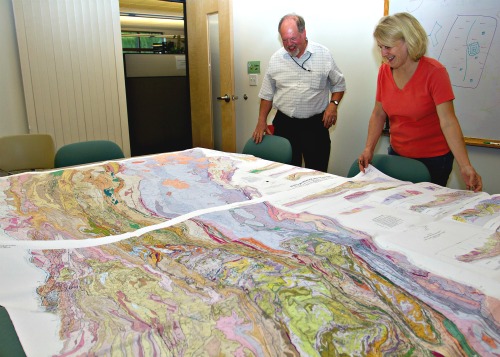
It depicts a version of Vermont long before there ever was a Vermont, before the formation of a continent that would eventually be called North America, and even before there was much life on planet Earth.
Portrayed in its swirls of colors are the uplift and erosion of mountains, the advance and retreat of oceans, the eruption of volcanoes, the formation of coral reefs, and even an eel-like creature called a conodont that lived about 460 million years ago.
The new bedrock map of Vermont is a chronology of this state expressed in stone as old as 1.4 billion years, and it is an emerging tool for making informed decisions about everything from highways to commerce to public health.
It turns out that life in Vermont is very much connected to life under Vermont.
“Every living thing basically depends on the bedrock, too,” says Marjorie Gale, a geologist with the Vermont Geological Survey who, with a cadre of colleagues, has devoted a good portion of her career to creating the new map.
No appreciation of this map can begin without recognition of its utter size and scope. The printed version covers three sheets, each more than six feet wide and five feet tall. Northern and southern Vermont each occupies its own sheet. The third sheet contains a legend to 486 identified bedrock types and a listing of scientific publications and other investigations that support the printed record of rock on the map. (The map is also available in digital formats.)
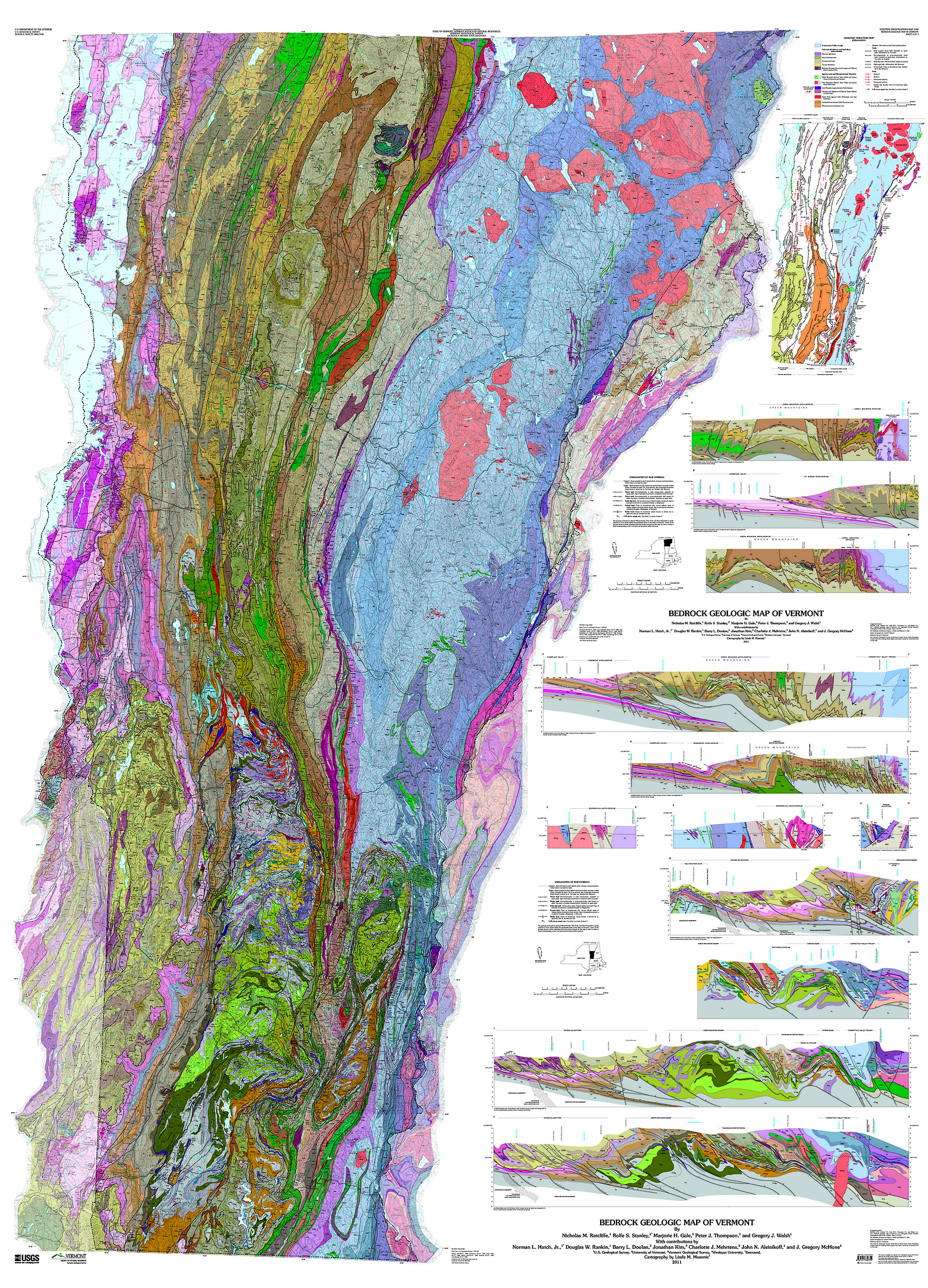
In representing each rock type, the map is an adventure in color and pattern, resembling something Ben and Jerry might have called “Melted Crayon Psychedelic Crunch.” The map’s level of swirling detail is the product of more than three decades of labor by more than 60 geologists.
As a graduate student at the University of Vermont in the 1970s, Gale unwittingly began early contributions to the map while swinging her rock hammer around Belvidere Mountain. Back then there were no GPS units to pinpoint a geologist’s location in the forest – or out on the ledge as the case may be. With map and compass, Gale would take to the woods and pace off her position until she encountered a ledge or outcrop or some other exposed bedrock.
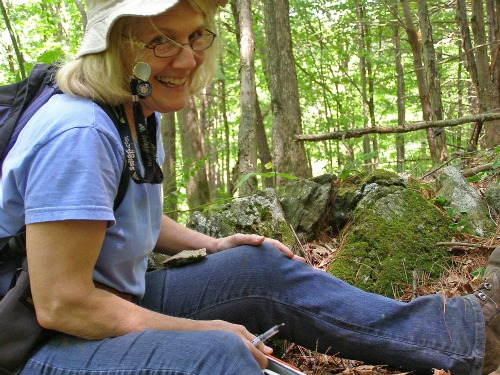
“You hit the rock, you identify it, and you make a lot of measurements,” says Gale, a spry, rugged scientist. It can be tedious, fun or exhilarating work: find bedrock, identify it, maybe run some chemical analyses, interpret the results, and then mark the rock type on a map. Then go find more rock. The fieldwork went on for decades.
The result is a portrait of a Vermont mostly hidden from view, a guide to what would be left if you were to scrape away everything but the rock below us. Driving some state bedrock maps is the search for metals, minerals and fossil fuels – resources often destined for extraction. But Vermont is hardly a big mining or oil state. The map is more a tool in the search for road materials, building stone, granite or marble, for example, or for anticipating what workers will encounter during road or bridge construction.
But most important for Vermonters is the relationship between rock and water. Here are a few examples of how the bedrock map is being put to use above ground:
• Geologists like to associate particular rock types and newly mapped thrust fault lines with high or low well yields for drinking water or for commercial or industrial use of water.
• Knowing a region’s bedrock type can help regulators determine any potential risks to drinking water from spreading farm manure on fields.
• Public health officials are investigating whether radioactive radon or uranium (both present in Vermont) seem to be associated with a particular bedrock type occurring around the state.
• The map may help locate areas suitable for cutting-edge geothermal heating or cooling systems.
As the 13th Vermont state geologist, Laurence Becker has his name printed in a lofty position atop the map. Becker describes bedrock as a kind of “connected providence” supporting the rest of the Vermont landscape and critical to understanding economic and environmental issues facing the state.
“The providence is the bedrock system,” says Becker. “The structure of the land, the high Green Mountains, the valleys to the west and east, they’re all related to the long-term bedrock geologic history.”
A diagram of Vermont’s ancient past
The last state bedrock map was produced in 1961 (the first in 1861), before a seminal theory in geology became widely accepted: plate tectonics. The theory helps explain how the land of this state came to exist.
And the new map is a schematic diagram to a billion years of Vermont history, which below is condensed into a few minutes of reading:
The theory of plate tectonics explains that the Earth’s surface comprises a dozen or more oceanic and continental plates, like simple puzzle pieces, floating on layers of more viscous material. Those plates drift somewhat independently, not much more than an inch or so per year. When plates collide or when one plate slides below another, things get hot and heavy. The earth trembles. Volcanoes erupt. And from layer upon layer of previously deposited sediments and stone, mountains rise. Each mountain-building event is called an orogeny.
In the geological lineage of Vermont, the first notable collision of plates was the Grenville Orogeny more than a billion years ago. The resulting mountains may have been as high as the Rockies (or higher). Yet over the course of several hundred million years after their formation, much of the Grenville Mountains eroded away. What remains of those old mountains is found in New York’s Adirondacks and within the core of the southern Green Mountains. On the bedrock map, those rock types appear in southern Vermont as amoeba-like crescents and oriented more horizontally than most other formations.
So although most Vermonters lump regions together – the Green Mountains, the Champlain Valley or the Northeast Kingdom, for example – the state bedrock is actually the product of a series of tectonic events, producing a mixture of rock formations, occurring hundreds of millions of years apart.
But tectonic plates not only smash ever so slowly into one another; they drift apart as well. When that happens, the valleys (or rifts) that result become oceans loaded with sediments and marine life. As the Grenville Mountains eroded, continental plates began to separate, resulting in a new ocean. The sediments and deceased marine life accumulating in that ocean became the raw materials of Vermont in the next round of mountain building, which took place about 450 million years ago.
Known as the Taconian Orogeny, this event was monumental in the geologic history of Vermont. As plates moved together again, ocean sediments and crusts were forced up, folded and faulted, becoming much of what is now the Green Mountains and western portions of Vermont. Those rock types appear on the map crunched in largely vertical patterns across the length of western Vermont.
Another orogeny about 360 million years ago, the Acadian Orogeny, would further deform and uplift these existing bedrocks now to the west, adding to their complexities (and mapping intricacy). The Acadian Orogeny also produced the more uniform rock types in the eastern half of the state.
So although most Vermonters lump regions together – the Green Mountains, the Champlain Valley or the Northeast Kingdom, for example – the state bedrock is actually the product of a series of tectonic events, producing a mixture of rock formations, occurring hundreds of millions of years apart.

When Gale looks at the map, she sees more than rock. She sees mountains, oceans, reefs and volcanoes no longer here. And she sees life in stone, including her colleagues who share authorship on the map – one now deceased – surveying the state for years in search of bedrock.
“For me it’s a very different thing,” says Gale. “I see people and experience.”

