

A Chittenden County sheriff’s deputy is under investigation for violating Vermont’s Fair and Impartial Policing Policy by calling U.S. Border Patrol to a Franklin County traffic stop that ended in an area farmworker being deported.
The internal investigation could test the limits Vermont places on cooperation between local police and federal immigration authorities. State policing policy generally bars officers from sharing someone’s location or vehicle information with federal immigration authorities unless there is a safety risk and state or local officers cannot provide urgent assistance.
“We have fought hard to create Vermont’s Fair and Impartial Policing Policy and have celebrated its implementation in this state,” Cristian Santos of Migrant Justice, an immigrant rights group, said. “We will not allow this to be swept under the rug: we demand justice for Alex and for an end to police collaboration with deportation agencies.”
Genri “Alex” Jimenez, 22, had worked on Franklin County dairy farms for about two years before he was detained during the July 19 traffic stop by sheriff’s deputy Sgt. Scott Costella, according to Migrant Justice. Jimenez spent nearly three weeks in federal immigration detention in Vermont, New Hampshire and Louisiana before being deported to Mexico, Migrant Justice confirmed on Monday.
The sheriff’s office “is conducting an internal review into the matter to determine if the actions taken during the reported incident were consistent with the agency’s Fair and Impartial Policing Policy,” Sheriff Dan Gamelin said in a complaint filed with the Vermont Criminal Justice Council.
Gamelin referred his deputy to the council’s Professional Regulation Subcommittee after Migrant Justice obtained records of the encounter and questioned whether Costella’s actions complied with the policy.
“A man who was living and working in this state has been separated from his partner and his family. That is serious, and I am not going to talk around it,” Gamelin said in a press release from the Sheriff’s Office. “We turned over what we had, and we did not hold back the uncomfortable parts. That is what accountability looks like at the front end, before anyone knows how the story ends.”
A message left for Costella’s attorney on Monday, asking for comment, was not immediately returned.
Migrant Justice alleges Costella summoned Border Patrol without first seeking state or local backup, and without identifying a specific threat that would qualify for the policy’s safety exception.
“It appears that there’s an effort on behalf of the department to justify these actions and square them within what is permitted under the policy,” Lambek said. “But, that falls apart very quickly once you look at what actually happened, and by any objective measure, there is no articulated risk of physical injury to Sergeant Costella that would justify his information sharing with Border Patrol.”
Records obtained by Migrant Justice and shared with news organizations show that Costella’s explanation for calling Border Patrol changed after the county’s internal legal review. Costella’s initial account cited the remote location, the impending tow of the vehicle and his uncertainty about its occupants.
The final version described Border Patrol as “officer safety backup” and added that Costella was “unsure how they would react,” apparently referring to the occupants of the stopped vehicle.
“I had requested a USBP agent for officer safety backup as I was out with two individuals, on a back country road, knowing that the vehicle was subsequently getting towed and unsure of how they would react, and I still do not know the history or circumstances involving the occupants of the vehicle,” Costella wrote in a statement to Migrant Justice.
‘Need one of you’
On July 19, Costella stopped a Chevrolet Spark on Potato Hill Road in Berkshire after noticing it did not have a front license plate. Anthony Cruz-Morales, who had recently purchased the vehicle, was driving. Jimenez was in the passenger seat.
According to Costella’s statement, state police dispatch had informed him that the vehicle registration had expired. Costella also said he confirmed by phone that the vehicle was not registered.
During the stop, Costella retrieved his personal cellphone and texted a group of Border Patrol agents, according to records obtained by Migrant Justice. “Potato hill rd on stop,” he wrote, followed by, “Need one of you.”
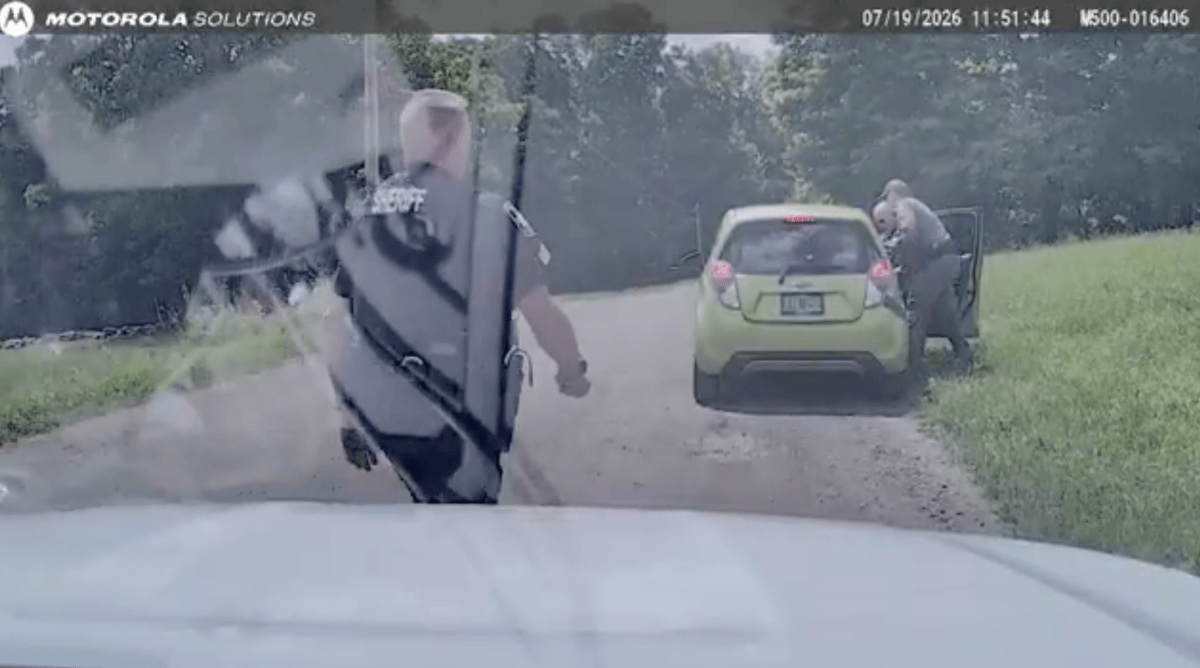
Two Border Patrol agents arrived about 15 minutes later. As they detained Jimenez, Costella assisted them in holding and handcuffing him, according to Migrant Justice’s review of body camera and dash camera footage. Costella then turned off his body camera for several minutes while speaking with the Border Patrol agents. After Jimenez was taken away, Costella texted the agents and offered to get lunch for them at Subway.
In his statement, Costella denied that his actions were based on the race or gender of Jimenez and Cruz-Morales.
“Until walking up to the vehicle on the passenger side for the initial approach, I was not aware of how many individuals were in the vehicle, male or female, or what race they were,” Costella said.
This is not the first time a deputy in the Chittenden County Sheriff’s Office has faced allegations of violating the state’s policing policy.
In 2023, the Chittenden County Sheriff’s Office paid a $25,000 settlement to an immigrant farmworker, after another deputy called Border Patrol during a 2019 traffic stop that resulted in his deportation.
The Criminal Justice Council can investigate alleged professional misconduct by Vermont law enforcement officers. Gamelin’s complaint asks the council to review whether Costella’s actions amounted to a violation of agency policy. The sheriff’s office is conducting its own review, and neither investigation has reached a conclusion.
The policing policy was put in place, Lambek said, to place a “firm barrier” between local police and federal deportation agencies.
“Simply put, Vermont police should not be in the business of deportations,” Lambek said.