

Jon Margolis is VTDigger.org’s political analyst.
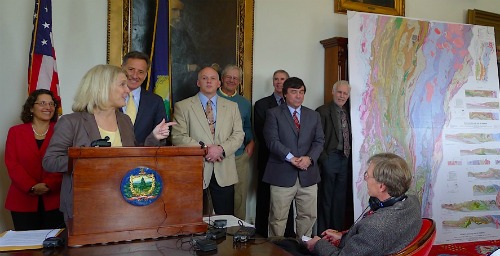
Gov. Peter Shumlin stepped away from the podium at his weekly news conference Wednesday, allowing state and federal geologists to display new maps of Vermont’s literal foundation, including bedrock which has been around for 1.4 billion years and scattered deposits of hard, flinty, granite.
After the geologists left the room, Shumlin turned hard and flinty himself on the issue that has dominated the Statehouse for days – the $21 million utility merger “windfall” and how it would be returned to the Central Vermont Public Service Corp. customers who paid it over the last several years.
A clear majority of the Senate, a likely majority of the House, and quite possibly a majority of the electorate think the money ought to be paid back by being … paid back, refunded to the customers of the utility, which has agreed to merge with Green Mountain Power.
The two utilities and the Shumlin administration disagree, and Shumlin defended his position more bluntly than he had before. His preference – that the $21 million be used to improve the “energy efficiency” of the homes and businesses of CVPS customers – was “the best possible deal for ratepayers,” he said, even if it meant that some of those customers would not get their money back as the term is usually understood.
Asked specifically about Mary Durfee, the 78-year-old St. Albans woman who complained that she and her husband had already tightened their home against the elements and would not live to see any benefit from a general upgrading of energy efficiency, the governor acknowledged that they would not, but that the benefits to the state as a whole would be greater.
Just as older people remain obligated to pay for public schools long after their own children have graduated, he said, individual ratepayers have “a collective responsibility” to support a plan that would “create jobs” and enable Vermonters to “use less energy.”
That responsibility, he said, is “just as important as public education.”
In the current political climate, politicians, even in Vermont, tend to be wary of talking about “collective responsibility.” In this case, Shumlin’s candor, while hardly likely to end the controversy over the $21 million, could very well tamp it down a bit. By holding fast to their opposition to any legislative intrusion into the pending case about the utility merger before the Public Service Board, the governor and the House leadership have raised the bar the dissident lawmakers will have to cross to pass legislation ordering a cash refund to the ratepayers.
The Public Service Board is scheduled to rule on conditions governing the merger sometime in June. This schedule renders it unlikely that the controversy will last nearly as long as the 1.4 billion year age of some of Vermont’s rocks, or even the mere 450 million or so years since those – and later-arriving – rocks settled into something like their present configuration.
In the long run, then – or actually, in this context, in quite a short run – the presentation of the geologic map will turn out to be more significant if less controversial than details of the utility merger. Introducing the geologists, Agency of Natural Resources Secretary Deb Markowitz said the new Bedrock Geologic Map “tells the story of Vermont,” and “illustrates our commitment to using good science.”
Calling the map “art and poetry,” as well as science, Markowitz said, “It’s complex. It’s mysterious.”
“Every 50 years or so something big happens,” Shumlin said. “This is one of them.”
This is Vermont’s third Bedrock Geologic Map. The first was produced 150 years ago and the second in 1961. Even that more recent map predated the development of plate tectonics, the study of the large-scale motions of the lithosphere, the earth’s outermost shell. Plate tectonics has for decades been an indispensible geological tool,so the new map is far more detailed than its predecessors.
According to Nicholas Ratcliffe of the USGS, the map reveals that some 570 million years ago, much of Vermont was an ocean floor. The oldest rocks in the state, Ratcliffe said, are in South Londonderry. The youngest, a mere 20 million years old, is the lignite in and around Brandon.
The product of more than 30 years of work in the field and the laboratories, the map was prepared by the U.S. Geological Survey, state geologists, and faculty and students at the University of Vermont. Among the practical uses of the map, geologists said, are guidance in finding potential sources of geothermal energy, choosing safe sites for waste disposal, and protecting sensitive ecosystems. The map could also help alert well-drillers where to be wary of possible arsenic contamination.
“The bedrock geology, in conjunction with the overlaying glacial deposits form the geologic system crucial to understanding economic and environmental issues that face our state,” said Laurence Becker, the 13th Vermont state geologist.
The map reveals two geologic phenomena Vermont does not have: faults likely to produce earthquakes (though the state could be rocked by quakes originating beyond its borders) and any appreciable deposits of natural gas.
That latter finding, Shumln said, should convince gas companies not to consider getting gas from the state by hydraulic fracturing (fracking), in which chemicals are injected into the ground to force natural gas out of the rocks containing it. Still, the governor said, he supports legislation that would ban fracking in the state.
He also reiterated his support for legislation that would allow physician-assisted suicide for the hopelessly ill. But he did not think the bill would pass, and he doubted that legislative officials would consider the effort to tack it on as an amendment to a tanning bed regulation bill to be “germane.”
As for legislation to require labeling of genetically modified food products, he favors the idea, but has been advised by lawyers that it could not survive a constitutional challenge.

