


The Shumlin administration says under state statute Vermont Yankee Nuclear Power Plant can continue to operate after its license expires on March 21.
The Vermont Department of Public Service, in a legal filing on Friday, says a Vermont law would allow the plant to operate past that date while the re-licensing process continues.
The state also asserted in its submission to the Vermont Public Service Board that the owner of the plant, Entergy Corp., must meet its obligation to fund the Clean Energy Development Fund. It is unclear whether the Louisiana-based company would still be required to pay millions of dollars in an assortment of other taxes to the state.
Gov. Peter Shumlin, meanwhile, told Vermont Public Radio on Friday he hopes the board, which has jurisdiction over the matter, will block a 20-year license extension for the 40-year-old plant.
Entergy Corp., the plant’s owner, and other parties to the re-licensing proceeding also filed papers Friday addressing the facility’s continued operation.
The company has yet to receive assurance from the Public Service Board that it can keep running the plant.”
Entergy obtained a victory in federal court finding the state overstepped its bounds when it tried to require legislative approval for the continued operation of Vermont Yankee.
The company has yet to receive assurance from the Public Service Board that it can keep running the plant. Entergy has gone back to federal court with two filings, asking for an injunction to ensure it can keep producing electricity after March 21.
In February, the board issued questions to Entergy and other parties asking how it should proceed and held a status conference March 9.
Entergy asked the federal court to step in, claiming it was not the company’s fault that the licensing process was put on hold by Vermont laws that were ultimately found unconstitutional.
Environmental groups and the state say the company needs to live up to its obligations under its existing permit.
One of these requirements, according to the filing by the Conservation Law Foundation, is that the facility can only store spent nuclear fuel produced up to March 21.
Neither the court nor the Public Service Board has announced when they will make a decision on the matter.
In 2012, Entergy made more than $7 million in total tax payments including an electrical energy tax ($1.4 million), an electric generating plant education property tax ($1 million), radiological emergency response plan payments ($2.13 million) and the Clean Energy Development Fund ($3.15 million), according to a report from the Joint Fiscal Office.
In addition, the corporation paid $108,000 in environmental fees for thermal discharges — hot water that flows from the plant into the Connecticut River.
Read the state’s filing with the Public Service Board 7440 DPS Cross Motion and Response
~ Alan Panebaker
House GOP allege Shumlin breached protocol
It isn’t often that a sitting governor makes an unannounced appearance in the House Chamber. Typically, when he or she graces the Big Room, it’s for an event filled with pomp and circumstance — the beginning of the legislative session, the budget address and the end of the session.
Last month, Gov. Peter Shumlin, a former representative and senator, sidestepped the usual form and took a seat in one of the plush red velvet-covered Senate chairs behind the House podium. The circumstance? The governor was making the rounds at the Statehouse with Thomas Sullivan, the new president of the University of Vermont, who was introduced to the General Assembly.
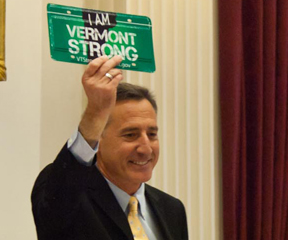
The governor didn’t speak or draw attention to himself, but his very presence was duly noted by Republicans who say Shumlin breached protocol by entering the chamber while the House was in session.
Rep. Tom Koch, a Republican member from Barre who has served in the House since 1997, called it a “symbolic type of thing.”
“When he’s at work, we don’t go marching into his office,” Koch said. “I don’t want to make a big stink about it, but it’s technically not proper.”
It’s a question of the governor respecting the separation of powers, according to Don Turner, the Minority Leader of the House.
“I know Gov. Shumlin is more down to earth, and it may be hard for him to be in that position,” Turner said. “I think he tries to be one of the people … but it’s the institution of our government that kind of is a question. When you’re the sitting governor you have certain obligations about the way you’ll act.”
Speaker of the House Shap Smith said he couldn’t understand what the problem was. The governor, in his view, was courteously ushering the president of UVM around the Statehouse and ended up coming into the chamber for the introduction. “It seemed quite frankly to me much ado about nothing,” Smith said. “I was disappointed anyone would make any comment about it.”
Donald Milne, Clerk of the House, says the governor’s presence in the House was unusual, but not inappropriate. The Senate seats in the House, he said, are open to the public — and the governor is a member of the public.
Gov. James Douglas appeared in the gallery several times over the course of his tenure in office, Milne recalled.
Shumlin’s office didn’t respond to a request for comment.
Turner pointed to the brouhaha over a member of the administration texting answers to a Democratic lawmaker during an interrogation about the health care exchange bill as an example of the Shumlin administration blurring the distinction between the roles of the executive and legislative branches. (The Republican from Milton said his complaint has nothing to do with technology — he emphasized that he does not want to ban iPads or cell phones in the House.)
“The Legislature has the responsibility to draft bills and when the executive branch is responding to questions in real time, does that not breach the separation of powers?” Turner said. “It’s a question of protecting the institution. If a committee of jurisdiction does not understand a bill well enough that the chair cannot answer questions on the floor there’s a problem.”
Smith said Turner’s question about real-time electronic communication during debate is legitimate, and he has asked Koch and Rep. David Deen, a Democrat, to take examine the chamber rules.
Critics say Shumlin, a Democrat, has undue influence over members of his party who hold an overwhelming majority in the House and Senate, and these incidents make some wonder to what extent the Legislature is independent from the governor.
Doubts about whether the Democratic majority in the General Assembly can stand up to the administration may have been partially put to rest last week. Shumlin wanted the Legislature to approve the decriminalization of pot, a 16-bed psychiatric hospital, a new state office complex outside of Waterbury and the Death with Dignity bill. Lawmakers prevailed on all those policy decisions.
~Anne Galloway
Keller says federal law doesn’t require brokers’ fee prohibition
The House gave initial approval to a bill last week that would eliminate brokers’ commissions from the sale of health insurance insurance policies.
Some brokers are concerned the scheme would cut them out of the picture and leave thousands of Vermonters without support in the exchange.
In 2014 the state will require individuals and small businesses to buy insurance through a health benefits exchange system that will enable consumers to evaluate the actuarial costs and benefits of different types of insurance plans.
When Rep. Sarah Copeland-Hanzas, vice chair of the House Committee on Health Care, pitched H.764 on the House floor last week, she said under federal law insurance companies can’t “bake in” or combine brokers fees into insurance premiums in the exchange.
Not so fast, says Jeanne Keller, a health policy analyst and lobbyist who represents brokers.
Keller says the state will be prohibiting insurance commissions on its own, not under cover of federal law.
Under the Affordable Care Act, states can hire “navigators” who would help people select insurance plans. Navigators would be paid through grants and would not be allowed to earn money directly from insurance companies per the federal law. Brokers, on the other hand, can receive compensation from insurers through a rate schedule set by the state under the federal law, Keller said.
Ruling out the commission scheme the state has been using for years could mean sending a lot of people into the exchange in 2014 with only support from navigators, she said. That might not be enough for the roughly 183,000 people who must buy insurance on the online marketplace, Keller said.
Robin Lunge, director of health care reform for the Shumlin administration, said in an email that the state is working to find roles for brokers in the exchange. They could become navigators, charge a fee directly to the employer, or the exchange could pay brokers outside the navigator system, she said.
According to recent data from the Vermont Department of Banking, Insurance, Securities and Health Care Administration, businesses paid about $17 million to brokers in 2010.
~ Alan Panebaker
Editor’s note: This column was updated at 5:36 a.m. March 19 with the section about the governor’s visit to the House Chamber.
