

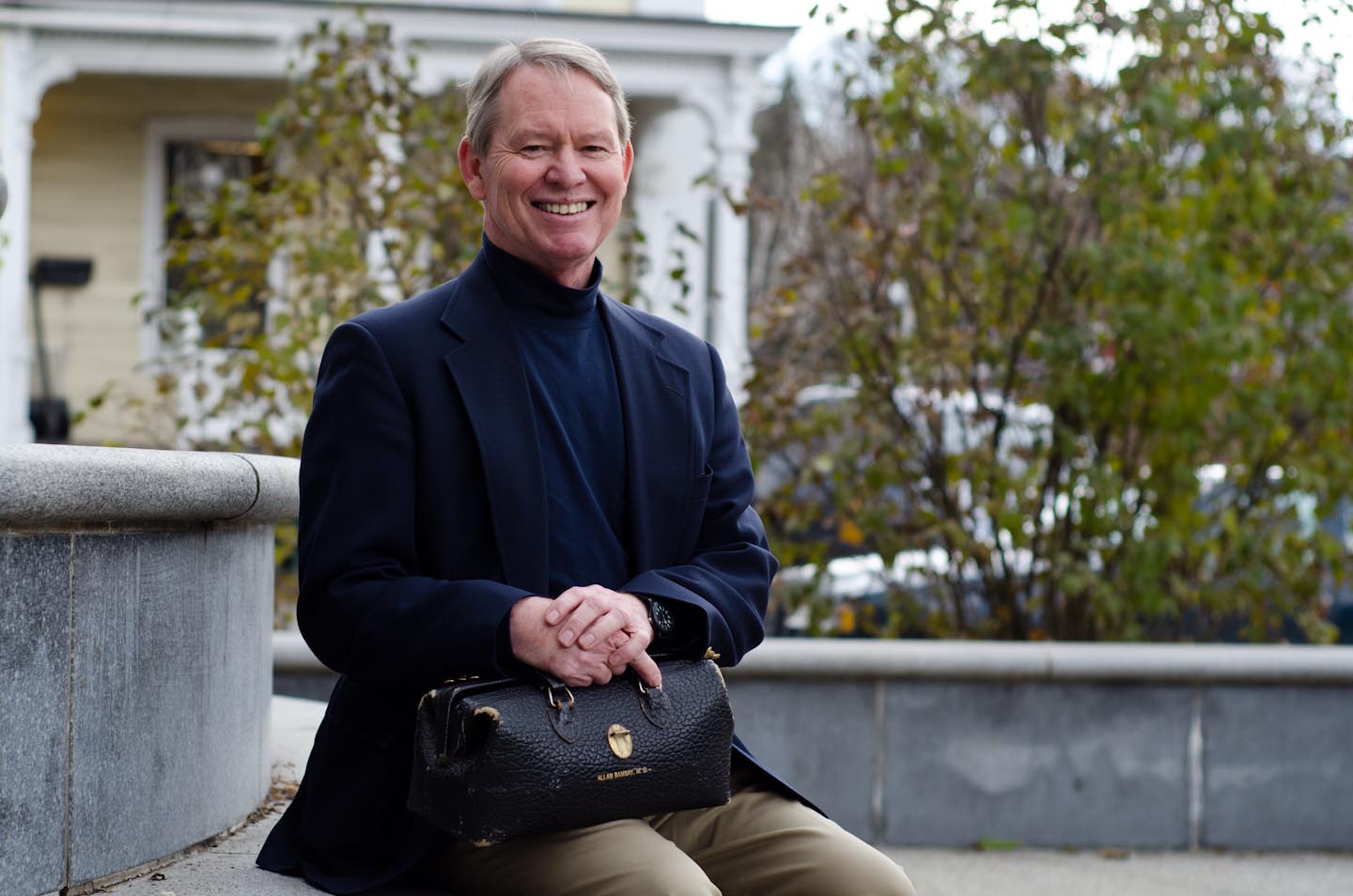
Thirty-five years ago Allan Ramsay graduated from medical school at Emory University and moved to a small town in Southern Colorado.
He was planning to go into the specialized field of oncology during med school, but he became a general practitioner instead because he wanted to build relationships with patients.
“I thought, if I’m going to be a real doctor, I better do it now,” Ramsay says. “A real doctor to me was a family doctor.”
Ramsay started Valley Wide Health Services, a rural, clinic health care system in southern Colorado. After five years, he moved back to the East, and embarked on what would become a career as a prominent physician in Vermont. After 30 years of holding various posts at Fletcher Allen Health Care and the University of Vermont College of Medicine, Ramsay resigned to take on a new role on the Green Mountain Care Board, which will play a major role in reforming the health care system in Vermont.
Ramsay, 64, gave up a successful career in medicine to take the position. He will not be able to work for a large hospital like Fletcher Allen because of conflict of interest issues, but will likely teach at the college of medicine as a professor emeritus.
Ramsay created the Palliative Care Service at Fletcher Allen Health Care in 2005 and the Rural Palliative Care Network to provide expertise to rural hospitals in Vermont and New York. He recently received the Distinguished Service Award from the Vermont Medical Society—the organization’s highest honor. He was, and is, passionate about his work.
One of Ramsay’s main goals is to ensure good palliative care for Vermonters. Palliative care, often confused with hospice, is a medical specialty that reduces or eliminates suffering — no matter what stage of treatment. Hospice is a version of palliative care that is specifically for people at the very end of life who would no longer going to benefit from curative or life-prolonging treatment.
Ramsay tells a story about a colleague and mentor in the palliative care field who helped convince him to get involved in the reform effort. Dr. Diane Meier, a pioneer in the palliative care field, had told him: “Allan, when it comes to reforming the health care system, you will be at the table, or you will be on the menu.”
Ramsay wants to be at the table.
The way Ramsay sees it, he has two constituencies. First and foremost, he has a responsibility to the people of Vermont: that means providing universal access, more primary care and good palliative care. He also has a responsibility to the medical community, to ensure high quality not only in the care the doctors provide but also in their practice life.
Part of this means giving doctors a voice in malpractice reform. Harvard University Economics Professor William Hsiao, who issued a report on health care reform to the Legislature, recommended that the state move toward a no-fault system that limits or eliminates medical malpractice litigation by ensuring compensation for those who are injured. For example, in New Zealand, a government-funded system compensates people with personal injuries, including those caused by medical malpractice, regardless of who is at fault.
Tort reform did not make it into Act 48, the health care reform bill. However, Ramsay says his colleagues will still expect to have a say in the issue.
Ramsay’s goal is pretty straightforward — he wants to focus on high quality care for all Vermonters. But reaching that goal is not so simple since the state has previously embarked on reform efforts like the Blueprint for Health and Catamount Health. According to recent U.S. Census statistics, Vermont already covers more of its residents than most states in the country.
“The problem in Vermont is that there isn’t any low-hanging fruit because we moved forward with reform faster than anyone else,” Ramsay says.
Ramsay is no stranger to making tough decisions, and he is not afraid to have conversations with patients that a lot of physicians might be afraid to have.
Dr. Tom Peterson, chair of the University of Vermont Department of Family Medicine, said Ramsay’s widespread respect in the medical community will go a long way in his new position.
“You need someone who has a really good understanding of how the system works,” Peterson said.
He said Dr. Ramsay has a track record for making difficult decisions, particularly in his work in palliative care, which is his passion.
“You see a lot of things [in palliative care],” Peterson said. “You see a lot of illness; a lot of health; and you see the way things you value over time changes.”
Treating patients with chronic illnesses; making sure they understand all their options; and trying to make care as good as possible for patients rather than focusing simply on fighting a disease is a tough thing for physicians to do, Peterson said.
Like Ramsay, Dr. Peterson said he understands the angst among physicians and Vermonters who do not know what reform means for them, but “the alternative is worse.”
For now, Ramsay said he is settling in and getting used to the learning curve in his new position on the Green Mountain Care Board.
“I’m just reassuring everyone they have a voice,” he said.
As a prominent physician working on health care reform issues, Ramsay says he might be a “lightning rod” for frustrations with the process or change that people do not like.
“I just have to remember,” Ramsay says. “It’s not about me. It’s about what we have to do.”

