

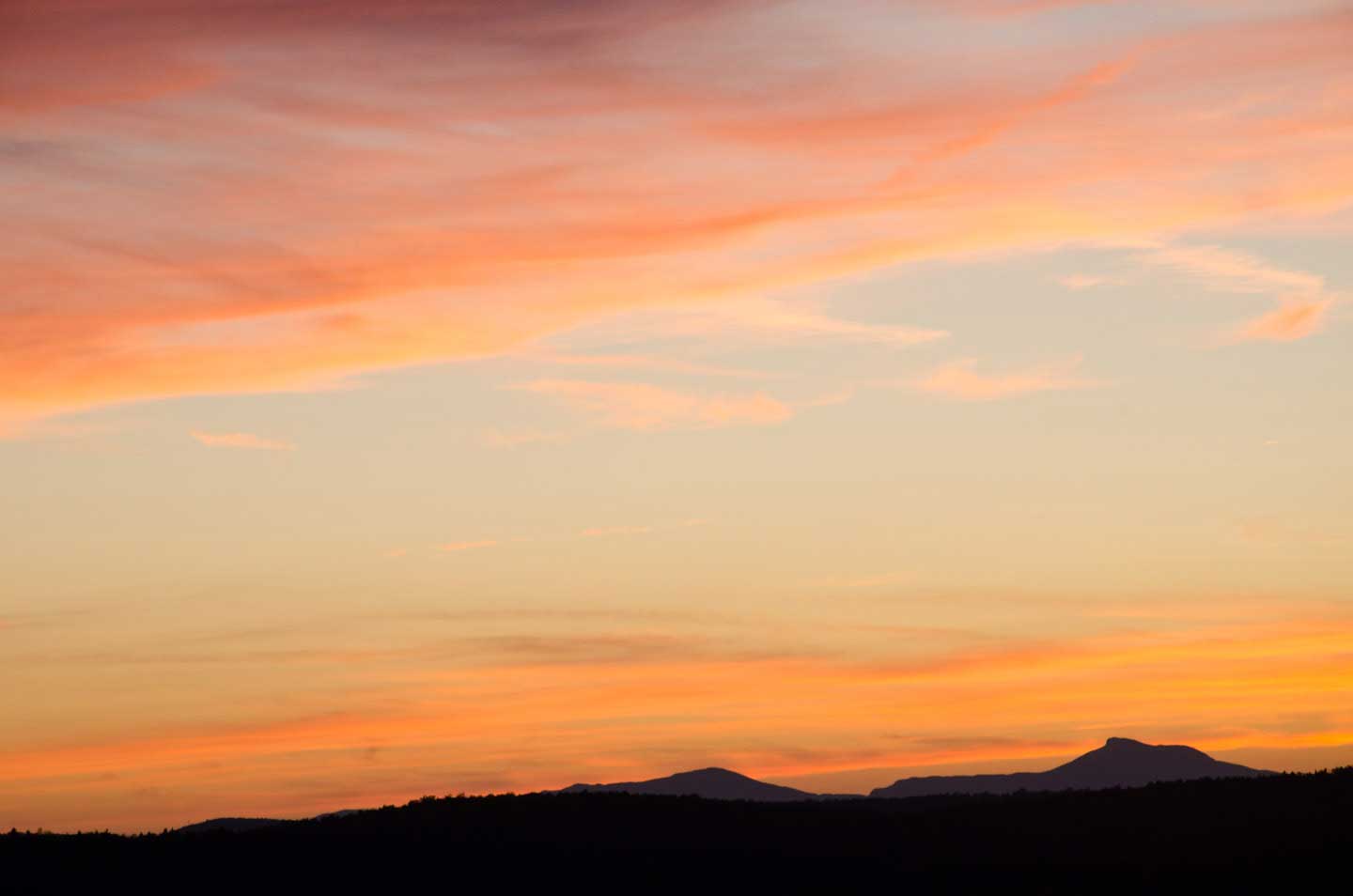
As Vermont hits peak foliage and peak hiking season, there’s good news afoot: Many Vermont trails are open and accessible for those seeking outdoor exercise and scenic vistas.
But one casualty of Tropical Storm Irene is iconic Camel’s Hump, whose trail access is still blocked by extensive damage to the approach roads on the Duxbury and Huntington side, according to the Green Mountain Club.
Camel’s Hump is one of the state’s five 4,000-foot peaks and a key destination in fall, said Will Wiquist, executive director of the Green Mountain Club. He said thousands of hikers troop up the peak in northern Vermont each year to enjoy its undeveloped summit and views of the high peaks of the Green Mountains.
However, other much-hiked peaks, such as Mt. Mansfield and Mt. Abraham in northern Vermont, are open for hikers, as are many other favorites such as Mt. Hunger, White Rocks and the Stowe Pinnacle on the Worcester Range.
Steve Cook, deputy commissioner of tourism and marketing, said Vermont is working hard to get the message out that the state is ready and open for foliage season.
“Vermont is becoming more and more accessible every day,” he said. The state annually sees around 3.5 million visitors during fall, and hiking is a prime outdoor recreation during fall, he said.
But whether it’s trails or roads, he added a caveat to “do a little research before you get here” at the state’s open-for-business Web site.
Wiquist said the state’s key hiking corridor, the 272-mile Long Trail from Massachusetts to the Canadian border, survived fairly well.
“The trail itself is mostly in good shape, except where it’s not,” he said, referring to a stretch just north of Clarendon Gorge from Route 103 to Route 4 near Killington, where a brook “took off with a big portion of the trail.”
That section, which is also part of the Appalachian Trail, remains closed for about 18 miles, according to officials from the Green Mountain National Forest.
The GMNF runs down the spine of the Green Mountains from Sugarbush Resort to the southern border and closure of the Appalachian Trail forced through-hikers on their 2,180-mile journey north from Georgia to the end at Mt. Katahdin in Maine to skip Vermont entirely. The Appalachian Trail coincides with the Long Trail until the two separate around Killington.
Wiquist said volunteers from the Green Mountain Club’s 14 hiking sections are beginning to get out on side trails to assess what’s open and look at damage. He said he didn’t have any financial figures but said it likely will be a costly and time-consuming effort to repair trails the club maintains up many peaks in Vermont.
“We think it’ll probably be a daunting task,” he said.
The nonprofit trails group based in Waterbury has had “quite a lot” of offers to help restore trails, which are appreciated. He estimated it could take a year to restore trails damaged by the storm.
On Friday, the GMNF listed five other trail closures, but conditions have been changing frequently and officials there urge checking for the latest trail updates.
GMNF spokesman Ethan Ready said two 20-person trail crews worked tirelessly after the storm so the 400,000-acre national forest could be reopened. Supervisor Colleen Pelles Madrid reopened the forest Sept. 16, a little over two weeks after Irene, but noted in a release that “bringing the forest infrastructure back to what it was will take many years.”
Ready said the GMNF crews were under “extreme pressure,” knowing that peak hiking season was looming.
“Our goal was to get the forest back up and running as soon as we can,” he said.
While that was accomplished, he said the scope of the damage was extensive.
“It was everything from road damage, culvert damage, blowdowns, stream erosion from stream banks,” he said, noting the impacts were heaviest in the same mountain towns that took the brunt of the storm, such as Lincoln, Rochester and Hancock, or the southern heart of the mountains around Killington and Wilmington and Mt. Snow.
Access to the Glastonbury Wilderness in southern Vermont remains an issue, because the east-west Kelly Stand Road is closed due to extensive damage, he said.
Ready said after all the publicity about closing the forest, he now wants to let visitors from around New England know the forest is open, though not back to where it was before Irene unleashed its deluge.
“There’s certain sections and certain specific sites that are not going to get completed this year,” he said.

