


Perhaps only in Vermont could a couple of legislators clicking into a website not intended for them rise (sink?) to the level of…well, it never became a scandal, but even a flap.
Just try telling someone from New Jersey, Illinois, or Louisiana that more than a few column inches of newsprint and minutes of air time were spent examining the ethics of this transgression. Said someone would respond with the blankest of stares.
Still, the episode is not without its value. It may even help provide some insight into potential strengths or weaknesses of the health care bill. It certainly illustrates how muddle-headedness reigns among some Republicans, Democrats, and journalists, whose transgressions here may at least equal the misconduct of the two lawmakers.
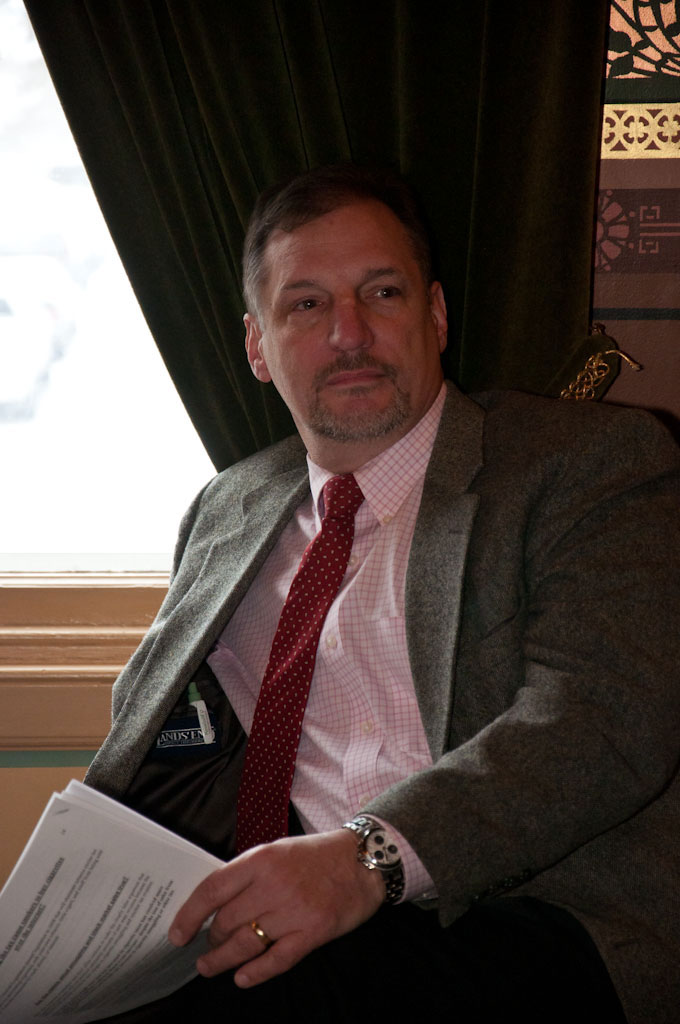
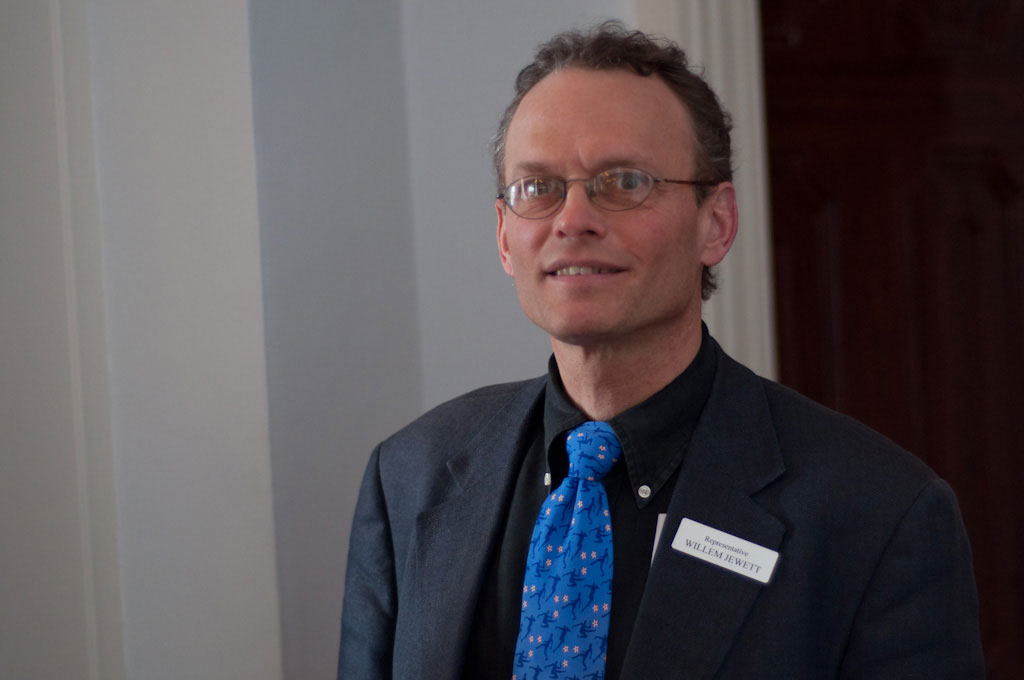
Not that they should have done what they did. One of them, Rep. Mike Fisher of Lincoln, said as much, and apologized to his colleague, Rep. George Till of Jericho (both Democrats, as is the other miscreant, Rep. Willem Jewett of Ripton who did not return a phone call).
Fisher and Jewett were the invaders of the web site, or, to be technically accurate, the url (uniform resource locator, a “link” in more common parlance) intended only for Vermont’s licensed physicians to participate in a poll on their views of the health care bill (H.202) making its way through the Legislature.
Till is a physician who designed the survey with the help of the Vermont College of Medicine, where he is on the obstetrics-gynecology faculty. He sent postcards to all 1,686 licensed physicians in the state urging them to take the survey and giving them the link via the Survey Monkey web site system.
Fisher and Jewett are not physicians. They took the poll anyway.
In the annals of villainy, this scarcely counts as a blip. Neither a law nor a code of ethics (the Legislature doesn’t have one) was violated. Fisher said he clicked into the survey “to see what the buzz was all about and to see if it was a secure survey.” He said he deliberately answered “neutral” on some questions to avoid distorting the results.
“I didn’t intend to have any impact,” he said.
As Dr. Till reports telling Fisher, he had an impact and distorted the results simply by taking the survey. But perhaps Fisher should not be blamed for not knowing this. He’s not a statistician.
Just as Dr. Till, not being a pollster, perhaps should not be blamed for what he later admitted was naïveté about his survey’s security. “I thought, this is Vermont. Who’s going to try to manipulate the survey?” he said.
Almost anyone, as it turned out. Participating in the poll, Fisher said, was “as simple as clicking on the link, and the link was being passed around on web pages. It was on blogs pro and con (the health care bill) and on news blogs.” No password was needed, just the url. Not only could non-physicians take the survey, they (or physicians) could take it twice, thrice, or more. Dr. Deb Richter, a supporter of the bill, who said she took the survey once but checked into it several times to see the results, said “all you had to do was erase your cookies and you could take it again.” (A “cookie” is a piece of text stored on a computer that can identify who has accessed a web site).
An insecure poll is … not a poll. Its results, while quite possibly accurate, are meaningless. In polling, quite possibly accurate isn’t good enough.
Both Fisher and Dr. Richter had nothing but praise for Dr. Till’s attempt to gauge the views of his fellow-doctors. “He was trying to do a good thing,” Fisher said, “trying to get some good data on how the doctors felt.”
Not surprisingly, Republicans, almost desperate as any small minority would be for any excuse to pounce, pounced. Republican Chair Pat McDonald issued a statement saying the Democratic leadership (Jewett is Assistant Majority Leader) “deliberately undermined (Dr. Till’s) efforts,” and “trying to keep Vermonters in the dark.” Rep. Jim Eckhardt of Chittenden lamented that Dr. Till had “used $1000 of his own money” (not really; see below) only to have “the Democratic Party go and purposely taint a harmless survey meant to give us information.”
More temperately, Rep. Anne Donahue of Northfield, while assuming that the Fisher-Jewett transgression was “more carelessness” without malicious intent, wondered if perhaps the Legislature should have a code of ethics and a mechanism for examining the seriousness of transgressions.
On the other side of the political spectrum, the liberal Democratic web site Green Mountain Daily accused Till of “trying to derail” the bill.
This seems unlikely. Dr. Till voted for the bill, though he has been critical of some aspects of it. His survey questions were straightforward, not tilted to evoke answers hostile to the bill. Besides, he embarked on his survey enterprise last summer, working through the College of Medicine and applying for a grant from University Heath Center, Inc., a 501(c)(3) corporation which works with, but is not part of, the College or Fletcher-Allen Health Care (the College’s affiliate).
The grant was approved. Dr. Till has put up the roughly $1,000 ($800 for the postcards, $200 to Survey Monkey, he said) but he will be reimbursed as soon as he gets time to complete the paperwork.
Both the bill’s opponents and many Vermont news organizations focused most of their attention on one question, and misinterpreted it, reporting that (these are WCAX’s words, but almost identical to those used by the Burlington Free Press and others) the poll showed that “more than one-quarter of Vermont’s doctors would leave the state if Vermont moves to a single-payer health care system.”
But: (1) The poll, as already demonstrated is not a poll, which is why the Associated Press, to its credit, would not have reported its results had not the “tampering” flap elevated the story; (2) The survey did not ask whether doctors would leave the state but whether they would “be likely” to stop practicing in Vermont under a single-payer system, a small but significant difference; (3) most important H.202 does not establish a single-payer system, rendering the question moot, a “hypothetical” in Dr. Till’s assessment.
Somehow, Vermont’s media seem unable to get their heads around the reality that the bill has dropped its original “single-payer” language. Vermont Public Radio’s “Vermont Edition” devoted its Thursday program to a debate over a “single-payer” plan that does not exist, a level of obtuseness that verges on irresponsibility.
Then there is the matter of journalists becoming so focused on the (invalid, in this case) information in front of them that they forget the real world. In that mysterious realm, almost every Vermont doctor has: a lucrative practice; a house, and one that perhaps cannot be easily sold these days; a family, or at least a significant other who (because people tend to marry within their socio-economic niche) also has a good-paying job nearby; a life, meaning friends and associations ranging from a preferred church to a favorite saloon.
And a sane person is going to give all that up over an ideological preference?
That doesn’t prove the health care bill is not making some physicians think about leaving the state. Dr. Till said he had heard of physicians pricing land in Florida and of a chief of surgeons urging his young associates to prepare their resumes.
That’s anecdotal, unconfirmed, evidence, but it’s not to be dismissed. Just think. If the Legislature were considering a bill that would fundamentally change the way lawyers, accountants, beauticians, or carpenters did their jobs and got paid, some lawyers, accountants, beauticians, and carpenters would start wondering whether they wanted to stay here. Doctors are no different.
Fisher said he has gotten the impression from some doctors that they think the system envisioned by the bill would pay physicians no more than they now get for treating Medicaid patients. That’s incorrect.
“We are not entertaining a Medicaid-like payment rate,” Fisher said. “The provider community has to be economically viable.”
While few doctors would leave the state simply because the bill passes, many might leave if the new system lowers their income. It might. In fact, like the national health care bill passed last year, holding down the rise of the compensation of some physicians (if not exactly reducing their incomes) is intrinsic to the concept of H.202.
The first task of the board, which would be created under the bill, is to control the rising cost of health care. One reason health care costs twice as much in the U.S. as it does in most other wealthy democracies is that doctors here earn more money, with American specialists earning considerably more than do family physicians.
A basic concept of health care change, as envisaged by both President Barack Obama and Gov. Peter Shumlin, is to make sure that everyone has access to a primary care physician so that fewer will have to see one of those specialists in the first place. If the Vermont plan works as Shumlin et. al. hope (always a big “if”), those primary care physicians would be paid not to treat the sick, but to keep the healthy from getting sick. Their economic incentive, then, would be, for instance, to get patients to change their diets and to exercise more so fewer would suffer from diabetes and heart problems. In that case, eventually the state would need fewer endocrinologists and cardiologists.
If it works out that way, Vermonters will look back and celebrate H. 202. But endocrinologists and cardiologists might not see things that way. Sure enough, it was mostly the specialists who told Dr. George Till’s survey that they’d be likely to leave Vermont if a single payer system were adopted.
A single payer system is not about to be adopted. Dr. Till’s survey has been rendered unscientific, hence invalid. The distress of some medical specialists is reasonable.
