

Editor’s note: Barbara Ann Curcio is a former syndicated columnist and reporter for The Washington Post.
WARNING: THIS STORY CONTAINS FOWL LANGUAGE.
Let’s talk turkey. No, not single-payer; the UVM Cats or how we’re all roof-deep in snow, but that down-home Vermont bird — the wild turkey.
This is a tough time of year for the Big Bird in Vermont. While we’re all warm and cozy inside, consider the plight of the poor turkey that has to wing it in winter — subsisting on mosses, buds, fern spores, seeds and the like. That’s as long as the snow’s hard-packed enough for walking and foraging (deep powder = deep trouble).
Talk about your cold turkey.
And once the spring comes, it’s “game” time and they’ll be dodging hunters fired up by a winter of watching “Turkey Call” on the Pursuit Channel.
But they’re tough birds and consummate survivors, given half a chance by humans and nature.
In 1854, the turkey went extinct here, given the bird by unregulated hunting and loss of habitat. Back then only 25 percent of the state was forested, and 75 percent open land, now it’s exactly the reverse — and definitely more turkey-friendly.
“Turkeys were one of the first to go, even before the beaver and the white-tailed deer,” says Lawrence Pyne of Vermont Public Television’s “Outdoor Journal,” The Burlington Free Press and Field & Stream.
But they’ve been thriving again for the past 42 years, with a turkey population estimated at up to 55,000.
In case there’s any doubt, we’re talking about the real thing here — meleagris gallopavo silvestris — a real mouthful. This is NOT the Hollywood-starlet, too-top-heavy-to-fly, unnaturally over-endowed triple D-Cup, domestic turkey with its thermometer implants, famous buttery moniker and paltry survival skills — a real butterball, as it were.
But just because the wild version is readily available right out in your back field, they’re hardly easy pickins.’ Turkey hunting is tricky — exceedingly tricky — and they’re not just one-trick ponies, hunters will tell you.
Talkin’ Turkey
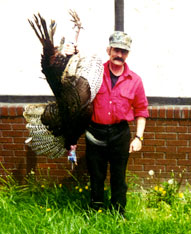
Turkey Hunting Tips
In this Vermont Folklife Center interview conducted by Greg Sharrow and produced by Erica Heilman, Addison County hunter Barry Forbes, pictured above, demonstrates some fowl talk and discusses the psychology behind luring in the toms.
“Some men are mere hunters, others are turkey hunters,” South Carolinian writer and hunter Archibald Rutledge once pronounced.
But wait, don’t shoot yet. Some history first. The first (private) attempts in the 1950s to bring the birds back failed, when game-farm turkeys released into the wild couldn’t survive without their customary handouts from farmers.
Then in 1969, when the Vermont Fish & Wildlife Department imported 31 “seed” birds from New York State, placing them in and around Southern Vermont’s “banana belt,” it finally worked, and by 1973 we even had us a turkey hunting season.
“The reintroduction of the turkeys was successful beyond our wildest dreams,” says Pyne, creating what has become a model program nationally and internationally. Vermont has provided “starter” birds to Maine, Michigan, New Jersey, Ontario and even West Germany, he says. (Those are some traveling turkeys!)
According to Pyne, the turkey population is bigger now than in the history of the state, and they’re in every county and every town, even those that were formerly thought climactically inhospitable.
One of the “big” four
The turkey thus features prominently in F&W’s ambitious “Big Game Management Plan” for 2010-2020, included in “the Big Four” — along with deer, moose and black bear. While the turkey gets the same respect as its other three colleagues in the “game” plan, it still lacks its very own “Turkey Crossing” signs on major thoroughfares.
Though a vehicular run-in with a turkey will probably not kill you, they can be a nuisance. Stories abound about low-flying, suicidal birds and near-misses with windshields. Direct hits probably go unreported because they don’t do significant enough damage, says Forrest Hammond, wildlife biologist at Fish & Wildlife. Victims of ill-timed turkey crossings on rural roads might say that there may be such a thing as too many turkeys.
Think about it: No one ever asks “Why did the turkey cross the road?” Either they’re smarter than chickens or they just don’t live to tell about it.
The tom’s heads are like mood rings. As they get more and more excited about mating, their wattles and snood can change from bright red to blue to white hot.”
In any case, the “Big Game Plan” — read it if you can, all 74 pages of it — was written to “guide conservation and management for the next 10 years”; help preserve the “tremendous hunting opportunities and provide hours of wildlife viewing”; and educate the public about how development can fragment and compromise turkey habitats.
The conservation program is funded by the sale of hunting licenses, along with taxes on firearms, ammunition and archery equipment.
These taxes and fees “generate more than $100 million each year for wildlife projects across the U.S.,” reports F & W. Vermont uses the funds to acquire land for “restoring and managing wildlife.”
Such efforts do not go unappreciated in a state where some 30 percent of Vermonters fish or hunt (versus 19 percent who ski). In fact, per capita, we are third nationally behind Maine and Alaska in numbers for hunting, fishing, trapping, feeding and observing wildlife, according to F & W.
“Be wary or be dead”
Which brings us back to the turkey, which can count among its friends Ben Franklin, who actually preferred it over the bald eagle as our national bird, says Pyne. Franklin thought the eagle a “scandalous bird,” lacking the moral fiber to represent the new nation. While turkeys were brave and noble like the new political union, eagles were shiftless fish thieves, victimizing harder-working birds. Or so the story goes.
Yet, it’s the turkey whose name is taken in vain. Back when the Vermont Legislature was debating the introduction of a turkey hunting season, proponents were known as “Turkeys” to their worthy opponents (just exercising their legislative pejorative, er, prerogative).
Pyne, however, agrees with Franklin, calling them “magnificent” birds.
Deciding for oneself is no simple matter, as getting close to these elusive birds is difficult. (Just try snapping their picture, for example.)
But when you do, what exactly makes them tick? Are they real turkeys, or what? Are they brave and bold or just big chickens? Just who are they and what do they want — to paraphrase a former vice-presidential candidate?
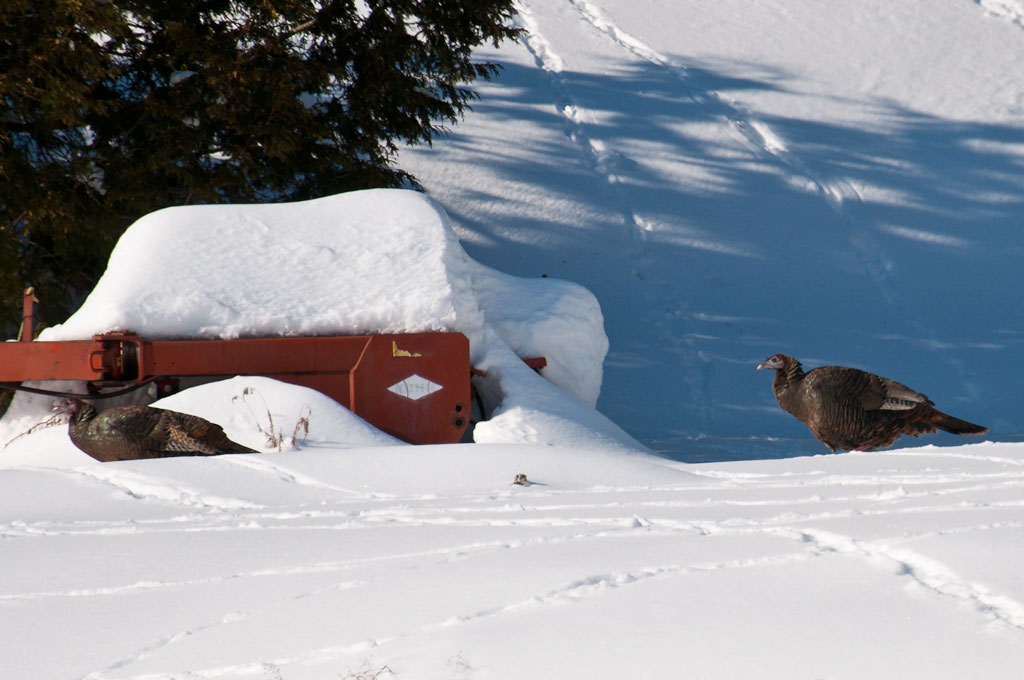
Basically, for a turkey it’s all about “stayin’ alive.” As prey animals, it’s “be wary or be dead,” says Pyne.
“Everything eats turkey — even other birds who steal their eggs,” says Pyne. Once hatched, the babies are then prey to all sorts of smaller creatures who wouldn’t touch the bigger, older birds.
“The first two weeks of a poult’s life are the most precarious,” says Dennis Jensen, outdoor editor at The Rutland Herald. Besides predators, they are also vulnerable to starvation or exposure in a cold, wet spring. A poult hatched in the spring will start out with around 11 siblings and by autumn will typically be down to about seven.
For full-grown turkeys, the predator pool is smaller, but they are still susceptible to coyotes, bobcats and other larger cats. Adults average 16-25 pounds, making them one of the largest birds in the United States, says Hammond, outweighing the bald eagle.
“Once a tom’s survived two or three hunting seasons, it’s more likely he’s going to die of old age,” says Jensen, because they have experience eluding hunters. Even the poults become more wary once they’ve had an encounter with a predator, according to the documentary “America’s Wild Turkey” from F & W’s library.
Seasoned hunters pursue the older birds, also known as “long beards,” says Hammond. And therein lies the addictive nature of turkey hunting.
“Real hunting is the combination of good woodsmanship and good calling skills,” says Pyne. “It’s a really interactive form of hunting, a lot like a chess match.”
Wattles, snood and all
One thing’s for sure: Turkey aficionados are particularly devoted to their fowl friends. “I love to watch ’em, listen to ’em, hunt ’em and eat ’em,” says Jensen. “And when I get too old to drag the shotgun out, I’ll probably still go out there and call to them.”
Partly what attracts hunters is the turkey’s beauty. Tom turkeys are most impressive, says avian ecologist and Associate Professor Allan Strong of UVM, when they’re strutting their stuff for the ladies in the spring courtship ritual. And what exactly is the well-dressed tom wearing? Says Strong, “They have beautiful iridescent green, copper and purple feathers and they puff up to about twice their normal size while displaying themselves.”
The three rules of turkey hunting, or even just turkey watching, are “Don’t Move,” “Don’t Move,” and “Don’t Move.”
The tom’s heads are like mood rings. As they get more and more excited about mating, their wattles and snood can change from bright red to blue to white hot. Then there are their spurs, sharp outgrowths on the back of their legs that don’t jingle-jangle-jangle, but get longer and sharper with age and are used in battles for dominance with other toms. And the males have “beards” — well, duh, you’re thinking — but they are actually in the middle of their chests.
But a turkey is more than just the sum of its parts.
Their unpredictability is what keeps hunters hunting, and, as Pyne likes to say, “roosted ain’t roasted.” You can never get too over-confident, he says. “They seem to know when it’s hunting season,” explains Hammond.
And the experience varies between the two hunting seasons: “You’re not going to kill a tom in the fall. They’re not looking for a hen, they’re looking to survive,” asserts Pyne.
Spring or fall, “You can’t just ‘slob’ out there and kill a wild turkey,” says Jensen. “It takes skill.”
Road hunters need not apply. The best hunters track their birds in the off-season, to ascertain flock movements, habitats and grazing patterns. Babies will come back to feed where Mama took them.
And while you’re observing them, they just may be watching you, too. Turkeys have a keen sense of self-preservation, coupled with amazing eyesight and great hearing. “They have the ability to pinpoint sound and come to the exact tree where I’m sitting,” says Jensen.
Their sharp eyesight makes them daunting opponents. The average turkey sees at least 10 times better than people, according to Vermont Fish & Wildlife. They can even distinguish colors — like hunter’s orange, says Hammond. Or camouflage? (He won’t say.)
Now hold on a minute, just how much better their sight is than ours depends on whom you ask. Professor Strong says it’s two and a half times.
Jensen is dubious: “Just how the heck do they measure that?” But there is no denying, he says, that a turkey has much better ability to detect movement. So the likelihood of a turkey sneaking up on and bagging an unskilled hunter is, at least theoretically, far greater than the reverse.
“A turkey can see the slightest movement from 100 yards away…even if you just move your arm, they’re outta here. A deer won’t see that,” says Jensen. Adds Pyne: “A deer sees a stump and thinks it’s a stump. A turkey sees a stump and thinks it’s a man” — a man who may be packing heat.
Hardly surprising, then, that the three rules of turkey hunting, or even just turkey watching, are “Don’t Move,” “Don’t Move,” and “Don’t Move.”
The toms can also be quite intimidating, and facing them requires intestinal fortitude. Says Jensen: “Some guys get really rattled, with a turkey gobbling at the top of its lungs running straight at them from 40 to 50 yards.” He admires the bird’s courage. The hens are pretty gutsy, too, he says.
Jensen was walking up a trail a few years back and saw some poults scattering. The hen saw him and charged.
You want a piece of that? Hunters had better be prepared to talk turkey. The main strategy for turkey hunting is knowing fowl language — and being prepared to use it. “I speak three languages,” says Jensen. “English, pig latin and turkey.”
“You know it’s not turkey season when you’re not practicing your calls in your car,” says Pyne.
Talking turkey

These calls come in handy in the spring when turkey hunting is literally all about tom foolery. The turkey hunter must sound like a real turkey — a female. Unfortunately, toms “looking for love in all the wrong places” end up getting hung out to dry.
“You can have a whole conversation with them,” Pyne says. So what exactly are they saying? “I am a big handsome Tom and you need to come to me.” And the reply? “No, I am a beautiful hen, and you need to come here.” It’s that basic. A really good caller can fool other hunters, too. “Sometimes I think it’s a bird, and it’s another hunter,” says Pyne.
Then again: “I had a coyote come in once thinking I was a turkey,” says Jensen (the coyote probably disappointed that it wasn’t lunchtime after all).
When you’re “talking turkey” — male or female — there are at least nine different distinct calls, according to the State of Wisconsin “Environmental Education for Kids” website. These include the Tree Yelp — a sound they make only in the a.m. that says “All is well after a nite in the old roost”; Plain Yelp (“communicating with birds far away”); Cluck (yo, pay attention!); Gobble; Purr; Putt; Mating Call (‘3 yelps, pause, then 2 soft clucks”); the Cut; and the Cackle (for laughing at inept hunters?).
Jensen has a few unusual calls in his repertoire — for example, the “Assembly” call, used to gather up the flock. Four or five hens usually flock together, and a nesting Mama Hen who doesn’t want another hen near her will make a “Cut” call (sounds like the word “Cut”), when agitated. But Jensen doesn’t use it for this purpose, he uses it because toms are attracted to it — he’s bagged a few using that sound. Then there’s the “Kee-Kee-Run,” the sound of a panicked turkey who has been separated from the flock. Or the “Cluck, Purr, chick-chick!” Jensen has learned “sounds that have never been heard before,” he says — no doubt from all that time spent in the company of turkeys.
But “Once you hear a ‘Putt’! It’s game over,” says Jensen. Time to pack up the gun and go home.
One time he was yelping like a hen and a tom started gobbling back. “I was yelping (he demonstrates) and he was gobbling back (he gobbles) and the closer the tom got, the more frantic the calls. “Gobble!….yelp…. gobble!.. yelp..gobble/yelp! “That’s when you know you’re gonna get a turkey!”
Bagging the big bird
Once you’ve got their attention and called them in, then what? (The squeamish will want to stop reading now.) When it comes to turkeys, it’s shoot to kill: The best hunters aim for the head and neck for a clean kill. Shooting them in the wing won’t necessarily kill them, because their tendons are so tough with “wings like armor,” says Jensen.
And while it’s satisfying to bag a bird, for hunters the whole experience is just as important: “You shoot so you can hunt, not the reverse,” says Pyne.
As for success in turkey hunting, “Luck has nothing to do with it,” says Jensen. “Consistency, killing turkeys year after year, is the mark of a good hunter.”
And a willingness to do more than just “talk the talk.”
Knowing your turkeys means learning the smallest details. Once they’re old enough, turkeys sleep in separate trees, a different one every night.
Babies are taught by their mothers to “scatter,” “hide” or “come back,” as a means of deterring predators.
Males mate with as many females as they can — to assure the preservation of the species — and in turn hens do their part by laying as many eggs as they possibly can. Jensen once saw 18 eggs in a nest, though the average is more like 10 to 12. So yes, turkeys are polygamous.
Eating, breeding and fleeing seem to be their three main activities, and of course, if you happen to be male, the related fighting (over breeding rights and food). There seems little doubt that turkeys would rather flee than fight, unless there’s a female turkey of breeding age around. And forget any ideas you might have about turkey society as patriarchy.
In the spring “the hens are in charge,” says Pyne. “They want to be bred.” All turkeys are smart enough to follow the Hen in Charge &mdash a dominant older hen who calls the shots — probably a tough old bird, who rules the roost. Every flock has one, and she knows where they will find their next meal. “And if she calls her flock before you do, it’s game over,” says Jensen.
Another anomaly: Jensen once heard a hen gobbling. Talk about a case of gender confusion.
And on the subject of fleeing: They can either turkey-trot away from danger, as fast as 25 mph, or fly away at up to 35 mph. Although somewhat lumbering in the takeoff, they get the job done.
Then there’s the matter of the National Wild Turkey Federation (NWTF): To join or not to join? Actually, it’s not for the birds at all.
Turkeys are more personable than you might guess, too, and can also be friendly and curious. Forrest Hammond raised them for food and found them quite sociable. They followed him around, wanted to roost on his porch, came when called and retired to their roost at night without any prompting (unlike chickens, he says). His birds liked to have their tummies rubbed and would stomp their feet in pleasure when massaged. He thinks a wild turkey could easily be a pet, since they imprint on the first thing they see. As for his personal flock, in the end, he couldn’t “execute” his plan.
All that AND they have good taste, too. “They have a smoky flavor as good as any free-range organic turkey you can find at the market,” says Pyne. “Wild turkeys are a better bird.” (Cooking tip: Since they have no fat, “wrap them in the cheapest bacon you can find and grill them,” Jensen suggests.)
More turkey facts: Wild turkeys like to free-range in the open, in fields or pastures, says Hammond, which of course makes them more vulnerable. But grazing in flocks is their natural safety mechanism. “If one turkey doesn’t see you, another probably will,” according to Hammond. He has even had reports of turkeys and deer grazing together. Now, that’s a hunter’s fantasy if there ever was one.
As for turkey/human relations, it’s typically their love of corn, above all, that gets them into trouble with farmers, whose silage they covet.
When turkeys behave badly, the local USDA Wildlife Services will intervene in what F & W calls “conflict situations.” And when the farmers think the birds are behaving like, well, turkeys, interventions might include “hazing” — loud noises — such as shooting off cracker shells to drive them away. Putting out spoiled silage for the birds at another location is also a strategy. But sometimes it’s a job for Wile E. Coyote in the form of decoys, complete with moveable heads and tails.
With prior approval of a game warden, shooting delinquent turkeys on your property is allowed by the Vermont turkey statute. But, to be fair, what constitutes a delinquent turkey is likely to be a one-sided story — unless you can get a hunter to translate.
Putt!

