


Editor’s note: “Inside the Golden Bubble” is an occasional news analysis column on politics and public policy.
The opening day of the 2011 legislative session marked the end of divided government for the next two years, and a new period of Democratic dominance. With the changing of the guard on the Fifth Floor, Democrats will hold the governor’s office for the first time since 2002. The last time the party also held the Senate and the House was 2000.
There is no question that the Dems wanted gubernatorial power badly. And now that they have it, the question is, will they succumb to pent-up demand from advocates for significant changes in policy and funding for services? If the first day of the legislative session is any indication, the answer is yes — to a degree.
Whatever pressures Democrats feel from activists and lobbyists of various left-leaning causes, however, the vise grip of the $150 million budget gap will temper lawmakers’ desire to float new proposals that don’t save money or aren’t at least revenue neutral.
Gov.-elect Peter Shumlin and his righthand man, former state treasurer Jeb Spaulding, and the secretary designee of the Agency of Administration, have warned the budget proposal they will introduce to lawmakers on Jan. 25 will be austere. Shumlin has pledged not to use money from the budget stabilization fund (a.k.a. rainy day fund). He has also said he will not raise taxes. That leaves only several alternatives, such as cutting services and wringing more efficiencies out of state government. Spaulding said in an interview that the administration is looking at a menu of unpleasant options, including increasing copays and premiums for the Catamount Health program, which provides government-subsidized insurance to Vermonters.
Hours before Gov. Jim Douglas gave his fond farewell to lawmakers and members of his staff and administration, there was a palpable psychological shift in the house of hopes and dreams.
On Wednesday, the new leadership made promises with an immediacy that wouldn’t have been possible a year ago when the Republican governor and his administration were at the ready to quash Democrats’ health care reform initiative and unmitigated support for human service programs at the low point of the recession.
Last year for example, Douglas eventually agreed to shift $400,000 from the weatherization program to homeless shelters as part of the Budget Adjustment Act, but the last minute-deal was touch and go. He opted not to sign Act 128 into law, the health care initiative that will culminate in a report from Harvard economist Dr. William Hsiao on three options for reform.
Yesterday, when single payer health care activists and advocates for the homeless pressed lawmakers and the governor to pledge support for their causes, little arm-twisting was necessary.
At a rally of several dozen people on the Statehouse steps, Gov.-elect Peter Shumlin and House Speaker Shap Smith promised to give homeless shelters $500,000 as part of the Budget Adjustment Act before the end of January.
A half-hour later, Smith and three other members of the General Assembly pledged to support health care reform, though it wasn’t clear whether single payer will be the alternative they consider exclusively. Shumlin has made the adoption of some form of single payer a top priority, and has created a “dream team” of health care policy experts to shepherd a plan through a myriad of federal and state legal hoops. (Neither he nor members of his health care team spoke to the activists in the Cedar Creek Room. It isn’t clear yet whether the new governor would endorse a “pure” single payer system, in which the government would administer payments to doctors and hospitals or a unified payment system, like Germany’s, in which the government sets prices for health care services and multiple insurers administer the payments.)
The dual message of new opportunity and fiscal restraint appears to be the main theme of the new administration and the 2011 session. Expect lawmakers and the governor to look for twofers – programs that achieve their twin goals of making state government more service-oriented and more cost effective, a la Challenges for Change.
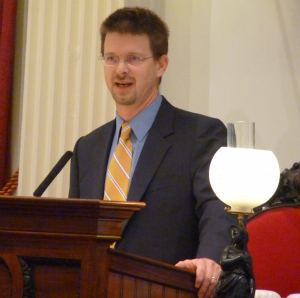
Smith, for example, announced a new initiative to upgrade the energy efficiency of 20 percent of the state’s building stock, in his address on Wednesday. He declared that the proposal would save money and help the environment.

It’s the kind of commonsense, modest proposal another elected official – of a different political stripe — might have endorsed, though with a different twist.
Smith ended his speech with this injunction to House members: “When wading through the tough choices we will undoubtedly face, I ask that you keep in mind what gives Vermont its character. Our independent nature; our commitment to a beautiful working landscape and pristine environment; our strong educational values; our dedication to healthcare for all; and the collaborative work ethic of its citizens. Keeping in mind these values, we can achieve great things, strengthen our communities, and insure our economic vitality.”
Gov. Jim Douglas, in his farewell address later that afternoon, rattled off a host of large and small accomplishments over the course of his eight years that fell within the parameters of a similar rubric, though with an emphasis on enjoining Vermonters who are having a tough time to find a way to pull up their bootstraps.
“Our ability to prosper is also a function of our fiscal management,” Douglas said. “We spent within our means, replenished and protected our stabilization reserves, and improved the effectiveness and efficiency of government. Even as the Great Recession squeezed revenues, we protected the most vulnerable and reformed programs to help those who have fallen on hard times realize a path back to self-sufficiency and independence.”
Though the Dems are setting the agenda in the executive and legislative branches, Smith warns that it won’t be all love, peace and harmony. He’ll be vetting Shumlin’s budget proposals, and he expects there will be disagreements.
“People should remember the Legislature is not going to do just what Peter (wants),” Smith said in an interview. “Peter and I have always had a good relationship, but where we have disagreed we moved along our own way. … I want to work with Peter; I agree with many of the things he does, but where we think there’s a direction we should go in, we will move forward in saying that. I think Peter understands that, too. It’s also about how we go about it. I don’t want to go to a place where we have dueling press conferences, but where we disagree with him we will let him know.”
Video footage of Smith’s speech follows. Due to technical problems, Douglas’ speech won’t be available until later today.
CORRECTION: Gov. Douglas wasn’t only reluctant to sign Act 128 — he refused to sign it.
