

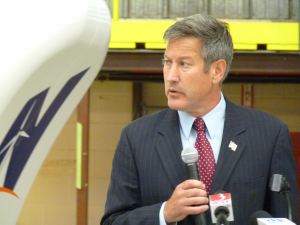
In the WVMT debate on Monday, Lt. Gov. Brian Dubie, the Republican candidate for governor, chastised lawmakers for their unwillingness to accept the Tiger Team recommendations. He said the reports, which were generated in December 2009, “will help us make reforms going forward.”
The Tiger Team reports were developed by groups of upper and middle management employees in the Douglas administration and orchestrated by Tom Pelham, a deputy secretary in the Agency of Administration, former Tax Commissioner and former commissioner of Finance and Management.
The Teams proposed significant reductions in health care programs for the poor and the mentally ill.
The individuals assigned to each team did not have expertise in the given areas they were asked to research. The teams analyzed audit reports and financial statements for state-funded programs run by designated nonprofit organizations, such as affordable housing groups and community service providers for mentally and developmentally disabled Vermonters. They also examined Medicaid expenditures for the suite of federally subsidized health care programs offered under Green Mountain Care: Medicaid, for the very poor; Dr. Dynasaur, a program for low-income children; and the Vermont Health Access Program and Catamount Health programs, which are designed for uninsured Vermonters.
Most of the Tiger Team suggestions were rejected by the Legislature. Several of the recommendations were adopted in the Appropriations bill, however, and in the Challenges for Change plan. Lawmakers, for example, approved a budget increase for an office that tracks Medicaid fraud and abuse. They also endorsed the creation of a clinical utilization review board, which could place caps on, say, the number of times Medicaid beneficiaries can go to the emergency room, visit a physical therapist or receive chiropractic services. CURB, as it’s known, is part of Challenges for Change and could save as much as $4 million.
“We were reasonably favorable in our review of CURB — we thought that was a reasonable idea — although there was some question whether we would achieve all of the savings and on what timeframe,” said Rep. Steve Maier, D-Middlebury. “We were sorting things in three buckets. This one went into the good idea bucket.” Maier said the state’s drug utilization board has created similar standards for pharmaceutical use.
We asked Pelham to help us understand what kind of savings might be achieved, should the Dubie administration adopt the Tiger Team recommendations.
Here’s what we gleaned from that interview and a review of the Tiger Team reports:
The reports don’t overtly propose specific savings in each area – they instead show areas where the “fat” lies in an organization or agency. Critics say the reports are skewed and target programs that help low-income, disabled, young or old Vermonters.
The Medicaid Tiger Team report suggests the state could save a lot more than $4 million on utilization caps. According to one of the spreadsheets, $22.5 million could be saved out of the $460 million total spent on Medicaid benefits, if the state limited patient access to physical and occupational therapy, nonmedical emergency transportation, prosthetic and orthotic devices, speech and language therapy, medical supplies and equipment, podiatrist services, private duty nurses for disabled Vermonters, eye exams, vision care and visits to qualified federally qualified health care centers. The figures for each category are derived from comparisons with 10 states that offer “high quality” care, according to Pelham.
Pelham said if we restored patient participation rates — premiums, copays and deductibles — back to where they were in 2002 the state could raise $6 million.
Pelham says the state could save $5 million to $15 million if it required the state’s 14 designated mental health agencies to spend down their cash on hand, which in 2009 totaled $35 million over a sample 45-day period.
The Tiger Teams also proposed moving the weatherization program for poor Vermonters from the Agency of Human Services into the Efficiency Vermont Program. By consolidating the programs, Pelham estimates $2 million could be saved.
“These ideas would be controversial,” Pelham said, but they would put Dubie “within kissing distance” of the $110 million,” and he would have more than that in savings if he pursued $84 million in cuts to education.
Rep. Ann Pugh, D-South Burlington, who is chair of the House Human Services Committee, said lawmakers looked at cuts that wouldn’t destroy the safety net for low-income Vermonters; the rest of the Tiger Team suggestions are questionable, in her view.
“People were looking under rocks to save money and maintain a modicum of a safety net,” Pugh said. “What is left in the Tiger Team reports is either against federal law, or the result would be untenable in terms of access to necessary bottom-line services. Are we going to roll back on our stated goal that more Vermonters are covered with health insurance? If we’re going to increase co-pays to a point where you don’t use it (services) because the co-pays are too high … it’s going to be an empty promise. I’m not going to say we have health insurance for all Vermonters when it’s an empty box of cereal.”
Pugh, who is a professional social worker, said one of the Tiger Team recommendations for mental health services was to introduce “standardized individual care plans,” as opposed to providing individualized treatment plans for Vermonters with mental illnesses.
“We are talking about people with individual needs,” Pugh said. “This is not cookie cutter. We are not talking about a recipe.”
Rob Hofmann, secretary of the Agency of Human Services, said it’s important to put all the ideas on the table – even those that are unpalatable.
“There may be ideas I’m more fond of than others, but I think it’s healthy to put all the ideas on the table when we’re facing such a staggering shortfall as a state,” Hofmann said. “People should put new ideas in the mix. It’s very easy to dump on ideas or proposals, and it’s very difficult to come up with alternatives.”
