

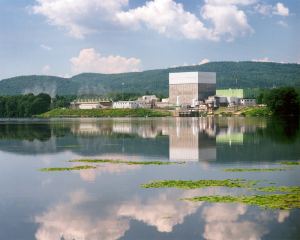
Vermont Yankee is leaking radioactive liquid again — two months after the first two leaks found at the plant in January were repaired.
Larry Smith, spokesman for Vermont Yankee, made the announcement on Saturday.
The original leaks of tritium, a radioactive isotope, were discovered at the 680-megawatt nuclear power plant in Vernon on Jan. 7.
The latest leak comes on the heels of other problems for the 38-year-old reactor on the banks of the Connecticut River.
* Last week, there was an automatic shutdown of the plant because of an electrical problem. Read the Rutland Herald story.
* Strontium-90, a “bone-seeking” radioactive isotope with a half-life of 28.8 years, was reported present in soils several weeks ago. Read the AP story.
* A fish upstream of the Connecticut River tested positive for SR-90 last week. Read the AP story.
* William Irwin, the state’s chief radiology officer, told the Rutland Herald on May 28 that the tritium leak likely started two years ago when five sinkholes began to appear in the plant compound.
The newly discovered leak, which came to light on Saturday, came from a hole the size of an eighth of an inch in diameter in a pipe located in the Advanced Off Gas System, the area previously excavated for the March 25 repairs of the first two leaks.
Smith said the leak found on Friday night lasted four hours and contaminated a “one foot radius of soil.” There is no threat to public health or safety, according to a press release from Smith.
The plant, which had recently shut down for refueling, was in the middle of restoring power when the leak was discovered, according to Smith. The discovery did not halt operation of the plant, and by Sunday, Smith said, it had reached 100 percent “steady power state.”
Smith said the vacuum created by the reactor will keep fluid from flowing through the hole. It is unnecessary, he said, for Entergy to shut down the plant to repair or replace the leaky section of pipe, which is encased in concrete.
The leak, he said, produced a slow drip from vapor that amounted to a gallon of liquid.
The following radioactive isotopes were present in soil samples in measurable levels: chromium-51, manganese-54, cobalt-58, cobalt-60, zinc-65, zinc-69, niobium-95, rhodium-105, xenon-131, cesium-137, barium-140 and lanthanum-140.
Smith said in an interview and in a press release that the leak is “new.” In a statement, he said that four of the radioactive isotopes released into the soil at the plant (rhodium-105, xenon-131, barium-140 and lanthanum-140) are short-lived, which indicates, he wrote, that the “contamination was recent.”
Arnie Gundersen, the nuclear engineer hired by the Legislature to monitor the plant’s activities, said the hole couldn’t possibly be new.
“The water they collected is new, but the hole is old,” Gundersen said. “There’s no way you can get an eighth-of-an-inch hole in a two-inch pipe overnight. It just doesn’t happen.”
The proof that the leak is old, Gundersen said, is the absence of a short-lived isotope that would have indicated a more recent problem: Cesium-134.
“What he (Smith) said was, this particular pipe was only used in startup for off gasses,” Gundersen said. “That means for years, every time they started up the reactor, water would flow out of this newly discovered old hole and into the vault.”
Smith said Gundersen’s assessment is speculation. When asked if he thought the hole had been there previously, he said, “I have no idea. That’s why we’re investigating.”
Gundersen counters that the burden of proof should be on Vermont Yankee to show this is a new hole, since “the evidence they have provided shows it was an old hole.” He also says it should have been detected by the robots and inspectors who were combing the excavated area in the Advanced Off Gas system.
“I have two concerns,” Gundersen said. “The area into which it leaked is the most studied piece of real estate at the plant, and they didn’t see it. The idea that the plant would run for four hours and spring a leak — these holes don’t pop up like mushrooms overnight. That tells me the inspection wasn’t as adequate as it could have been.”
Gundersen said the concrete vault where the leaking pipe is located was inaccessible for 33 years, so no one knows what caused the leak, how long it has existed, or how many times it has leaked during the startup process.
“The point is, they had 50 to 60 engineers study this system for five months, and nobody figured this out,” Gundersen said.
The state’s consultant, Nuclear Safety Associates, reported on April 30 that Vermont Yankee does not “have an effective program or practices in place for early leak detection and monitoring of underground and non-readily accessible piping.”
“The extent of conditions from the current AOG leak event is unknown and will not be fully understood until after the completion of the Root Cause Analysis,” NSA officials wrote. “Therefore, underground and other non-readily accessible piping could be a challenge to future plant reliability if they are not proactively monitored, detected, and managed.”
Oyster Creek Nuclear Power plant in New Jersey and Indian Point Energy Center on the Hudson River in New York State are both planning to replace their Advanced Off Gas systems, Gundersen said. Several other plants that have also had tritium leaks are moving all of their pipes above ground. Gundersen called this the “ultimate solution.”
Smith said that replacing the Advanced Off Gas system might be one of the “corrective actions” taken by Entergy, the corporation based in Louisiana that has owned the plant since 2002, but that the expense would be a factor.
Bob Stannard, a lobbyist for Citizens Awareness Network, an anti-nuclear group, says Entergy hasn’t wanted to investigate problems, such as the sinkholes which first became apparent in July 2008, because the corporation doesn’t want to spend money on the plant.
“It’s not about doing the right thing, it’s about making money, and it’s shameful,” Stannard said. “They’re hammering on this plant, milking the last megawatt out of it. It’s leaking, falling apart. They say they’re concerned about safety. What they’re concerned about is profit. They want to make money off this plant.”
Twenty-seven out of 104 nuclear power plants in the United States have leaked tritium into the environment, according to the Associated Press.
