

Summary of Legislature’s unemployment proposal
Editor’s note: Shumlin, Smith and Douglas made public statements this week about their negotiations on resolving the state’s bankrupt unemployment fund. Video clips of their comments are at the bottom of this post.
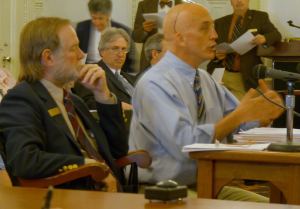
Speaker of the House Shap Smith and Senate President Pro Tem Peter Shumlin asked a joint legislative committee Friday to take up a bill designed to shore up the state’s bankrupt unemployment fund.
The Democratic leadership introduced the bill a week before the end of the session because they said they had no choice. Smith and Shumlin said in a press conference on Thursday that if negotiations with Gov. Jim Douglas and his staff weren’t settled by Friday morning they would have to move ahead with legislation in order to get the process rolling in time for adjournment on May 8.
Though Smith, Shumlin and the Douglas administration were engaged in tense, on-and-off negotiations all week, even by late Friday Neale Lunderville, Secretary of Administration, said they had not come to an agreement. (Smith, Shumlin and an entourage of lawmakers were seen traipsing back and forth between the Speaker’s office and Douglas’ office, trailed by the press corps as word spread that a decision was imminent.)
Shumlin: “Wherever you have shared sacrifice and shared pain you have lots of people advocating that no solution might be better.”
On Thursday, Shumlin and Smith were mum about the sticking points. They refused to answer detailed questions about the nature of the talks, and Shumlin went so far as to say they were not going to negotiate through the press.
In testimony before the House Ways and Means and Economic Development committees and the Senate Finance Committee the next day, Smith said talks would continue as lawmakers pursue a legislative remedy outside the negotiations process.
The bill, which was described but not distributed on Friday, would originate in the Senate.
Shumlin apologized for bringing the issue to the committee so late in the session; he had hoped there would have been an agreement by this time.
If the administration and lawmakers are unable to strike a deal on fixes to the unemployment system, the state will have to borrow as much as $200 million in the next two years, in order to pay benefits to workers who have been laid off.
“I just want to emphasize we’re still talking to the administration, but we haven’t come to an agreement,” Shumlin said. “Why? There is something for everyone to dislike in this proposal. When you’re trying to put the state back in a position of fiscally responsible budgeting, which is what we’re trying to do, it’s easy for those of us who have to vote to dislike the solution because it’s asking both the employers who are struggling in many cases to survive in this economy by their fingernails … to contribute more than they have contributed, and it’s asking those who are unemployed to also make some sacrifices. Wherever you have shared sacrifice and shared pain you have lots of people advocating that no solution might be better.”
If the administration and lawmakers are unable to strike a deal on fixes to the unemployment system, the state will have to borrow as much as $200 million in the next two years, in order to pay benefits to workers who have been laid off.
The fund’s bankruptcy would hurt the state’s budget and business bottom lines, and could have sobering implications for the state’s fragile economic recovery.
The fund went broke in January, and since then, the state has had to borrow $4.1 million a week from the federal government. Until next year, the loans are interest-free; after that the state will owe, in addition to the principle it borrows, 5.2 percent in interest payments, which must be paid out of the General Fund. The cost? Anywhere from $6 million to $12 million a year, starting in 2012.
As long as the unemployment system is running into the red, all Vermont employers will be penalized under federal rules.
As long as the unemployment system is running into the red, all Vermont employers will be penalized under federal rules. Right now, businesses pay a significantly discounted rate on federal unemployment taxes; until the fund is solvent again, they will lose a significant proportion of that deduction.
The fund went bankrupt because the state didn’t require businesses to pay adequate unemployment taxes for a 27-year period, even as it pegged benefits for workers to inflation. The taxable wage base, which is a percentage tax on a portion of an employee’s earnings, has not been significantly increased since 1983, though last year lawmakers raised the base from $8,000 to $10,000.
As Mark Perrault, of the Joint Fiscal Office, put it: “We had a structural problem that was waiting to explode.”
Everyone agrees something needs to be done; the question is how best to achieve solvency quickly — without hurting the state’s recovery.
On Friday, Smith said the legislative proposal places less of a burden on businesses than the governor’s plan.
The bill would raise the base to $13,000 in fiscal year 2011 and to $16,000 in fiscal year 2012; the Douglas administration has proposed an increase to $12,000 in fiscal year 2011; $15,000 in 2012; and $18,000 in 2013.
Under the legislative plan, there would also be a 0.5 percent surcharge placed on employers that chronically lay off workers. For years, according to Patricia Moulton Powden, the commissioner of the Department of Labor, Vermonters who work for “negative balance employers” withdraw more from the fund than their employers pay in. The surcharge is meant to fix this problem. Like the increase in fines for employers who fail to file timely reports or who misclassify workers, the surcharge is an apparent area of agreement between the administration and the Democratic leadership.
Like Powden’s proposal, the legislative plan, Smith said, would bring the unemployment fund back into solvency by 2014.
The areas of disagreement appear to revolve around benefits. The Douglas administration wants to significantly restrict access to unemployment compensation; the Democratic leadership opposes benefit reductions for unemployed Vermonters, though in recent negotiations, negotiators seems to have made a number of concessions.
Douglas, in his weekly press conference, reiterated his stance that Vermont’s benefits for unemployed workers are too generous; that any unemployment fund fix should be “balanced” (that is, employers and unemployed workers should each take a hit).
The governor said he wants laid off workers to receive less compensation, and he wants unemployed workers guilty of misconduct to be precluded from receiving benefits.
The governor said he wants laid off workers to receive less compensation, and he wants unemployed workers guilty of misconduct to be precluded from receiving benefits.
The department’s proposal includes seven significant restrictions on benefits, including a reduction in earnings for laid-off seasonal workers, a reduction in the maximum weekly compensation, new misconduct rules, a one-week waiting period for receipt of benefits, disallowing compensation to unemployed workers during a period in which they receive severance pay, and a penalty for part-time employment.
Taken together, the benefit restrictions would be the most punitive in the country, according to the National Employment Law Project.
The Democratic leadership has made the following concessions: freezing the maximum benefit at $425 per week; a one-week benefit waiting period for newly laid off workers (this provision would start in 2012 and sunset in 2014); and the elimination of the option to receive severance pay and unemployment compensation simultaneously.
Once the fund is back in balance, the frozen maximum benefit of $425 per week would be reset, based on 57 percent of the average weekly wage.
Increases in benefits after that would be tagged to inflation. (Currently, the average compensation for unemployed Vermonters is $309 per week.)
Lawmakers have agreed to impose extended waiting periods and to limit the benefit duration to 23 weeks for unemployed workers who are accused of simple misconduct. The department would draft new rules for gross misconduct.
Under the legislative plan, there would be changes to the part-time wage formula as well.
Negotiations are expected to continue next week.
