


The Vermont House passed the budget bill Thursday night, 123-16, but the vote count doesn’t reflect the struggle that ensued when debate on the proposed legislation began.
There was no discussion of the budget itself — which resolved the $154 million shortfall for fiscal year 2011 and put $62.5 million in federal Medicaid money in the kitty for future demands on human services. It also met the 5 percent stabilization reserve requirement under law ($54.5 million was put into the rainy day funds) and, perhaps most importantly, closes the fiscal year 2012 budget gap from $250 million to $94 million. The General Fund budget, which came in at $1.074 billion, was balanced through cuts, government restructuring, labor savings, retirement savings and changes in revenue. The Douglas administration’s proposed budget is $1.18 billion.
Lawmakers overwhelmingly supported the work of the House Appropriations Committee. In fact, Rep. Peter Fagan, R-Rutland City, was the only member of the General Assembly to ask a question about the budget – regarding state payments to funeral homes for cremation services for Vermonters on general assistance. An amendment from Rep. Paul Poirier, I-Barre City, to add an appropriation for $25,000 to reopen the Canteen at the Vermont State Hospital passed unanimously without discussion.
It was a chunk of the budget that had already been removed — $38 million — as part of the Challenges for Change government restructuring plan (also known as Act 68) that was the subject of lawmakers’ indignation, disbelief and rhetorical stances. The General Assembly passed Act 68 in February, but on Thursday, when they went to examine the appropriations bill, many members experienced a serious case of buyer’s remorse.
The dissenters – namely legislators from the Republican side of the aisle, independents and a few maverick Dems – took issue with the way Challenges for Change is being rolled out by the Douglas administration, the House majority’s Democratic leadership and the Joint Legislative Government Accountability Committee.
The plans for Act 68 will be presented to lawmakers, reporters and the public in a series of meetings next week, according to Tom Evslin, the state’s chief technology officer, and head of the Challenges project.
Evslin said the chairs of the Legislature’s committees are meeting with administration officials and the legislative leadership on Monday behind closed doors to discuss the details of the progress report in advance of the first meeting with reporters on Tuesday morning and lawmakers that afternoon.
A number of legislators were dismayed that the deadline for reporting out on the Challenges – March 25 as stated in the law — wasn’t met in anticipation of the House budget vote. They questioned how they could vote in good conscience on a bill that excises $38 million from the budget without knowing the details about how the money would be cut from state government.
They called for a delayed vote on the appropriations bill until after the Challenges presentation next week, arguing that their decisions about the three biggest bills facing the General Assembly – the budget, the transportation bill and the miscellaneous tax bill – were being made in a vacuum. Rep. Patti Komline, R-Dorset, proposed an amendment that would have pushed the budget vote off until next Wednesday. The amendment was defeated by a vote of 36-103.

Rep. Anne Donahue, R-Northfield, led the charge on the floor of the House.
Donahue declared the planned rollout violates Act 68. “The consultant (from Public Strategies Group) from Challenges for Change … said it was fully ready to report, but they were instructed by the leadership team to report next week.
“The report may have significant impact on readjustments to the appropriations bill,” Donahue continued. “This present moment is our last opportunity to debate and require amendments. When the bill returns, we will give a yes or no vote to what, for all we know, could be radical changes. To give us this information past the deadline forces us to vote without knowing what impacts on the budget will be a misuse of power, and it interferes with our ability to represent our constituents. This is wrong.”
Speaker of the House Shap Smith and other members of the leadership team explained that when House members passed the Challenges bill in February they effectively removed the money from the budget at that time. They said the Challenges legislation was on a separate trajectory from the traditional budgeting process.
The Republicans said they had been told in a caucus with Evslin that the Challenges report was already complete.
This led them to believe that the delay was political in nature. Majority Leader Floyd Nease, D-Johnson, said it was not.
Rep. Mary Morrissey, R-Bennington, said though she appreciated the hard work of the Appropriations Committee, she couldn’t justify voting for the budget bill. She took exception to the way in which the Challenges were taking shape and reminded lawmakers that many of them had swallowed hard when they voted for the bill in February.
“I had hoped Challenges for Change would be transparent and provide timely information to make decisions on bills before us today possible,” Morrissey said. “These decisions in the Challenges have long impact across budgets, and they will have a ripple effect across this state by the cuts or efficiency measures being made outside this body. Today, we were supposed to hear a progress update, which we were told was ready.
“I feel we are in free fall,” Morrissey said. “We are responsible to our constituents back home. We may take out more state employees, we may cut programs, and the good work the Appropriations Committee did may disappear behind closed doors after we’ve left the Legislature.”
To give us this information past the deadline forces us to vote without knowing what impacts on the budget will be a misuse of power, and it interferes with our ability to represent our constituents. This is wrong.”
At that point, Komline proposed the amendment for delaying the budget vote.
Rep. Mark Larson, D-Burlington, vice chair of the Appropriations Committee, defended the Challenges plan and exhorted members to pass the budget bill immediately. He said they would have an opportunity to vote on “Challenges 2,” a second bill that will include changes to statutes affecting proposed efficiencies, later in the session.
“When we passed the first Challenges bill we embarked on an attempt to do budgeting differently,” Larson said. “We (decided we) would have targets that would include specific outcomes we would achieve. We would step back and try to get the same for less and see the same outcomes. Our job was to ensure that when they went forward that we held (the administration) accountable to those outcomes and to the people we represent.”
Larson said the Challenges will require an implementation plan, statute changes and a system of accountability that would be approved by the Legislature. He explained that the plan would be referred to the Appropriations Committee for statutory changes. (Evslin said policy committees would also review the Challenges.) The bill would move through Appropriations and then come to the floor for a vote. “If we have concerns about how they are implemented or measured or proposed, we would have an opportunity to vote at that point,” Larson said.
He pointed out that last year, lawmakers asked the administration to find $17 million in savings in the state workforce. “We were asked to vote on a budget that didn’t include a plan for how those savings would be achieved,” Larson said. “The Challenges reflect our learning from that process — that we would take action on those things we wanted to take action on and have a full debate.”
Rep. Martha Heath, D-Westford, chair of Appropriations, said she saw the Challenges plan as separate from the budgeting process.
“I never connected the two things … except that I personally didn’t want to have a vote on Challenges and the budget bill on the same day,” Heath said. “I do believe we made a mistake by not letting the body know that the administration and the leadership had made the decision to postpone for a couple of days the report on the Challenges bill.”
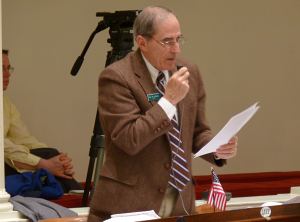
From there, the debate centered on the amendment to delay the budget vote, and when the discussion became inflamed, Speaker of the House Shap Smith called for a 10-minute Democratic caucus. The heated exchanges upstairs on the floor, caught flame down in Room 11: The meeting, which was crashed by Republicans, independents, and Progressives, stretched to 45 minutes.
Democrats who were dismayed by the Challenges presentation’s delay questioned the Democratic leadership; Republicans demanded permission to speak and were denied the opportunity by Majority Leader Floyd Nease. Rep. David Zuckerman, P-Burlington, and Rep. Topper McFaun, R-Barre Town, both berated Nease (each apologizing later on the floor of the House).
The focus of all this vitriol? Who knew what and when. Rep. George Till, D-Jericho, wanted to know why the GOP caucus had been told that the progress report was ready to go. He asked: “I heard it wasn’t available, and if it is available, then why don’t we know about it?”
Smith told the crowd that the report hasn’t been finalized, and his main concern was to make sure the Challenges didn’t come to the floor at the same time as the Appropriations bill because he thought it would be too much for the House to deal with at one time.
“It wasn’t tied to the budget at all,” Smith said. “It could have come up next week, or it could have come up last week. We wanted to make sure the chairs (of committees) would be able to concentrate on what they needed to do. We didn’t want to do it while other deliberations were going on.”
“There is $38 million less in the budget and that’s what the Challenges was about,” Smith said. “We already voted on that. The second challenge is to figure out how to deal with the outcomes and the design.”
Secretary of Administration Neale Lunderville told the caucus that he didn’t want to see lawmakers delay the budget vote. “There are a lot of things we should talk about in the budget,” Lunderville said, “but with regard to delaying the budget, our belief is we should not delay it. We should vote tonight.”
Rep. Cynthia Browning, D-Arlington, said the extension of the Challenges deadline was unacceptable.
“I’m suffering from buyer’s regret. We allocated $13 million in re-investment spending (which is deducted from the overall savings of $51 million for fiscal year 2011) before we knew how the plan would realize the savings.”
Less than an hour later, the amendment went down and the budget was passed overwhelmingly.
