



Vermont faces a $150 million deficit, give or take $10 million in fiscal year 2011, and if lawmakers and the Douglas administration don’t find long-term solutions, the state could face even larger budget gaps in the years to follow, according to budget projections from the Joint Fiscal Office.
The estimated budget deficit for fiscal year 2012 is $240 million to $260 million.
The deficits for fiscal years 2011 and 2012 represent approximately 7 percent and 12 percent, respectively, of the total General Fund expenditures for each year.
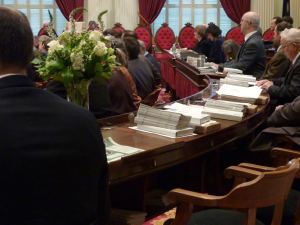
Stephen Klein, chief fiscal officer of the Joint Fiscal Office, told the House Ways and Means Committee and the GOP caucus on the first day of the new legislative session that legislators need to cut about 20 percent of state spending by 2012. One-time savings this year will reappear as deficits next year, he said.
As the Joint Fiscal Office stated in its “Facing Vermont’s Fiscal Challenges” report, lawmakers will have to build a budget next year that is “essentially 12 percent less” than the 2010 budget. “How would you do it?” That question is followed by a list of government services and the percentage of the budget they represent. K-12 education, for example, represents 26 percent of the General Fund budget; Medicaid 24 percent; the corrections system 10 percent and services for children and families 7 percent. Klein warned lawmakers that taking the big budget items, education and Medicaid, off the table, will increase pressures significantly on the rest of state government.
Why and how the state got into this mess is complicated.
The problem began with dramatically declining tax revenues. The global recession has significantly driven down incomes, business profits, sales and services in Vermont. Consequently, the state has not been able to collect as much in taxes and fees from these sources, and General Fund tax revenues are now hovering at 2005 levels. In addition the aforementioned government services, the General Fund is used to pay for higher education, debt service, public safety, the Agency of Natural Resources, the Department of Labor, economic development and other government services.
The drop in state revenues occurred with the onset of the Wall Street financial crisis in fiscal year 2008, and hit bottom in 2009. Last November, the state’s economists reported that tax revenues had leveled off for the time being, but the damage had been done: The percentage growth in taxes for the state of Vermont last year was -8.1 %. The state went from General Fund tax collections of $1.119 billion to $1.026 billion in a two-year period.
Fiscal analysts say the revenue declines sustained by the state are permanent, and the climb out of the recession is projected to be slow: Vermont won’t see 2005 level revenues again until 2012 – and that’s only if the economy recovers as expected.
Since April 2008, more than 636 state jobs have been cut. The government now has 7,786 workers – about the same number it employed in 2002.
Last year, the Legislature and the Douglas administration made $99 million in reductions, adjustments and rescissions, according to Joint Fiscal Office figures. They shut down four interstate rest areas, partially closed courts, eliminated smoking cessation programs, and cut reimbursements for health care providers by 2 percent.
The General Fund expenditures for FY2010 totaled $1.255 billion, $21 million more than the previous year, and $215 million more than the state collected in tax revenues, according to Joint Fiscal Office figures. One-time federal stimulus funds of $174.5 million helped to fill the gap.
This fiscal year, starting on July 1, the feds are coming to the rescue again, and the state is banking on $100 million in American Recovery and Reinvestment Act dollars, but it won’t be enough to alleviate the state’s fiscal woes. In 2012, ARRA funding is slated to end.
That’s because depressed revenues are only half of the equation. Costs are increasing at the same time state coffers are emptying. Vermonters are relying more heavily on services in the down economy. In the current budget year, fiscal year 2010, homeless shelters are asking for $1 million in additional funding because they are turning people away; the Department of Corrections has seen an increase of 224 prisoners at a cost of $2.6 million; and increases in the number of disabled and needy Vermonters asking for assistance will add nearly $1 million. These items are under consideration as part of the FY 2010 budget adjustment process.
This is how state obligations add up to $141 million to $161 million in red ink for next year’s budget, fiscal year 2011:
* The state is starting out $89.9 million in the hole because of the drop in state revenues and a reduction in the amount of federal stimulus funds currently available.
* Obligations for retirement funds have risen by $28.8 million. The state is spreading out losses from the stock market crash over five years.
* The Agency of Human Services budget will be up by $10 million to $20 million because more Vermonters will need state services as a result of the ongoing recession.
* This is the odd calendar year that pushes the number of pay periods up a week. The state has to come up with $8.5 million to meet a 27th week of payroll and $7.5 million for a 53rd pay week for vendors.
* Insurance premiums are expected to cost an additional $4.2 million.
* Medicaid expenditures are estimated to be $20 million to $30 million higher, because of recessionary pressures.
The state’s budget projections do not include costs for millions of dollars in projects that are long overdue, such as replacing the Vermont State Hospital, school construction and transportation infrastructure improvements.
Klein explains how the deficit happened
Klein: One-time fixes won’t work
Klein answers questions from the GOP caucus
