

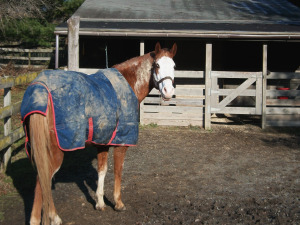
Ah, the joys of global warming in December here on our small horse farm in Charlotte, where we have been blessed with not one, but two mud seasons in this year. A time when visions of seasonal sugar plums dancing in our heads is displaced by wheelbarrows stuck in the mud up to the tops of our tire rims.
If I run aground just short of the slippery plywood bridge that leads into our mountainous muck pile, I may find myself doubly trapped, sinking up to my ankles, unable to either move or dislodge my heavy load of muck.
Thankfully, not having been through a winter, my new rubber boots have not yet cracked, else the mud would make it through the layer of three socks I’m wearing on each foot to protect against the violent temperature swings–balmy 40s one morning, frigid 20s the next, just cold enough to freeze my toes.
I contemplate the prospect of myself mired in the mud unable to move, spending the winter out here if a sudden sub-zero freeze comes, unless I can get a neighbor to winch me out. But alas, I don’t carry my cell phone for the morning muck. There would be no one to rescue me.
Our two gray horses and red-and-white pinto now all sport murky brown thigh-high support hose that may or may not end in horseshoes. I dare not inspect them to learn the truth.
The horses look at me helplessly one recent morning as their turn-out has suddenly turned into a waterscape of ponds, streams and one river that now runs downhill, dividing it into pasture east and pasture west. On the trek out, they had stayed on the east ,on the barn side, and headed up to the drier top of the hill, but then wandered over to the west side in search of something, anything, to eat. Now, they find themselves on the wrong side of the flowing muddy water.
The lead horse, Silver, bravely fords the stream at the prospect of his morning breakfast. The remaining two have to be led across, not trusting this new waterway that was not there last night. Even Scout, the normally unflappable pinto, is uncertain.
Ah, Vermont, land of a thousand lakes? If the waterways get any bigger, I will be forced to start naming them. I’ve always wanted to say I lived on De-Nial.
Perhaps I can score some horsey waterwings? One more heavy rain and I have visions of a new sport–water polo with polo ponies (riderless, as I will decline to participate.) Or maybe I can coach the first equine synchronized swimming team?
In the field, the last few semi-rotten apples stubbornly refuse to fall from the naked trees even in the stiffest of winds, tittilating the horses. They can see them like so many bulbs on a denuded Christmas tree–among the last few edibles in a pasture whose anemic brown grass is eaten as soon as it pokes up its bewildered head.
At 11 a.m., when I turn them out after their morning hay, Silver has to be dragged out in chains. Bailey, my pure white Connemara pony, who is now dirty cream and shades of tan and brown, goes willingly, but then comes right back and refuses to leave again. He’s used to being ridden at this time of day, and he’s confused. (He is not alone!) By 3 p.m., all three horses are roving the field, up to mischief. If they cannot find sustenance, they will wreak havoc instead, tearing up the speed fence that still remains around the sand riding ring, or raiding the mountainous brush pile my husband has stacked for future burning. “Is it time yet?” they seem to be saying. “See what happens when you don’t feed us? Bring
us in now or prepare for the consequences!”
Riding is impossible–the woods and fields too wet to negotiate. Horsey boredom rules. By 4 p.m., the paddock looks like the staging area at O’Hare, all three horses taxiing according to their pecking order, waiting for take-off into the barn and arrival at their portions of luscious hay.
The red-tailed hawks have an excellent view of all this activity from their perches in the naked trees. Good thing for them there are no larger raptors likely to take them on–they are, in all their predatory glory, like sitting ducks.
Even the geese are confounded. “Hey, you’re going the wrong way,” my husband yells up to a flock that is late migrating, disoriented by the lingering 50-degree weather, headed mistakenly north. At the sound of his voice and the sight of his waving arms, they suddenly veer and turn sharply south, well on their way to their rightful winter abode. Like Bailey, they, too, are confused.
Meanwhile, indoors, cluster flies that favor the skylights in the upstairs bathroom of our old renovated farm house have not yet disappeared, but are evolving into more giant versions so big I can look them in the eyes on the top of their heads as they stare back soulfully, making premeditated murder all but impossible.
Perhaps the patriotic thing would be to ship them all to Afghanistan, to help bedevil the enemies of democracy. Just how many could I cram into one of those new priority mail boxes for export–”if it fits, it ships”?
I’ve waited patiently for two days for their pre-death break-dancing to begin, signalling their demise. Enough with the dive-bombing, long-term parking on the bathroom fixtures and Larry David-like stare downs. Soon I will go in search of my weapon of mass destruction—an old can of “Dragon” insect spray that is rusting with age but still packs a lethal punch. Begone, flies, and take with you this perverse second coming of mud!
I remember in the dark reaches of my English Major’s-mind the poet Percy Bysshe Shelley words in “Ode to the West Wind,“ “If winter comes can spring be far behind?” But suppose, just suppose, winter doesn’t come?
Somehow, as I write this, I am sure before it is posted I will have succeeded in shaming the recalcitrant Vermont climate into more seasonal behavior.
Otherwise, forget 2012. The end may indeed be near!
Barbara Ann Curcio is a former reporter and columnist for The Washington Post.

