

[V]ERNON — The long-term presence of spent nuclear fuel at Vermont Yankee and other plants around the nation has created a tangled mess of financial, legal and environmental concerns.
And the federal government, despite pledges to find a central storage site for radioactive waste, has not come up with a solution.
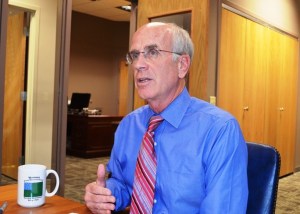
But U.S. Rep. Peter Welch, D-Vt., says he is seeing signs of progress. In a meeting last week with a citizen nuclear advisory panel in Brattleboro, and in a subsequent interview, Welch said he and some congressional colleagues are making a fresh push for an interim storage area – possibly in Texas — that could accept spent fuel from plants like Vermont Yankee.
“Here’s what’s changing: There are more communities that are having their plants decommissioned … so it creates the potential for me to work with allies,” Welch said.
He could not, however, offer a schedule for that work to come to fruition.
Although Vermont Yankee hasn’t produced power for more than a year, the majority of its radioactive spent fuel — nearly 3,000 assemblies — remains in a cooling pool inside the reactor building. Plant owner Entergy has said all that fuel will be transferred into sealed dry casks at the Vernon site by the end of 2020.
And there it will stay, because the federal government has not developed its long-promised repository for nuclear waste. Entergy predicts the U.S. Department of Energy will remove all spent fuel from Vermont Yankee by 2052, but some believe it will take much longer than that.
The storage of spent nuclear fuel is expensive: Long-term fuel management is expected to cost $225 million at Vermont Yankee alone, and Entergy expects to sue the Department of Energy in an attempt to recover some of those costs. Leaving spent fuel on site also delays the eventual decommissioning and redevelopment of a former nuclear plant, since tight security and radiation control measures must be maintained around the storage casks.
It’s a nationwide problem that continues to worsen, as Vermont Yankee spokesman Marty Cohn wrote in a recent piece published in Nuclear Power International Magazine. “Commercial nuclear power production in the U.S. has generated over 70,000 metric tons of spent nuclear fuel … and the inventory is increasing by about 2,200 metric tons per year,” Cohn wrote.
The problem spurred a November letter to federal lawmakers from citizen groups in four states; the signatories included Kate O’Connor, chairwoman of the Vermont Nuclear Decommissioning Citizens Advisory Panel. The groups called for “meaningful action in this session of Congress to overcome the national nuclear waste management policy impasse.”
Welch met with several members of the Vermont panel Wednesday in Brattleboro for an informal discussion that included his hopes for resolving the spent fuel issue. He sits on the House Energy and Commerce Committee, which has jurisdiction over nuclear issues.
In an interview Thursday, Welch said he’s been working with U.S. Rep. Mike Conaway, R-Texas, to advance legislation called the Interim Consolidated Storage Act. The bill would authorize the Department of Energy to enter into fuel storage contracts with private entities that have received a Nuclear Regulatory Commission license.
According to a federal summary of the bill, the priority would be providing storage for “used fuel and high-level nuclear waste at sites where there is no longer an operating nuclear reactor” — meaning a site like Vermont Yankee.

While federal officials would continue to work toward a permanent storage facility for nuclear waste, the bill would allow interim sites to begin taking that material. Welch said one potential interim storage site is in Texas — hence his work with Conaway.
“We want to get rid of that waste so that Vernon is not a long-term repository,” Welch said.
It helps, he said, that other nuclear communities are about to go down the same decommissioning road that Vernon has been traveling. For instance, Entergy plans to shut both the FitzPatrick Nuclear Power Plant in Scriba, New York, and the Pilgrim Nuclear Power Station in Plymouth, Massachusetts, over the next several years.
In light of the Pilgrim announcement, Welch said, he’s been talking about spent fuel and other nuclear issues with members of the Massachusetts congressional delegation. “A lot of folks in that community are asking the same questions that the folks in Windham County are,” he said.
The citizen groups’ letter also brought a response last month from U.S. Sen. Patrick Leahy, D-Vt. He pointed to a new U.S. Department of Energy program aimed at finding communities willing to host spent fuel storage facilities. But that program is in its infancy.
O’Connor said she was encouraged by Welch’s congressional update on the spent fuel situation, though she knows there are no guarantees.
“Whether you like nuclear power or you don’t, the universal thing is that we have to move this waste off of these (plant) sites,” O’Connor said. “To me, if you have local communities, members of Congress and the nuclear industry all on the same page with something, that’s a big deal, and hopefully we can move this issue forward.”

