


A spokesman for an alliance of sporting groups said his organization would actively oppose the restrictions Burlington voters passed in 2014.
The measures would prohibit guns in venues that serve alcohol, require the safe storage of guns in homes, and allow police to confiscate weapons in certain domestic violence cases.
Because they are changes to the city charter, they need approval from the Legislature.
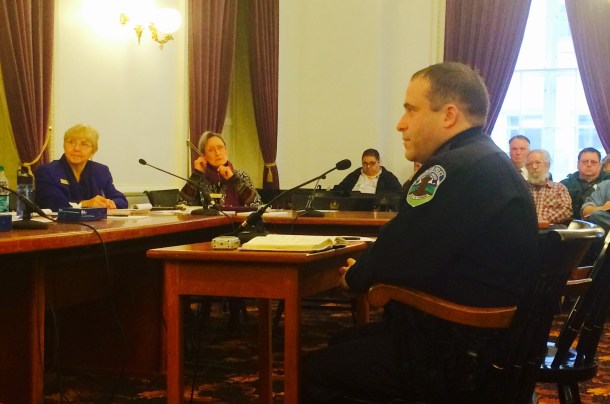
For the second year, city officials pleaded their case to the House Committee on Government Operations. Last year, that committee voted against sending the ballot items to the full House, arguing they conflicted with the constitutional right to bear arms.
Vermont has some of the least restrictive gun laws in the country.
Mayor Miro Weinberger argued the proposals aren’t “pioneering or novel” and are needed to reduce crime. He also said the Legislature usually delegates public safety issues to local communities. The mayor noted Burlington residents approved the measures after the mass school shooting in Newtown, Connecticut, in 2012 — prompting a committee member to ask if any of the measures would have helped in that case.
“I don’t mean to suggest there’s anything directly in the three charter changes that would have precluded Newtown,” Weinberger said, but he maintained there is a close connection between domestic violence and mass shootings, with 57 percent of killings of four or more people involving a family member or partner.
In Burlington last year, 779 cases of domestic disturbance or abuse were reported.
Chief Brandon del Pozo said: “None of the pieces of legislation here are beyond the pale or irreconcilable, in my opinion, with a state that has a strong commitment to the Second Amendment.”
Del Pozo noted some departments prohibit off-duty police officers from carrying guns in bars, and he said many confiscate the weapons of officers charged with domestic assault. He also drew parallels between the dangers of mixing alcohol and cars, which he said was a “deadly weapon,” and mixing booze and guns.
Evan Hughes, vice president of the Vermont Federation of Sportsmen’s Clubs, said the measures would violate the so-called Sportsmen’s Bill of Rights, state statutes passed in 1988 that protect gun ownership and prohibit municipalities from regulating the “possession, ownership, transportation, transfer, sale, purchase, carrying, licensing or registration of traps, firearms, ammunition or components of firearms or ammunition.”
Hughes said: “This would put a dagger right into the heart of the Sportsmen’s Bill of Rights.”
“Any compromise of that law will open it for every town in this state to challenge any aspect of that law that they see fit,” Hughes said. “We are not going to keep running up here and fighting town after town wanting to defeat our Sportsmen’s Bill of Rights.”
“We are going to fight it right here today,” he said.
Last year, only one of the 11 committee members voted to approve the charter changes, Rep. Joanna Cole, D-Burlington.
Committee Chair Donna Sweaney, D-Windsor, raised constitutional questions last year. During a break Thursday, she still had unresolved questions.
Asked if the resolutions would violate the Sportsmen’s Bill of Rights, she said: “That’s a question I want to talk to our staff about.”
Testimony went on for hours and included passionate Burlington residents on both sides of the issue, as well as advocates.
Ed Cutler, president of Gun Owners of Vermont, vigorously defended the right to bear arms. Karen Horn, policy director at the Vermont League of Cities and Towns, said Burlington should be able to act independently.
Benjamin Vidal, 21, said he has been bartending for two years to support his studies of economics and political science at the University of Vermont.
“Just recently,” Vidal testified, “I found myself in my workplace literally standing in between a group of large college students and a small group of older men who were physically threatening violence by way of lifting their shirts and showing their guns to the students.”
Vidal said one of the older men, who was less inebriated, helped him defuse the situation.
“These sorts of situations have become more and more commonplace,” he said.
Vermont Fish and Wildlife Commissioner Louis Porter testified that the Burlington charter changes could make hunting more difficult and impede efforts to manage game species.
Cole said she didn’t think the charter changes would affect hunters. “If you’ve looked at these bills, I don’t believe that they repeal the sportsmen’s rights, so to speak, or that they have anything to do with hunting or fishing,” Cole said.
Porter answered: “I’m addressing more the fact that doing this kind of statewide policy through charters, and the potential to do additional changes, in my view, conflict — would conflict — with the Sportsmen’s Bill of Rights.”
After the hearing, Weinberger said he thought the city had made a stronger case this year. He also argued that circumstances have changed, with more mass killings in the past year, and that political leaders at the national level seem more sympathetic to gun restrictions.
“I don’t know that we’re going to have a different outcome,” the mayor said.
Sweaney said testimony would continue and no committee vote is expected before the end of the week.


