

[T]he City of Burlington has solicited public input for a city-led South End redevelopment plan, but artists in the neighborhood question whether the mayor’s office has taken their suggestions seriously.
The 2-mile-long by 1-mile-wide wedge of Burlington is slated for a massive redevelopment as outlined in planBTV South End, which was released by the city in mid-June. In just over one month the public comment period for the proposal will be over, despite statements made by planners at the June 16 unveiling of the master plan that the process was just beginning.
In the beginning, artists say, it appeared that the city wanted to maintain a vibrant arts community in the South End. The city put out calls for artwork and involved artists in collaborative planning sessions.
Now many of the artists that committed time, artwork and countless hours in planning sessions say they feel their feedback has been ignored.
Only two pages of the 99-page book, which was released will illustrations of the master plan when it was made public back in June, mention how to preserve the artistic and cultural area that has made the South End attractive to businesses big and small.
Artists also wonder what became of a $100,000 grant from the National Endowment of the Arts awarded last year to Burlington City Arts to enable an “artist-led engagement and visioning process to help develop a comprehensive cultural master plan.”
Charles Norris-Brown, a children’s book writer and illustrator who works in the South End, said that in early discussions the city had called local artists “the core” of the planning process. “It’s such a big sham, the whole thing is a total big sham,” he said.
City officials, including the city planner for Burlington as well as the head of the arts organization, say they have made an effort to include artists in the planning process.
Increasingly, the demands of artists like Norris-Brown and others are appearing on signs all over the main strip of Pine Street, on utility poles, on bulletin boards and outside local shops.
“Weinberger Administration: Developers Gone Wild” reads one sign. “BCA: Will you stand with the arts community to preserve industrial zoning in the SEAD?” says another, referring to the South End Arts District.
The slogans contrast with green and white official city road signs for the arts district directing tourists to the quirky neighborhood.
Terry Zigmund, a glass artist who’s been in a studio behind Speeder & Earl’s on Pine Street for 17 years, said she’s skeptical now of her early involvement in PlanBTV South End.
“They say there was a community input stage, and I’m one of the artists that did get grant money from them, through their RFP process which was a joke,” said Zigmund, a South End glass artist with a shared space in the Howard Center studio.
The request for proposals (RFP) was put out by Burlington City Arts, which is both the nonprofit partner that was charged with leading outreach to the arts community – as well as a city agency in its own right. It first asked artists to create ways of engaging the public with a re-envisioning process in October 2014, after winning the NEA grant.
“I’m happy to take their money,” said Zigmund, but added, “I felt like it was a joke. The stuff that we did, they didn’t take it seriously.”
Her piece, which was interactive and had wooden leaves hung on trees along Pine Street, is in storage somewhere, she said.
On Oct. 31, when she thought she and the other grant recipients were going to present the results of their artwork in a public show, turnout was sparse, and the show didn’t have signage. “We were talking to an empty room,” she said.
Grant recipient Amey Radcliffe, who now prints the protest fliers, recalled what she was told to do for the grant: “I thought they wanted to know what we thought and what our ideas are for the South End – but it wasn’t really about that, it was about how can you help us engage the public,” she said.
“It became clear that the kind of data they were seeking seemed to be superficial,” she said.
Burlington City Arts and consultants the city had hired told the artists to gather suggestions for what could be improved in the South End.
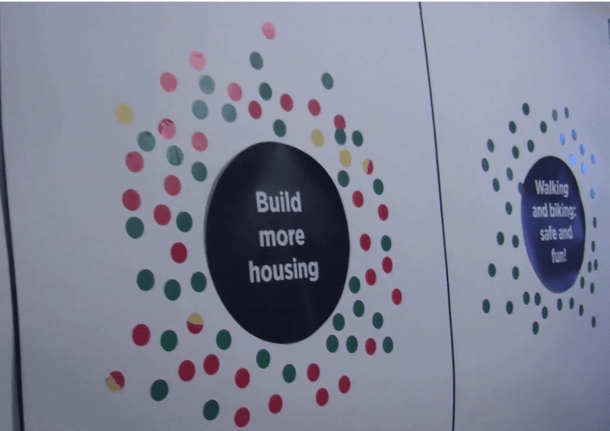
Radcliffe took her own approach. Brainstorming with some friends, she created development statements for the South End, and then hung big posters with the phrases written on them in a black circle. Then people voted on them with colored stickers. One of her statements – Build more housing – set off a firestorm.
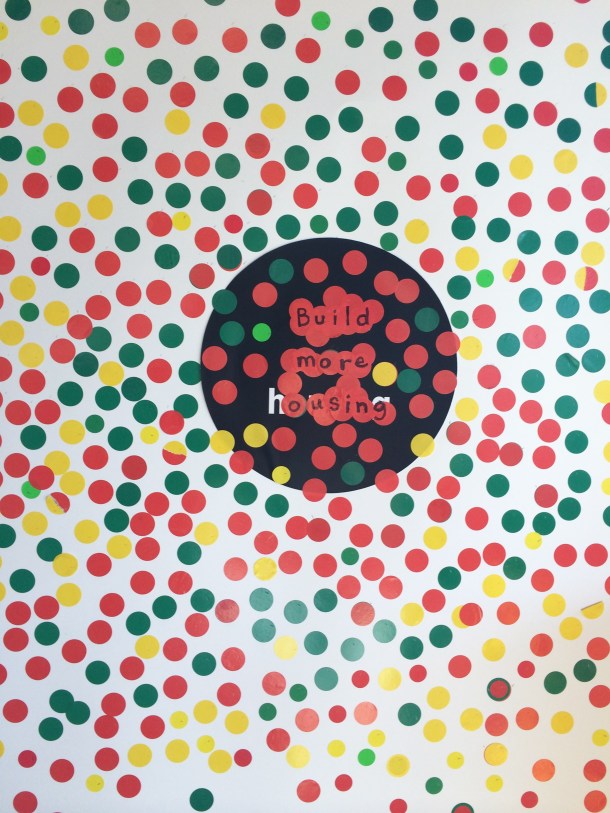
In early photos she took of it, a smattering of red, yellow and green stickers fill that page – green, meaning go, yellow meaning “proceed with caution” and red meaning stop. After she hung the work at Feldman’s Bagels, she said, it got really interesting. In a final photo, red stickers cover the statement completely.
“That’s the one that got so many red stickers. And it was a hot button issue like I thought it was, and it got a lot of feedback,” she said. The poster series is in the BCA’s possession now.
At the release of planBTV South End, an event held at the venue Arts Riot that was anticipated since public forums began last fall, consultants hired by the city unveiled the glossy, multi-page master plan.
It shocked some members of the arts and business community that the plan showed several pockets of residential rezoning in a gritty industrial stretch now known as the Enterprise Zone.
There were no renderings of swimming pools and leafy biking corridors, as was suggested at those meetings leading up to the proposal – although renderings of a park at the current Superfund site of Barge Canal showed breezy boardwalk paths and recreational spaces.
To many, it looked mostly like lot like sleek, multi-story residences and passive green space over what is now empty lots, rail yards, and old buildings.
Options such as light industrial, retail, or more open space weren’t really put out there – and businesses weren’t polled, noted Norris-Brown.
“They haven’t really gone to the businesses and asked them what they need. Those businesses haven’t talked to planBTV people,” he said.
Genese Grill, another artist, said she’s tried to get the Burlington City Arts – also called BCA – to publicly show support for South End artists’ concerns and desire to retain the industrial zoning in the district. But she said other groups’ engagement, no matter how passionate, seems ignored if it runs counter to the city’s housing suggestions.
“The real problem is that the plan (and the consultants and BCA too) has studiously ignored that we already have a very good protection against the whims of the market: our industrial zoning,” she said in an email.
Doreen Kraft, executive director of the BCA, said her organization’s role wasn’t to take sides, and it wasn’t to back any city agenda – it was to find a way to use the work of artists to engage the public.
“What we’re trying to do is develop an expertise in the community to be able to use the arts to engage, and to bring people out,” she said. “So it’s not traditional talking heads meetings.”
PlanBTV Downtown in 2012, which some South Enders pointed to as having a more publicly visible engagement process, was run the same, said Kraft, except for one thing: her group’s role.
“We got this grant to allow us to do a more significant engagement process, and to use the work of artists as tools to bring different constituencies out to be involved in planning,” she said.
But a description used by Sara Katz, the assistant director of BCA, in a presentation to the New England Foundation for the Arts in early June themed, “Community Engagement and Planning Through Arts: What it Means to Have a Place at the Table,” framed the artists as an “obstacle” to the project’s completion.
“…A number of artists in the South End revolted against the project, believing that the intentions of the plan were to gentrify the area rather than protect its unique characteristics. While it was a small group, it created confusion about the purpose of the plan, and our communications efforts were too behind to head-off the initial derailment,” read the document.
In a six-page screed, Norris-Brown objected to the characterization. He sent his response to the National Endowment for the Arts, asking it go in the file for the group’s $100,000 Our Town grant.
His rebuttal stated that the South End Alliance’s ranks weren’t small, at roughly 300 strong, and they included businesses and residents.
“Secondly, we are not ‘creating confusion’ about PlanBTV South End. We have very sincere concerns both in terms of what the hidden agenda of the Plan is (or at least its implications) as well as how our voices have been represented,” he wrote.
When asked how the NEA handled complaints about the Our Town grant’s use in Burlington, Director of Design Programs Jason Schupbach wrote in an email:
“The NEA is responsible for working with its grantees to assure that projects are completed as those projects were detailed in the application. If issues about the project are brought to the NEA’s attention, then we will be in touch with the grantee directly to assure compliance.”
He said they were already aware that the community-based partner organization that partnered with the city for the grant, was also in fact, a city agency as well.
It’s a pervasive belief of artists that housing was always part of the South End plan.

While city leaders stopped short of saying that housing was an original component of the plan, David White, the planning commissioner, said the project started with “my staff and other city staff, along with consultants” looking at what was there already, and trying to see what areas could be enhanced and built out.
Long-range goals of the city helped lead the plans, as did the search for better zoning in the South End while meeting needs for housing in the face of predictable changes.
“There are places where we want (change to happen) and places where we don’t,” White said. “This is a place where we expect development to happen, and we want it to … part of the process is to understand what kind of development will be there, what it is we want, what we like and where it goes and what it does.”
Contrary to artists’ beliefs, housing is desired by some constituencies in the South End.
“You have a lot of suggestions that are counter to each other,” said Joan Shannon, city councilor for Ward 5 in the South End. “It’s not like the community has any consensus about what should happen.”
“The artists don’t want housing in the arts district. And what I’m hearing from my neighborhood planning assembly is that they do want housing. … So people that live in the South End don’t necessarily agree with the artists,” she said.
Both artists and planners often point to two surveys the city took that polled artists and workers at the big companies in the area on housing needs.
The artist study found that 65 percent don’t consider themselves full-time artists, and only 15 percent of them worked in studio space outside of their homes. While 40 percent said they’d be interested in a work/live scenario, just 22 percent, or 65 people, could afford more than $800 a month, which is just below fair market rent for a one bedroom apartment, city reports show. (See the documents below).
About 45 percent of the artists already owned homes, fewer on average than the workplace survey found, where 60 percent own homes. Of the workplaces polled, about 34 percent of respondents indicated they would be interested in nearby housing options.
When asked why she thought the artists were resistant, Kraft said she thought part of it had to do with her group’s inexperience in the targeted planning and outreach.
“We certainly made a lot of mistakes in this process, but one mistake we made is that there was a conflict of interest there. In that the artists were also stakeholders. We didn’t really understand that until we got into it. It’s not a terrible thing, it’s part of the process,” she said. She also said the artists were largely unversed in how planning works, and many misunderstood what was shown in renderings to mean what was going to be built, definitively.
“Even though people have been what may be seen as divisive on the South End Alliance, it’s an important voice and it needs to be heard. It’s not our job to advocate … it’s our job to get people out and encourage people to be heard,” she said.
The master plan is expected to ready for recommendation to the Planning and Zoning Commission by November or December, city officials said.
Clarification: Comments attributed to Joan Shannon were clarified Aug. 24.

