

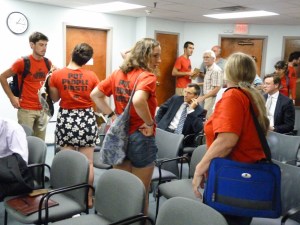
[A]bout two dozen supporters of the Healthcare is a Human Right campaign Wednesday urged the Green Mountain Care Board to reject Blue Cross and Blue Shield of Vermont’s request for a rate increase.
The board held a public hearing Wednesday as it considers BCBSVT’s request for an average 8.6 percent increase in premiums for policies sold on the Vermont Health Connect exchange next year.
After hearing an actuarial report prepared for the board, Blue Cross agreed to adjust its request down to 7.2 percent, but that did not appease opponents who say the policies are still too expensive.
Bekah Mandell of Burlington, a member of the Vermont Workers’ Center, told the board she has a 9-month-old baby and her health insurance rates are more expensive than her mortgage.
“I want Vermont to be a place where I can stay and raise my family and not have to move somewhere else so I can live cheaper,” Mandell said.
Jess Fuller, another member of the Vermont Workers’ Center and a recent graduate of UVM, told the board she was hit by a car this summer and was struggling with her health insurance rates and student loan debt.
“I can’t afford this,” she said.
The actuarial firm Lewis and Ellis reviewed the proposed rates filed by MVP Health Care and Blue Cross. After their recommendations, Blue Cross Blue Shield’s requested rate increase was lowered to an average of 7.2 percent. Because pharmacy costs were higher than expected the adjusted rate increase was set at 7.5 percent.
“It’s a good start, but 7.5 is still — I don’t know many people who are getting a 7.5 percent increase in their wages next year,” Brunner said.
The board will decide on the BCBSVT request and MVP’s request for a 2.4 percent average increase in August.
The numbers
Cynthia Stuart, deputy commissioner of the Department of Financial Regulation, said in the department’s solvency analysis that, unless the Green Mountain Care Board explicitly says the filing will produce inadequate or excessive rates, the filed rates will sustain the solvency of Blue Cross Blue Shield.
Paul Schultz, chief actuary at Blue Cross Blue Shield, said the company had to make a number of assumptions as part of the rate adjustment. One of the main factors in predicting trends is the demographic profile of customers. If the average age were to go from 42 to 44, for example, Schultz said the rate would go up accordingly.
Though generic brand drug utilization in Vermont is well above 80 percent, Schultz said the Vermont law regarding the maximum out-of-pocket prescription expenses has resulted in customers buying more expensive brands.
Another factor is the federal subsidy amount available the next year. As federal premium subsidies go away, the cost shifts over to the members through the premium, Schultz said.
“This year, we’ve requested the amount we think is necessary to maintain a certain level of reserves,” Schultz said.
Reserves are required to pay for unforeseen claims, such as those resulting from an epidemic, said Judy Daye, executive assistant of Blue Cross Blue Shield. Contributions to reserves were something that Novarest, an actuarial consulting firm, suggested could be reduced without threat to their solvency.
Schultz said he disagreed with this.
“If we only covered trend, ultimately we wouldn’t have the money to pay for advance events,” Schultz said.
Reserves can only be used for claims, not for infrastructure or administrative costs, Schultz said.
A public trust
In a statement issued Tuesday, Keith Brunner, communications director for the Vermont Workers’ Center, proposed that Blue Cross be dissolved and its assets turned over to a new public corporation that can operate Green Mountain Care “as a true public good that belongs to all of us.”
The Vermont Workers’ Center seeks to establish a health care system that treats health care as a human right, according to its website.
Only seven or so people spoke at Wednesday’s hearing, and 20 to 25 supporters attended the hearing.
“A lot of people weren’t able to come out because it’s the middle of the day, so I think a lot of people submitted testimony online,” Brunner said.
Brunner said Blue Cross is a nonprofit company set up under Vermont law with the purpose of decreasing the cost of health services for the people of Vermont. It is exempt from paying taxes. The Vermont Workers’ Center says if the company wasn’t a nonprofit, it would pay $15 million in taxes this year.
“Yet BCBS is unable and unwilling to ensure that all Vermont residents can get the health care they need,” Brunner said in the statement.
Brunner also said in the statement that it is unfair that one in five people are struggling with medical costs when 10 Blue Cross executives are paid up to a half million dollars each. There are actually only seven executives at BCBSVT, according to its 2014 annual report. The chief executive officer is also the only executive paid $500,000 or more, while the other six executives earn $350,000 or less, according to the report.
For 2015, Blue Cross requested a rate increase of 9.8 percent. The board approved 7.7 percent.
